

1.2 Integrals with Parameters
7
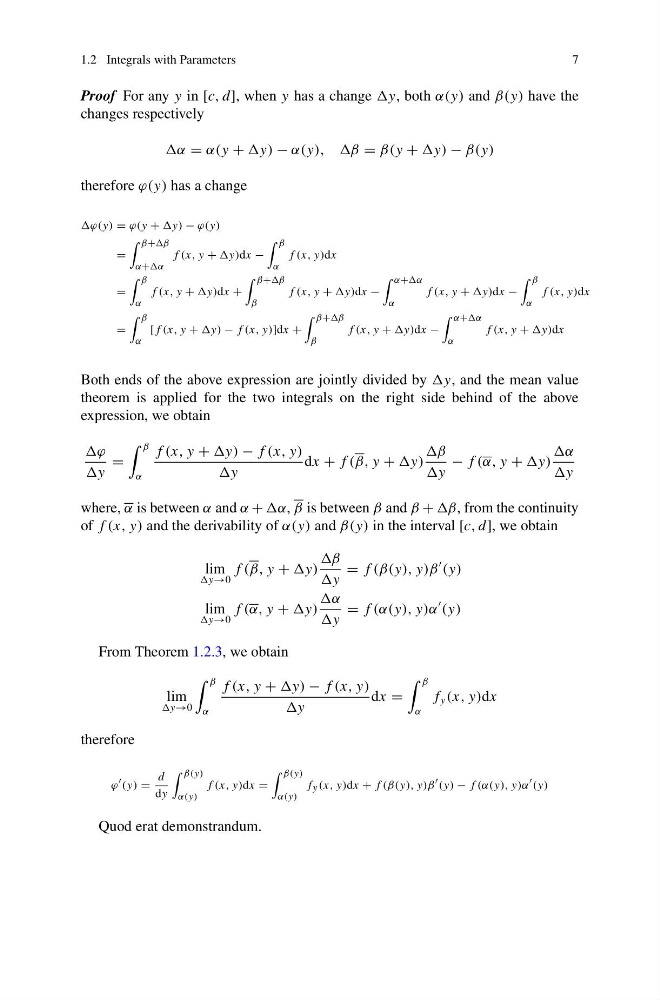
Proof For any y in [c, d], when y has a change y, both α(y) and β(y) have the
changes respectively
α = α(y + y) − α(y), ,β = β(y + y) − β(y)
therefore ϕ(y) has a change
ϕ(y) = ϕ(y + y) − ϕ(y)
=
β+β
α+α
f (x, y + y)dx −
β
α
f (x, y)dx
=
β
α
f (x, y + y)dx +
β+β
β
f (x, y + y)dx −
α+α
α
f (x, y + y)dx −
β
α
f (x, y)dx
=
β
α
[ f (x, y + y) − f (x, y)]dx +
β+β
β
f (x, y + y)dx −
α+α
α
f (x, y + y)dx
Both ends of the above expression are jointly divided by y, and the mean value
theorem is applied for the two integrals on the right side behind of the above
expression, we obtain
ϕ
y
=
β
α
f (x, y + y) − f (x, y)
y
dx + f (β, y + y)
β
y
− f (α, y + y)
α
y
where, α is between α and α + α, β is between β and β + β, from the continuity
of f (x, y) and the derivability of α(y) and β(y) in the interval [c, d], we obtain
lim
y→0
f (β, y + y)
β
y
= f (β(y), y)β
(y)
lim
y→0
f (α, y + y)
α
y
= f (α(y), y)α
(y)
From Theorem 1.2.3, we obtain
lim
y→0
β
α
f (x, y + y) − f (x, y)
y
dx =
β
α
f y (x, y)dx
therefore
ϕ (y) =
d
dy
β(y)
α(y)
f (x, y)dx =
β(y)
α(y)
f y (x, y)dx + f (β(y), y)β (y) − f (α(y), y)α (y)
Quod erat demonstrandum.
7
Proof For any y in [c, d], when y has a change y, both α(y) and β(y) have the
changes respectively
α = α(y + y) − α(y), ,β = β(y + y) − β(y)
therefore ϕ(y) has a change
ϕ(y) = ϕ(y + y) − ϕ(y)
=
β+β
α+α
f (x, y + y)dx −
β
α
f (x, y)dx
=
β
α
f (x, y + y)dx +
β+β
β
f (x, y + y)dx −
α+α
α
f (x, y + y)dx −
β
α
f (x, y)dx
=
β
α
[ f (x, y + y) − f (x, y)]dx +
β+β
β
f (x, y + y)dx −
α+α
α
f (x, y + y)dx
Both ends of the above expression are jointly divided by y, and the mean value
theorem is applied for the two integrals on the right side behind of the above
expression, we obtain
ϕ
y
=
β
α
f (x, y + y) − f (x, y)
y
dx + f (β, y + y)
β
y
− f (α, y + y)
α
y
where, α is between α and α + α, β is between β and β + β, from the continuity
of f (x, y) and the derivability of α(y) and β(y) in the interval [c, d], we obtain
lim
y→0
f (β, y + y)
β
y
= f (β(y), y)β
(y)
lim
y→0
f (α, y + y)
α
y
= f (α(y), y)α
(y)
From Theorem 1.2.3, we obtain
lim
y→0
β
α
f (x, y + y) − f (x, y)
y
dx =
β
α
f y (x, y)dx
therefore
ϕ (y) =
d
dy
β(y)
α(y)
f (x, y)dx =
β(y)
α(y)
f y (x, y)dx + f (β(y), y)β (y) − f (α(y), y)α (y)
Quod erat demonstrandum.