

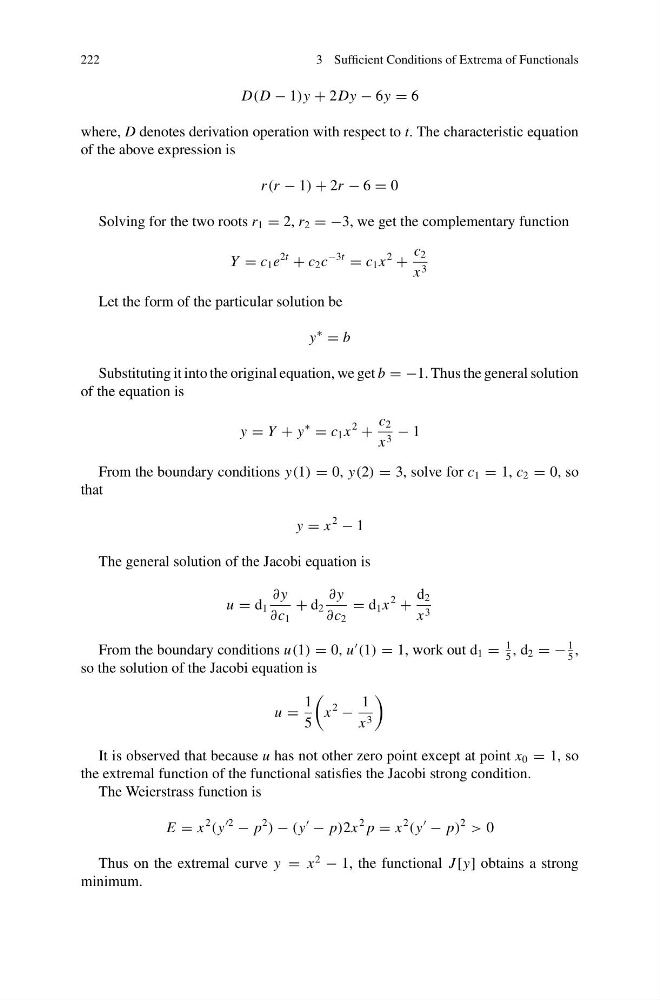
222
3 Sufficient Conditions of Extrema of Functionals
D(D − 1)y + 2Dy − 6y = 6
where, D denotes derivation operation with respect to t. The characteristic equation
of the above expression is
r (r − 1) + 2r − 6 = 0
Solving for the two roots r 1 = 2, r 2 = −3, we get the complementary function
Y = c 1 e
2t
+ c 2 c
−3t
= c 1 x
2
+
c 2
x 3
Let the form of the particular solution be
y
∗
= b
Substituting it into the original equation, we get b = −1. Thus the general solution
of the equation is
y = Y + y
∗
= c 1 x
2
+
c 2
x 3 − 1
From the boundary conditions y(1) = 0, y(2) = 3, solve for c 1 = 1, c 2 = 0, so
that
y = x
2
− 1
The general solution of the Jacobi equation is
u = d 1
∂ y
∂c 1
+ d 2
∂ y
∂c 2
= d 1 x
2
+
d 2
x 3
From the boundary conditions u(1) = 0, u
(1) = 1, work out d 1 =
1
5
, d 2 = −
1
5
,
so the solution of the Jacobi equation is
u =
1
5
x
2
−
1
x 3
It is observed that because u has not other zero point except at point x 0 = 1, so
the extremal function of the functional satisfies the Jacobi strong condition.
The Weierstrass function is
E = x
2
(y
2
− p
2
) − (y
− p)2x
2 p = x
2
(y
− p)
2
> 0
Thus on the extremal curve y = x
2
− 1, the functional J [y] obtains a strong
minimum.
3 Sufficient Conditions of Extrema of Functionals
D(D − 1)y + 2Dy − 6y = 6
where, D denotes derivation operation with respect to t. The characteristic equation
of the above expression is
r (r − 1) + 2r − 6 = 0
Solving for the two roots r 1 = 2, r 2 = −3, we get the complementary function
Y = c 1 e
2t
+ c 2 c
−3t
= c 1 x
2
+
c 2
x 3
Let the form of the particular solution be
y
∗
= b
Substituting it into the original equation, we get b = −1. Thus the general solution
of the equation is
y = Y + y
∗
= c 1 x
2
+
c 2
x 3 − 1
From the boundary conditions y(1) = 0, y(2) = 3, solve for c 1 = 1, c 2 = 0, so
that
y = x
2
− 1
The general solution of the Jacobi equation is
u = d 1
∂ y
∂c 1
+ d 2
∂ y
∂c 2
= d 1 x
2
+
d 2
x 3
From the boundary conditions u(1) = 0, u
(1) = 1, work out d 1 =
1
5
, d 2 = −
1
5
,
so the solution of the Jacobi equation is
u =
1
5
x
2
−
1
x 3
It is observed that because u has not other zero point except at point x 0 = 1, so
the extremal function of the functional satisfies the Jacobi strong condition.
The Weierstrass function is
E = x
2
(y
2
− p
2
) − (y
− p)2x
2 p = x
2
(y
− p)
2
> 0
Thus on the extremal curve y = x
2
− 1, the functional J [y] obtains a strong
minimum.