

206
3 Sufficient Conditions of Extrema of Functionals
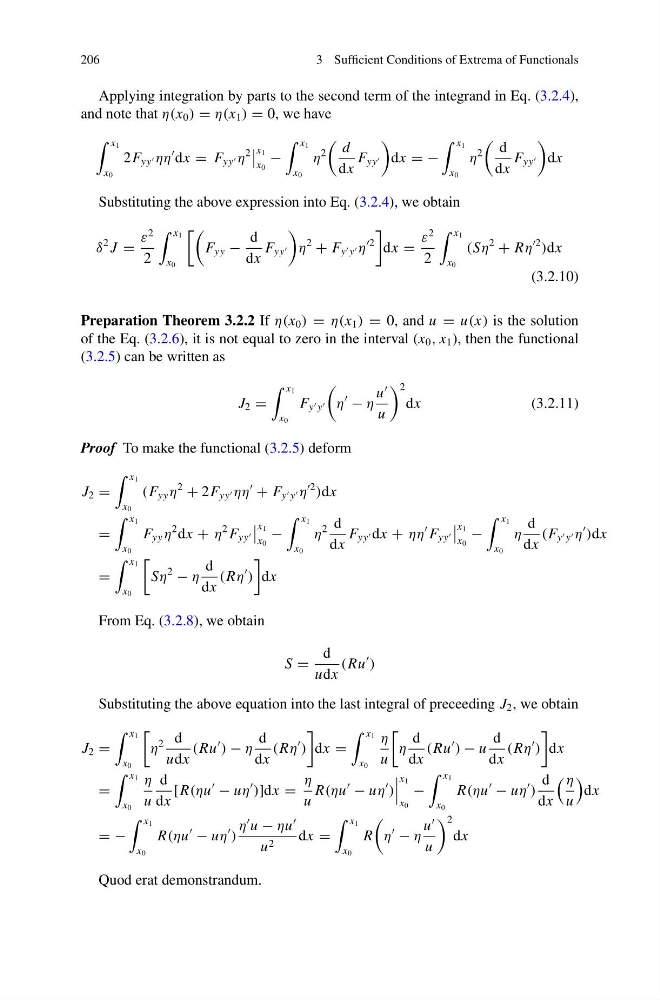
Applying integration by parts to the second term of the integrand in Eq. (3.2.4),
and note that η(x 0 ) = η(x 1 ) = 0, we have
x 1
x 0
2F yy ηη
dx = F yy η
2
x 1
x 0
−
x 1
x 0
η
2
d
dx
F yy
dx = −
x 1
x 0
η
2
d
dx
F yy
dx
Substituting the above expression into Eq. (3.2.4), we obtain
δ
2 J =
ε
2
2
x 1
x 0
F yy −
d
dx
F yy
η
2
+ F y y η
2
dx =
ε
2
2
x 1
x 0
(Sη
2
+ Rη
2
)dx
(3.2.10)
Preparation Theorem 3.2.2 If η(x 0 ) = η(x 1 ) = 0, and u = u(x) is the solution
of the Eq. (3.2.6), it is not equal to zero in the interval (x 0 , x 1 ), then the functional
(3.2.5) can be written as
J 2 =
x 1
x 0
F y y
η
− η
u
u
2
dx
(3.2.11)
Proof To make the functional (3.2.5) deform
J 2 =
x 1
x 0
(F yy η
2
+ 2F yy ηη
+ F y y η
2
)dx
=
x 1
x 0
F yy η
2 dx + η
2 F yy
x 1
x 0
−
x 1
x 0
η
2 d
dx
F yy dx + ηη
F yy
x 1
x 0
−
x 1
x 0
η
d
dx
(F y y η
)dx
=
x 1
x 0
Sη
2
− η
d
dx
(Rη
)
dx
From Eq. (3.2.8), we obtain
S =
d
udx
(Ru
)
Substituting the above equation into the last integral of preceeding J 2 , we obtain
J 2 =
x 1
x 0
η
2 d
udx
(Ru
) − η
d
dx
(Rη
)
dx =
x 1
x 0
η
u
η
d
dx
(Ru
) − u
d
dx
(Rη
)
dx
=
x 1
x 0
η
u
d
dx
[R(ηu
− uη
)]dx =
η
u
R(ηu
− uη
)
x 1
x 0
−
x 1
x 0
R(ηu
− uη
)
d
dx
η
u
dx
= −
x 1
x 0
R(ηu
− uη
)
η
u − ηu
u 2
dx =
x 1
x 0
R
η
− η
u
u
2
dx
Quod erat demonstrandum.
3 Sufficient Conditions of Extrema of Functionals
Applying integration by parts to the second term of the integrand in Eq. (3.2.4),
and note that η(x 0 ) = η(x 1 ) = 0, we have
x 1
x 0
2F yy ηη
dx = F yy η
2
x 1
x 0
−
x 1
x 0
η
2
d
dx
F yy
dx = −
x 1
x 0
η
2
d
dx
F yy
dx
Substituting the above expression into Eq. (3.2.4), we obtain
δ
2 J =
ε
2
2
x 1
x 0
F yy −
d
dx
F yy
η
2
+ F y y η
2
dx =
ε
2
2
x 1
x 0
(Sη
2
+ Rη
2
)dx
(3.2.10)
Preparation Theorem 3.2.2 If η(x 0 ) = η(x 1 ) = 0, and u = u(x) is the solution
of the Eq. (3.2.6), it is not equal to zero in the interval (x 0 , x 1 ), then the functional
(3.2.5) can be written as
J 2 =
x 1
x 0
F y y
η
− η
u
u
2
dx
(3.2.11)
Proof To make the functional (3.2.5) deform
J 2 =
x 1
x 0
(F yy η
2
+ 2F yy ηη
+ F y y η
2
)dx
=
x 1
x 0
F yy η
2 dx + η
2 F yy
x 1
x 0
−
x 1
x 0
η
2 d
dx
F yy dx + ηη
F yy
x 1
x 0
−
x 1
x 0
η
d
dx
(F y y η
)dx
=
x 1
x 0
Sη
2
− η
d
dx
(Rη
)
dx
From Eq. (3.2.8), we obtain
S =
d
udx
(Ru
)
Substituting the above equation into the last integral of preceeding J 2 , we obtain
J 2 =
x 1
x 0
η
2 d
udx
(Ru
) − η
d
dx
(Rη
)
dx =
x 1
x 0
η
u
η
d
dx
(Ru
) − u
d
dx
(Rη
)
dx
=
x 1
x 0
η
u
d
dx
[R(ηu
− uη
)]dx =
η
u
R(ηu
− uη
)
x 1
x 0
−
x 1
x 0
R(ηu
− uη
)
d
dx
η
u
dx
= −
x 1
x 0
R(ηu
− uη
)
η
u − ηu
u 2
dx =
x 1
x 0
R
η
− η
u
u
2
dx
Quod erat demonstrandum.