

2.9 Variational Problems of Complete Function
177
the complete functional structure in the calculus of variations. The various Euler
equations in variational methods are all the embodiment form of the complete Euler
equations (2.9.11)–(2.9.11), Can through the equations of variables and letters of
certain value to get, they can be obtained through m, l, n k and S k etc. of the various
equations getting some specific values. When any one in m, l, n k and S k approaches
infinity, the complete system of Euler equations are from finite to infinite.
In the Euler equations (2.9.11)–(2.9.14), if the subscript s k of i and the order i s k of
partial derivative D are omitted, and like the Einstein summation convention, making
convention: The two identical partial differential operators in one term indicates
summation, such sum number can also be omitted, then the Euler equations (2.9.11)–
(2.9.14) can be written as the following more simple forms
F u k + (−1)
i D F Du k = 0 (k = 1, 2, · · · , l)
(2.9.16)
F u k + (−1)
i D
∂ F
∂ Du k
= 0 (k = 1, 2, · · · , l)
(2.9.17)
(−1)
i D F Du k = 0 (k = 1, 2, · · · , l)
(2.9.18)
(−1)
i D
∂ F
∂ Du k
= 0 (k = 1, 2, · · · , l)
(2.9.19)
The Euler equations (2.9.16)–(2.9.19) and the Euler equation of the simplest functional have the same form. It is interesting to note that the Euler equation (2.9.18), like
the Euler equation (2.4.3) of the simplest functional, is expressed with 12 symbols,
but the Euler equations (2.9.18) can extend the three independent variables x, y(x),
y
(x) which the simplest functional depend to into infinite.
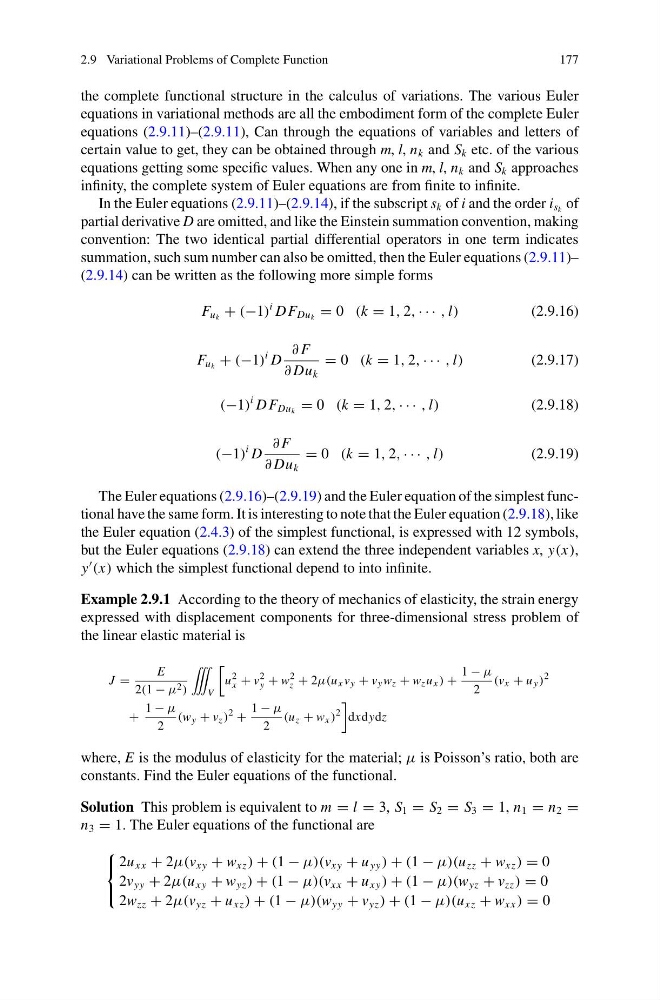
Example 2.9.1 According to the theory of mechanics of elasticity, the strain energy
expressed with displacement components for three-dimensional stress problem of
the linear elastic material is
J =
E
2(1 − μ 2 )
˚
V
u
2
x + v
2
y + w
2
z + 2μ(u x v y + v y w z + w z u x ) +
1 − μ
2
(v x + u y )
2
+
1 − μ
2
(w y + v z )
2 +
1 − μ
2
(u z + w x )
2
dxdydz
where, E is the modulus of elasticity for the material; μ is Poisson’s ratio, both are
constants. Find the Euler equations of the functional.
Solution This problem is equivalent to m = l = 3, S 1 = S 2 = S 3 = 1, n 1 = n 2 =
n 3 = 1. The Euler equations of the functional are
⎧
⎨
⎩
2u xx + 2μ(v xy + w xz ) + (1 − μ)(v xy + u yy ) + (1 − μ)(u zz + w xz ) = 0
2v yy + 2μ(u xy + w yz ) + (1 − μ)(v xx + u xy ) + (1 − μ)(w yz + v zz ) = 0
2w zz + 2μ(v yz + u xz ) + (1 − μ)(w yy + v yz ) + (1 − μ)(u xz + w xx ) = 0
177
the complete functional structure in the calculus of variations. The various Euler
equations in variational methods are all the embodiment form of the complete Euler
equations (2.9.11)–(2.9.11), Can through the equations of variables and letters of
certain value to get, they can be obtained through m, l, n k and S k etc. of the various
equations getting some specific values. When any one in m, l, n k and S k approaches
infinity, the complete system of Euler equations are from finite to infinite.
In the Euler equations (2.9.11)–(2.9.14), if the subscript s k of i and the order i s k of
partial derivative D are omitted, and like the Einstein summation convention, making
convention: The two identical partial differential operators in one term indicates
summation, such sum number can also be omitted, then the Euler equations (2.9.11)–
(2.9.14) can be written as the following more simple forms
F u k + (−1)
i D F Du k = 0 (k = 1, 2, · · · , l)
(2.9.16)
F u k + (−1)
i D
∂ F
∂ Du k
= 0 (k = 1, 2, · · · , l)
(2.9.17)
(−1)
i D F Du k = 0 (k = 1, 2, · · · , l)
(2.9.18)
(−1)
i D
∂ F
∂ Du k
= 0 (k = 1, 2, · · · , l)
(2.9.19)
The Euler equations (2.9.16)–(2.9.19) and the Euler equation of the simplest functional have the same form. It is interesting to note that the Euler equation (2.9.18), like
the Euler equation (2.4.3) of the simplest functional, is expressed with 12 symbols,
but the Euler equations (2.9.18) can extend the three independent variables x, y(x),
y
(x) which the simplest functional depend to into infinite.
Example 2.9.1 According to the theory of mechanics of elasticity, the strain energy
expressed with displacement components for three-dimensional stress problem of
the linear elastic material is
J =
E
2(1 − μ 2 )
˚
V
u
2
x + v
2
y + w
2
z + 2μ(u x v y + v y w z + w z u x ) +
1 − μ
2
(v x + u y )
2
+
1 − μ
2
(w y + v z )
2 +
1 − μ
2
(u z + w x )
2
dxdydz
where, E is the modulus of elasticity for the material; μ is Poisson’s ratio, both are
constants. Find the Euler equations of the functional.
Solution This problem is equivalent to m = l = 3, S 1 = S 2 = S 3 = 1, n 1 = n 2 =
n 3 = 1. The Euler equations of the functional are
⎧
⎨
⎩
2u xx + 2μ(v xy + w xz ) + (1 − μ)(v xy + u yy ) + (1 − μ)(u zz + w xz ) = 0
2v yy + 2μ(u xy + w yz ) + (1 − μ)(v xx + u xy ) + (1 − μ)(w yz + v zz ) = 0
2w zz + 2μ(v yz + u xz ) + (1 − μ)(w yy + v yz ) + (1 − μ)(u xz + w xx ) = 0