

144
2 Variational Problems with Fixed Boundaries
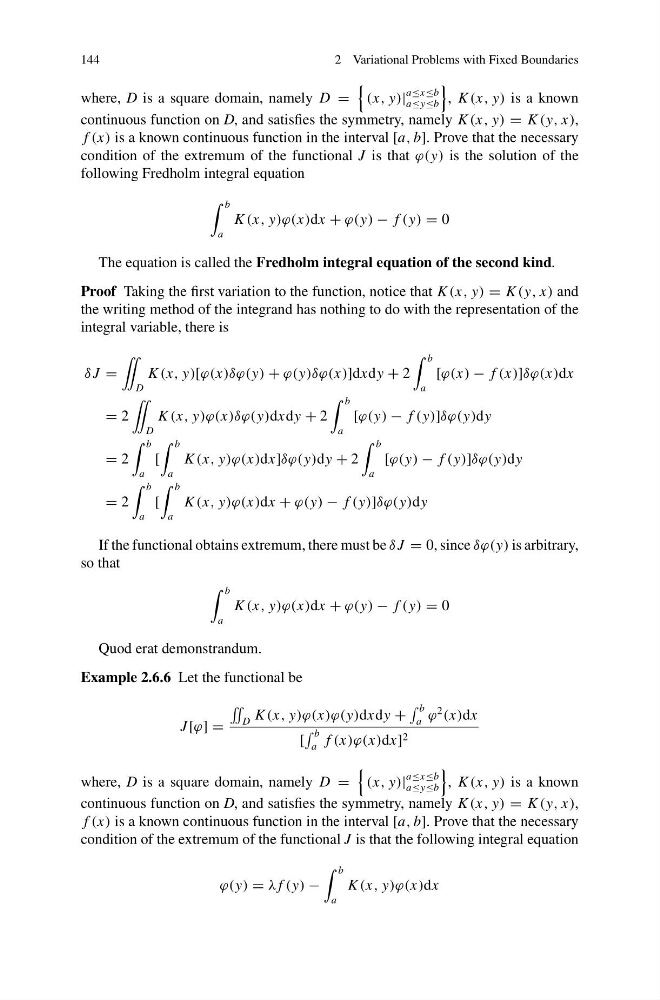
where, D is a square domain, namely D =
(x, y)|
a≤x≤b
a≤y≤b
, K (x, y) is a known
continuous function on D, and satisfies the symmetry, namely K (x, y) = K (y, x),
f (x) is a known continuous function in the interval [a, b]. Prove that the necessary
condition of the extremum of the functional J is that ϕ(y) is the solution of the
following Fredholm integral equation
b
a
K (x, y)ϕ(x)dx + ϕ(y) − f (y) = 0
The equation is called the Fredholm integral equation of the second kind.
Proof Taking the first variation to the function, notice that K (x, y) = K (y, x) and
the writing method of the integrand has nothing to do with the representation of the
integral variable, there is
δ J =
¨
D
K (x, y)[ϕ(x)δϕ(y) + ϕ(y)δϕ(x)]dxdy + 2
b
a
[ϕ(x) − f (x)]δϕ(x)dx
= 2
¨
D
K (x, y)ϕ(x)δϕ(y)dxdy + 2
b
a
[ϕ(y) − f (y)]δϕ(y)dy
= 2
b
a
[
b
a
K (x, y)ϕ(x)dx]δϕ(y)dy + 2
b
a
[ϕ(y) − f (y)]δϕ(y)dy
= 2
b
a
[
b
a
K (x, y)ϕ(x)dx + ϕ(y) − f (y)]δϕ(y)dy
If the functional obtains extremum, there must be δ J = 0, since δϕ(y) is arbitrary,
so that
b
a
K (x, y)ϕ(x)dx + ϕ(y) − f (y) = 0
Quod erat demonstrandum.
Example 2.6.6 Let the functional be
J [ϕ] =
˜
D K (x, y)ϕ(x)ϕ(y)dxdy +
b
a ϕ
2
(x)dx
[
b
a f (x)ϕ(x)dx] 2
where, D is a square domain, namely D =
(x, y)|
a≤x≤b
a≤y≤b
, K (x, y) is a known
continuous function on D, and satisfies the symmetry, namely K (x, y) = K (y, x),
f (x) is a known continuous function in the interval [a, b]. Prove that the necessary
condition of the extremum of the functional J is that the following integral equation
ϕ(y) = λ f (y) −
b
a
K (x, y)ϕ(x)dx
2 Variational Problems with Fixed Boundaries
where, D is a square domain, namely D =
(x, y)|
a≤x≤b
a≤y≤b
, K (x, y) is a known
continuous function on D, and satisfies the symmetry, namely K (x, y) = K (y, x),
f (x) is a known continuous function in the interval [a, b]. Prove that the necessary
condition of the extremum of the functional J is that ϕ(y) is the solution of the
following Fredholm integral equation
b
a
K (x, y)ϕ(x)dx + ϕ(y) − f (y) = 0
The equation is called the Fredholm integral equation of the second kind.
Proof Taking the first variation to the function, notice that K (x, y) = K (y, x) and
the writing method of the integrand has nothing to do with the representation of the
integral variable, there is
δ J =
¨
D
K (x, y)[ϕ(x)δϕ(y) + ϕ(y)δϕ(x)]dxdy + 2
b
a
[ϕ(x) − f (x)]δϕ(x)dx
= 2
¨
D
K (x, y)ϕ(x)δϕ(y)dxdy + 2
b
a
[ϕ(y) − f (y)]δϕ(y)dy
= 2
b
a
[
b
a
K (x, y)ϕ(x)dx]δϕ(y)dy + 2
b
a
[ϕ(y) − f (y)]δϕ(y)dy
= 2
b
a
[
b
a
K (x, y)ϕ(x)dx + ϕ(y) − f (y)]δϕ(y)dy
If the functional obtains extremum, there must be δ J = 0, since δϕ(y) is arbitrary,
so that
b
a
K (x, y)ϕ(x)dx + ϕ(y) − f (y) = 0
Quod erat demonstrandum.
Example 2.6.6 Let the functional be
J [ϕ] =
˜
D K (x, y)ϕ(x)ϕ(y)dxdy +
b
a ϕ
2
(x)dx
[
b
a f (x)ϕ(x)dx] 2
where, D is a square domain, namely D =
(x, y)|
a≤x≤b
a≤y≤b
, K (x, y) is a known
continuous function on D, and satisfies the symmetry, namely K (x, y) = K (y, x),
f (x) is a known continuous function in the interval [a, b]. Prove that the necessary
condition of the extremum of the functional J is that the following integral equation
ϕ(y) = λ f (y) −
b
a
K (x, y)ϕ(x)dx