

140
2 Variational Problems with Fixed Boundaries
or
3
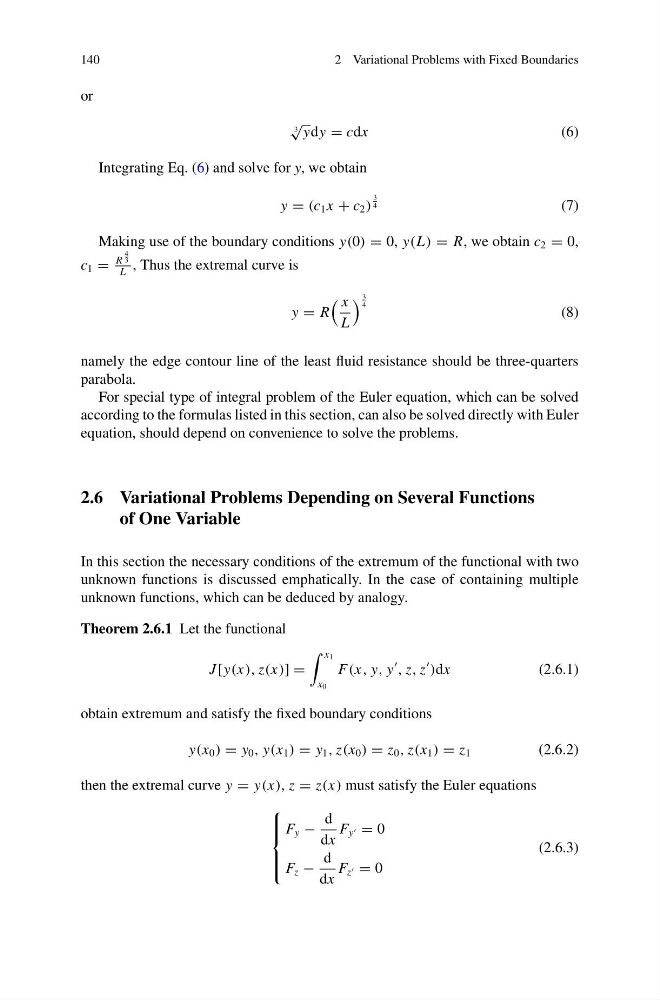
√ ydy = cdx
(6)
Integrating Eq. (6) and solve for y, we obtain
y = (c 1 x + c 2 )
3
4
(7)
Making use of the boundary conditions y(0) = 0, y(L) = R, we obtain c 2 = 0,
c 1 =
R
4
3
L
, Thus the extremal curve is
y = R
x
L
3
4
(8)
namely the edge contour line of the least fluid resistance should be three-quarters
parabola.
For special type of integral problem of the Euler equation, which can be solved
according to the formulas listed in this section, can also be solved directly with Euler
equation, should depend on convenience to solve the problems.
2.6 Variational Problems Depending on Several Functions
of One Variable
In this section the necessary conditions of the extremum of the functional with two
unknown functions is discussed emphatically. In the case of containing multiple
unknown functions, which can be deduced by analogy.
Theorem 2.6.1 Let the functional
J [y(x), z(x)] =
x 1
x 0
F(x, y, y
, z, z
)dx
(2.6.1)
obtain extremum and satisfy the fixed boundary conditions
y(x 0 ) = y 0 , y(x 1 ) = y 1 , z(x 0 ) = z 0 , z(x 1 ) = z 1
(2.6.2)
then the extremal curve y = y(x), z = z(x) must satisfy the Euler equations
⎧
⎪ ⎪ ⎨
⎪ ⎪ ⎩
F y −
d
dx
F y = 0
F z −
d
dx
F z = 0
(2.6.3)
2 Variational Problems with Fixed Boundaries
or
3
√ ydy = cdx
(6)
Integrating Eq. (6) and solve for y, we obtain
y = (c 1 x + c 2 )
3
4
(7)
Making use of the boundary conditions y(0) = 0, y(L) = R, we obtain c 2 = 0,
c 1 =
R
4
3
L
, Thus the extremal curve is
y = R
x
L
3
4
(8)
namely the edge contour line of the least fluid resistance should be three-quarters
parabola.
For special type of integral problem of the Euler equation, which can be solved
according to the formulas listed in this section, can also be solved directly with Euler
equation, should depend on convenience to solve the problems.
2.6 Variational Problems Depending on Several Functions
of One Variable
In this section the necessary conditions of the extremum of the functional with two
unknown functions is discussed emphatically. In the case of containing multiple
unknown functions, which can be deduced by analogy.
Theorem 2.6.1 Let the functional
J [y(x), z(x)] =
x 1
x 0
F(x, y, y
, z, z
)dx
(2.6.1)
obtain extremum and satisfy the fixed boundary conditions
y(x 0 ) = y 0 , y(x 1 ) = y 1 , z(x 0 ) = z 0 , z(x 1 ) = z 1
(2.6.2)
then the extremal curve y = y(x), z = z(x) must satisfy the Euler equations
⎧
⎪ ⎪ ⎨
⎪ ⎪ ⎩
F y −
d
dx
F y = 0
F z −
d
dx
F z = 0
(2.6.3)