

138
2 Variational Problems with Fixed Boundaries
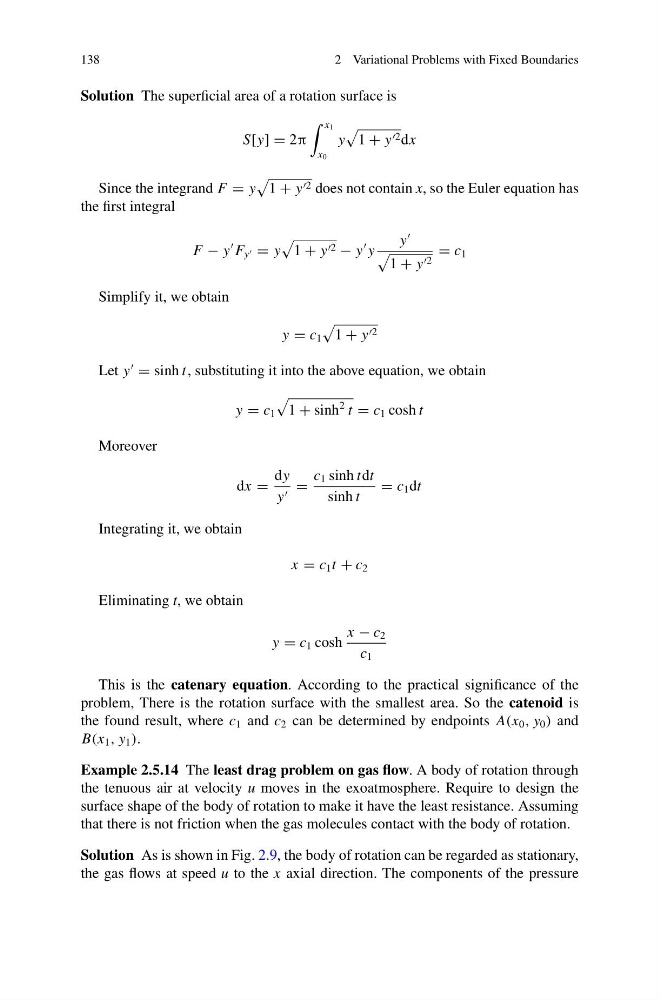
Solution The superficial area of a rotation surface is
S[y] = 2π
x 1
x 0
y
1 + y 2 dx
Since the integrand F = y
1 + y 2 does not contain x, so the Euler equation has
the first integral
F − y
F y = y
1 + y 2 − y
y
y
1 + y 2
= c 1
Simplify it, we obtain
y = c 1
1 + y 2
Let y
= sinh t, substituting it into the above equation, we obtain
y = c 1
1 + sinh
2 t = c 1 cosh t
Moreover
dx =
dy
y =
c 1 sinh tdt
sinh t
= c 1 dt
Integrating it, we obtain
x = c 1 t + c 2
Eliminating t, we obtain
y = c 1 cosh
x − c 2
c 1
This is the catenary equation. According to the practical significance of the
problem, There is the rotation surface with the smallest area. So the catenoid is
the found result, where c 1 and c 2 can be determined by endpoints A(x 0 , y 0 ) and
B(x 1 , y 1 ).
Example 2.5.14 The least drag problem on gas flow. A body of rotation through
the tenuous air at velocity u moves in the exoatmosphere. Require to design the
surface shape of the body of rotation to make it have the least resistance. Assuming
that there is not friction when the gas molecules contact with the body of rotation.
Solution As is shown in Fig. 2.9, the body of rotation can be regarded as stationary,
the gas flows at speed u to the x axial direction. The components of the pressure
2 Variational Problems with Fixed Boundaries
Solution The superficial area of a rotation surface is
S[y] = 2π
x 1
x 0
y
1 + y 2 dx
Since the integrand F = y
1 + y 2 does not contain x, so the Euler equation has
the first integral
F − y
F y = y
1 + y 2 − y
y
y
1 + y 2
= c 1
Simplify it, we obtain
y = c 1
1 + y 2
Let y
= sinh t, substituting it into the above equation, we obtain
y = c 1
1 + sinh
2 t = c 1 cosh t
Moreover
dx =
dy
y =
c 1 sinh tdt
sinh t
= c 1 dt
Integrating it, we obtain
x = c 1 t + c 2
Eliminating t, we obtain
y = c 1 cosh
x − c 2
c 1
This is the catenary equation. According to the practical significance of the
problem, There is the rotation surface with the smallest area. So the catenoid is
the found result, where c 1 and c 2 can be determined by endpoints A(x 0 , y 0 ) and
B(x 1 , y 1 ).
Example 2.5.14 The least drag problem on gas flow. A body of rotation through
the tenuous air at velocity u moves in the exoatmosphere. Require to design the
surface shape of the body of rotation to make it have the least resistance. Assuming
that there is not friction when the gas molecules contact with the body of rotation.
Solution As is shown in Fig. 2.9, the body of rotation can be regarded as stationary,
the gas flows at speed u to the x axial direction. The components of the pressure