

2.5 Several Special Cases of the Euler Equation and Their Integrals
129
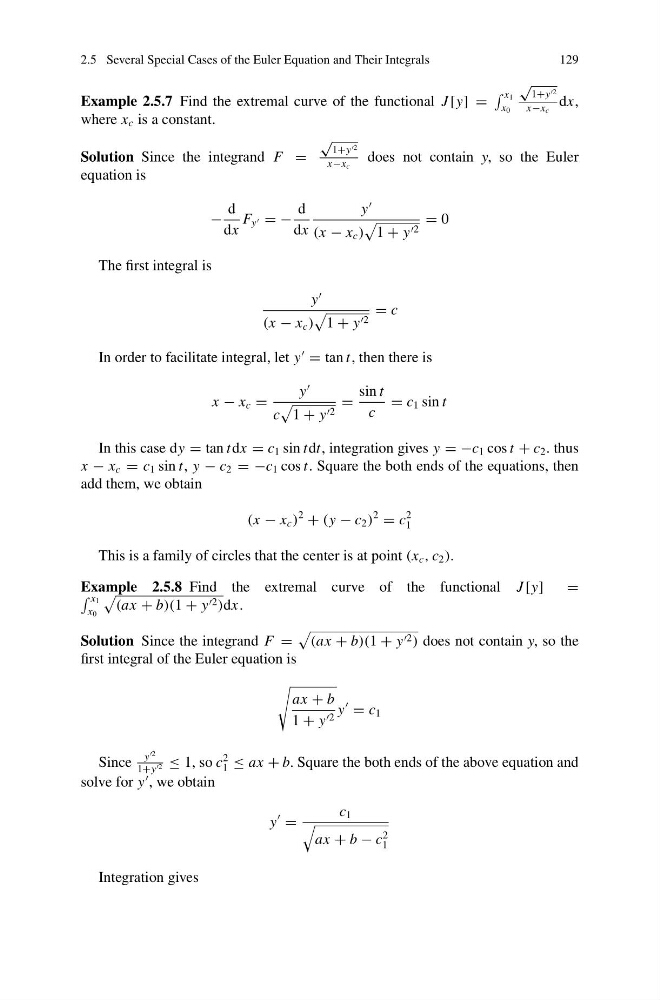
Example 2.5.7 Find the extremal curve of the functional J [y] =
x 1
x 0
√
1+y 2
x−x c
dx,
where x c is a constant.
Solution Since the integrand F =
√
1+y 2
x−x c
does not contain y, so the Euler
equation is
−
d
dx
F y = −
d
dx
y
(x − x c )
1 + y 2
= 0
The first integral is
y
(x − x c )
1 + y 2
= c
In order to facilitate integral, let y
= tan t, then there is
x − x c =
y
c
1 + y 2
=
sin t
c
= c 1 sin t
In this case dy = tan tdx = c 1 sin tdt, integration gives y = −c 1 cos t + c 2 . thus
x − x c = c 1 sin t, y − c 2 = −c 1 cos t. Square the both ends of the equations, then
add them, we obtain
(x − x c )
2
+ (y − c 2 )
2
= c
2
1
This is a family of circles that the center is at point (x c , c 2 ).
Example 2.5.8 Find the extremal curve of the functional J [y]
=
x 1
x 0
(ax + b)(1 + y 2 )dx.
Solution Since the integrand F =
(ax + b)(1 + y 2 ) does not contain y, so the
first integral of the Euler equation is
ax + b
1 + y 2 y
= c 1
Since
y
2
1+y 2 ≤ 1, so c
2
1 ≤ ax + b. Square the both ends of the above equation and
solve for y
, we obtain
y
=
c 1
ax + b − c
2
1
Integration gives
129
Example 2.5.7 Find the extremal curve of the functional J [y] =
x 1
x 0
√
1+y 2
x−x c
dx,
where x c is a constant.
Solution Since the integrand F =
√
1+y 2
x−x c
does not contain y, so the Euler
equation is
−
d
dx
F y = −
d
dx
y
(x − x c )
1 + y 2
= 0
The first integral is
y
(x − x c )
1 + y 2
= c
In order to facilitate integral, let y
= tan t, then there is
x − x c =
y
c
1 + y 2
=
sin t
c
= c 1 sin t
In this case dy = tan tdx = c 1 sin tdt, integration gives y = −c 1 cos t + c 2 . thus
x − x c = c 1 sin t, y − c 2 = −c 1 cos t. Square the both ends of the equations, then
add them, we obtain
(x − x c )
2
+ (y − c 2 )
2
= c
2
1
This is a family of circles that the center is at point (x c , c 2 ).
Example 2.5.8 Find the extremal curve of the functional J [y]
=
x 1
x 0
(ax + b)(1 + y 2 )dx.
Solution Since the integrand F =
(ax + b)(1 + y 2 ) does not contain y, so the
first integral of the Euler equation is
ax + b
1 + y 2 y
= c 1
Since
y
2
1+y 2 ≤ 1, so c
2
1 ≤ ax + b. Square the both ends of the above equation and
solve for y
, we obtain
y
=
c 1
ax + b − c
2
1
Integration gives