

2.5 Several Special Cases of the Euler Equation and Their Integrals
127
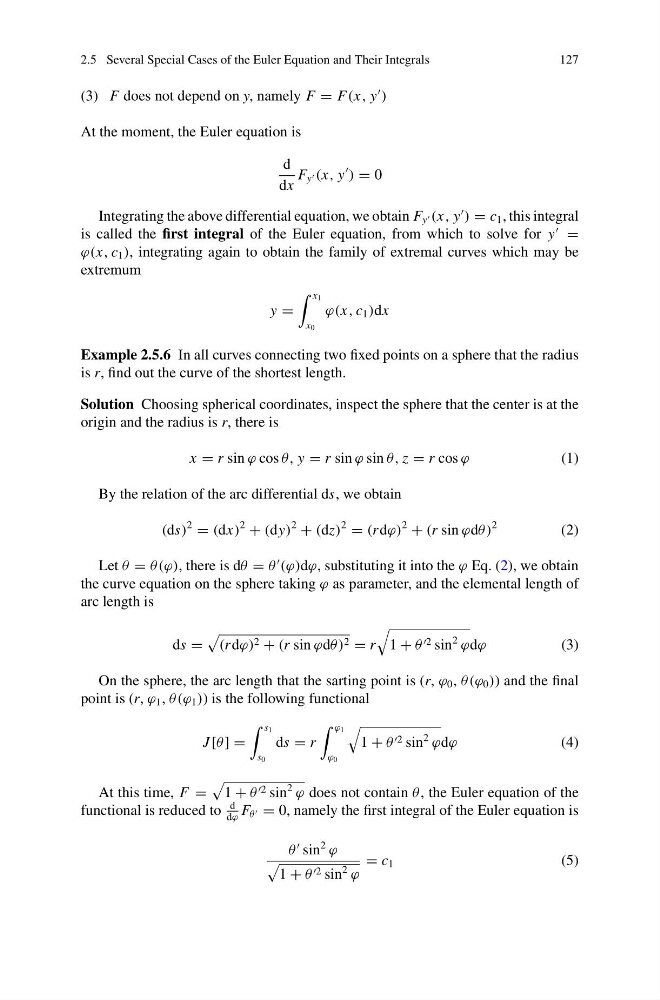
(3) F does not depend on y, namely F = F(x, y
)
At the moment, the Euler equation is
d
dx
F y (x, y
) = 0
Integrating the above differential equation, we obtain F y (x, y
) = c 1 , this integral
is called the first integral of the Euler equation, from which to solve for y
=
ϕ(x, c 1 ), integrating again to obtain the family of extremal curves which may be
extremum
y =
x 1
x 0
ϕ(x, c 1 )dx
Example 2.5.6 In all curves connecting two fixed points on a sphere that the radius
is r, find out the curve of the shortest length.
Solution Choosing spherical coordinates, inspect the sphere that the center is at the
origin and the radius is r, there is
x = r sin ϕ cos θ, y = r sin ϕ sin θ, z = r cos ϕ
(1)
By the relation of the arc differential ds, we obtain
(ds)
2
= (dx)
2
+ (dy)
2
+ (dz)
2
= (r dϕ)
2
+ (r sin ϕdθ)
2
(2)
Let θ = θ(ϕ), there is dθ = θ
(ϕ)dϕ, substituting it into the ϕ Eq. (2), we obtain
the curve equation on the sphere taking ϕ as parameter, and the elemental length of
arc length is
ds =
(r dϕ) 2 + (r sin ϕdθ) 2 = r
1 + θ 2 sin
2
ϕdϕ
(3)
On the sphere, the arc length that the sarting point is (r, ϕ 0 , θ(ϕ 0 )) and the final
point is (r, ϕ 1 , θ(ϕ 1 )) is the following functional
J [θ ] =
s 1
s 0
ds = r
ϕ 1
ϕ 0
1 + θ 2 sin
2
ϕdϕ
(4)
At this time, F =
1 + θ 2 sin
2
ϕ does not contain θ , the Euler equation of the
functional is reduced to
d
dϕ
F θ = 0, namely the first integral of the Euler equation is
θ
sin
2
ϕ
1 + θ 2 sin
2
ϕ
= c 1
(5)
127
(3) F does not depend on y, namely F = F(x, y
)
At the moment, the Euler equation is
d
dx
F y (x, y
) = 0
Integrating the above differential equation, we obtain F y (x, y
) = c 1 , this integral
is called the first integral of the Euler equation, from which to solve for y
=
ϕ(x, c 1 ), integrating again to obtain the family of extremal curves which may be
extremum
y =
x 1
x 0
ϕ(x, c 1 )dx
Example 2.5.6 In all curves connecting two fixed points on a sphere that the radius
is r, find out the curve of the shortest length.
Solution Choosing spherical coordinates, inspect the sphere that the center is at the
origin and the radius is r, there is
x = r sin ϕ cos θ, y = r sin ϕ sin θ, z = r cos ϕ
(1)
By the relation of the arc differential ds, we obtain
(ds)
2
= (dx)
2
+ (dy)
2
+ (dz)
2
= (r dϕ)
2
+ (r sin ϕdθ)
2
(2)
Let θ = θ(ϕ), there is dθ = θ
(ϕ)dϕ, substituting it into the ϕ Eq. (2), we obtain
the curve equation on the sphere taking ϕ as parameter, and the elemental length of
arc length is
ds =
(r dϕ) 2 + (r sin ϕdθ) 2 = r
1 + θ 2 sin
2
ϕdϕ
(3)
On the sphere, the arc length that the sarting point is (r, ϕ 0 , θ(ϕ 0 )) and the final
point is (r, ϕ 1 , θ(ϕ 1 )) is the following functional
J [θ ] =
s 1
s 0
ds = r
ϕ 1
ϕ 0
1 + θ 2 sin
2
ϕdϕ
(4)
At this time, F =
1 + θ 2 sin
2
ϕ does not contain θ , the Euler equation of the
functional is reduced to
d
dϕ
F θ = 0, namely the first integral of the Euler equation is
θ
sin
2
ϕ
1 + θ 2 sin
2
ϕ
= c 1
(5)