

2.3 Variations of the Simplest Functionals and Necessary Conditions …
101
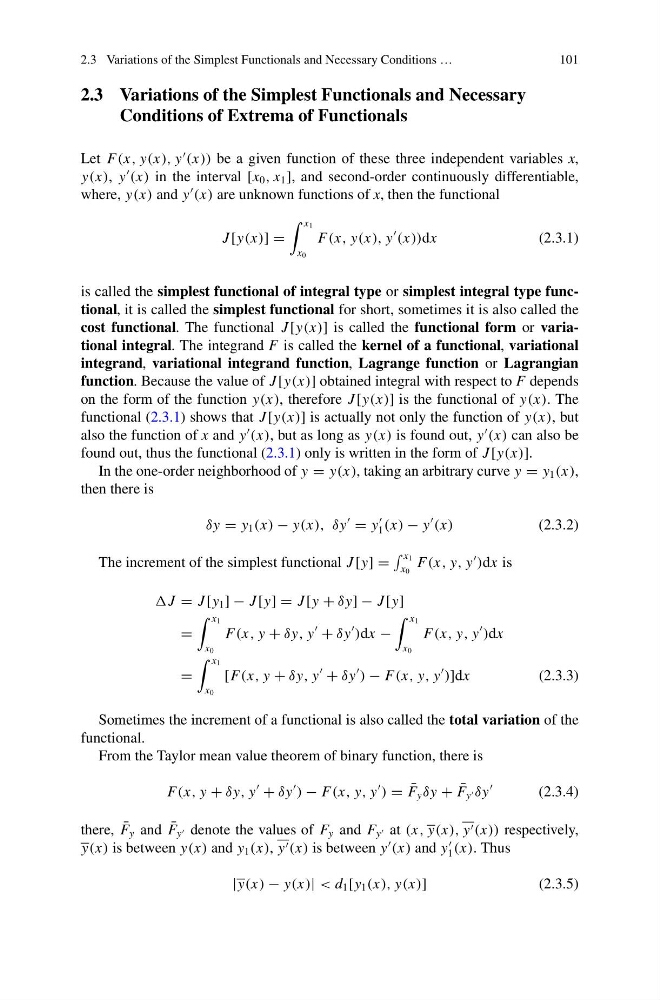
2.3 Variations of the Simplest Functionals and Necessary
Conditions of Extrema of Functionals
Let F(x, y(x), y
(x)) be a given function of these three independent variables x,
y(x), y
(x) in the interval [x 0 , x 1 ], and second-order continuously differentiable,
where, y(x) and y
(x) are unknown functions of x, then the functional
J [y(x)] =
x 1
x 0
F(x, y(x), y
(x))dx
(2.3.1)
is called the simplest functional of integral type or simplest integral type functional, it is called the simplest functional for short, sometimes it is also called the
cost functional. The functional J [y(x)] is called the functional form or variational integral. The integrand F is called the kernel of a functional, variational
integrand, variational integrand function, Lagrange function or Lagrangian
function. Because the value of J [y(x)] obtained integral with respect to F depends
on the form of the function y(x), therefore J [y(x)] is the functional of y(x). The
functional (2.3.1) shows that J [y(x)] is actually not only the function of y(x), but
also the function of x and y
(x), but as long as y(x) is found out, y
(x) can also be
found out, thus the functional (2.3.1) only is written in the form of J [y(x)].
In the one-order neighborhood of y = y(x), taking an arbitrary curve y = y 1 (x),
then there is
δy = y 1 (x) − y(x), δy
= y
1 (x) − y
(x)
(2.3.2)
The increment of the simplest functional J [y] =
x 1
x 0
F(x, y, y
)dx is
J = J [y 1 ] − J [y] = J [y + δy] − J [y]
=
x 1
x 0
F(x, y + δy, y
+ δy
)dx −
x 1
x 0
F(x, y, y
)dx
=
x 1
x 0
[F(x, y + δy, y
+ δy
) − F(x, y, y
)]dx
(2.3.3)
Sometimes the increment of a functional is also called the total variation of the
functional.
From the Taylor mean value theorem of binary function, there is
F(x, y + δy, y
+ δy
) − F(x, y, y
) = ¯
F y δy + ¯
F y δy
(2.3.4)
there, ¯
F y and ¯
F y denote the values of F y and F y at (x, y(x), y (x)) respectively,
y(x) is between y(x) and y 1 (x), y (x) is between y
(x) and y
1 (x). Thus
|y(x) − y(x)| < d 1 [y 1 (x), y(x)]
(2.3.5)
101
2.3 Variations of the Simplest Functionals and Necessary
Conditions of Extrema of Functionals
Let F(x, y(x), y
(x)) be a given function of these three independent variables x,
y(x), y
(x) in the interval [x 0 , x 1 ], and second-order continuously differentiable,
where, y(x) and y
(x) are unknown functions of x, then the functional
J [y(x)] =
x 1
x 0
F(x, y(x), y
(x))dx
(2.3.1)
is called the simplest functional of integral type or simplest integral type functional, it is called the simplest functional for short, sometimes it is also called the
cost functional. The functional J [y(x)] is called the functional form or variational integral. The integrand F is called the kernel of a functional, variational
integrand, variational integrand function, Lagrange function or Lagrangian
function. Because the value of J [y(x)] obtained integral with respect to F depends
on the form of the function y(x), therefore J [y(x)] is the functional of y(x). The
functional (2.3.1) shows that J [y(x)] is actually not only the function of y(x), but
also the function of x and y
(x), but as long as y(x) is found out, y
(x) can also be
found out, thus the functional (2.3.1) only is written in the form of J [y(x)].
In the one-order neighborhood of y = y(x), taking an arbitrary curve y = y 1 (x),
then there is
δy = y 1 (x) − y(x), δy
= y
1 (x) − y
(x)
(2.3.2)
The increment of the simplest functional J [y] =
x 1
x 0
F(x, y, y
)dx is
J = J [y 1 ] − J [y] = J [y + δy] − J [y]
=
x 1
x 0
F(x, y + δy, y
+ δy
)dx −
x 1
x 0
F(x, y, y
)dx
=
x 1
x 0
[F(x, y + δy, y
+ δy
) − F(x, y, y
)]dx
(2.3.3)
Sometimes the increment of a functional is also called the total variation of the
functional.
From the Taylor mean value theorem of binary function, there is
F(x, y + δy, y
+ δy
) − F(x, y, y
) = ¯
F y δy + ¯
F y δy
(2.3.4)
there, ¯
F y and ¯
F y denote the values of F y and F y at (x, y(x), y (x)) respectively,
y(x) is between y(x) and y 1 (x), y (x) is between y
(x) and y
1 (x). Thus
|y(x) − y(x)| < d 1 [y 1 (x), y(x)]
(2.3.5)