

2.2 Fundamental Conceptions of the Calculus of Variations
99
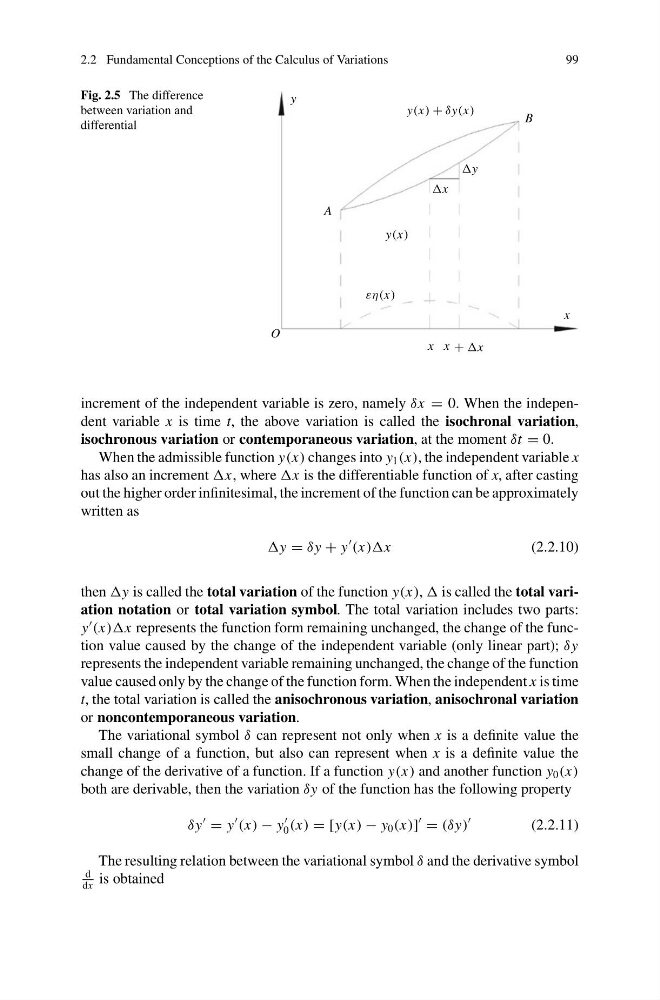
Fig. 2.5 The difference
between variation and
differential
O
x
y
A
B
x
x
y
y(x)
y(x
x
x
) +
+
δy(x)
εη(x)
increment of the independent variable is zero, namely δx = 0. When the independent variable x is time t, the above variation is called the isochronal variation,
isochronous variation or contemporaneous variation, at the moment δt = 0.
When the admissible function y(x) changes into y 1 (x), the independent variable x
has also an increment where is the differentiable function of x, after casting
out the higher order infinitesimal, the increment of the function can be approximately
written as
= δy + y
(x))x
(2.2.10)
then is called the total variation of the function y(x), is called the total variation notation or total variation symbol. The total variation includes two parts:
y
(x))x represents the function form remaining unchanged, the change of the function value caused by the change of the independent variable (only linear part); δy
represents the independent variable remaining unchanged, the change of the function
value caused only by the change of the function form. When the independent x is time
t, the total variation is called the anisochronous variation, anisochronal variation
or noncontemporaneous variation.
The variational symbol δ can represent not only when x is a definite value the
small change of a function, but also can represent when x is a definite value the
change of the derivative of a function. If a function y(x) and another function y 0 (x)
both are derivable, then the variation δy of the function has the following property
δy
= y
(x) − y
0 (x) = [y(x) − y 0 (x)]
= (δy)
(2.2.11)
The resulting relation between the variational symbol δ and the derivative symbol
d
dx
is obtained
99
Fig. 2.5 The difference
between variation and
differential
O
x
y
A
B
x
x
y
y(x)
y(x
x
x
) +
+
δy(x)
εη(x)
increment of the independent variable is zero, namely δx = 0. When the independent variable x is time t, the above variation is called the isochronal variation,
isochronous variation or contemporaneous variation, at the moment δt = 0.
When the admissible function y(x) changes into y 1 (x), the independent variable x
has also an increment where is the differentiable function of x, after casting
out the higher order infinitesimal, the increment of the function can be approximately
written as
= δy + y
(x))x
(2.2.10)
then is called the total variation of the function y(x), is called the total variation notation or total variation symbol. The total variation includes two parts:
y
(x))x represents the function form remaining unchanged, the change of the function value caused by the change of the independent variable (only linear part); δy
represents the independent variable remaining unchanged, the change of the function
value caused only by the change of the function form. When the independent x is time
t, the total variation is called the anisochronous variation, anisochronal variation
or noncontemporaneous variation.
The variational symbol δ can represent not only when x is a definite value the
small change of a function, but also can represent when x is a definite value the
change of the derivative of a function. If a function y(x) and another function y 0 (x)
both are derivable, then the variation δy of the function has the following property
δy
= y
(x) − y
0 (x) = [y(x) − y 0 (x)]
= (δy)
(2.2.11)
The resulting relation between the variational symbol δ and the derivative symbol
d
dx
is obtained