

1.9 Introduction to the Famous Scientists
83
V
⎛
⎜
⎜
⎜
⎝
n
i=1
ϕ i
m
j=1
ϕ j
∇u · ∇
m
j=1
ϕ j +
n
i=1
ϕ i u
⎞
⎟
⎟
⎟
⎠
dV =
S
n
i=1
ϕ i
∂u
∂n
dS
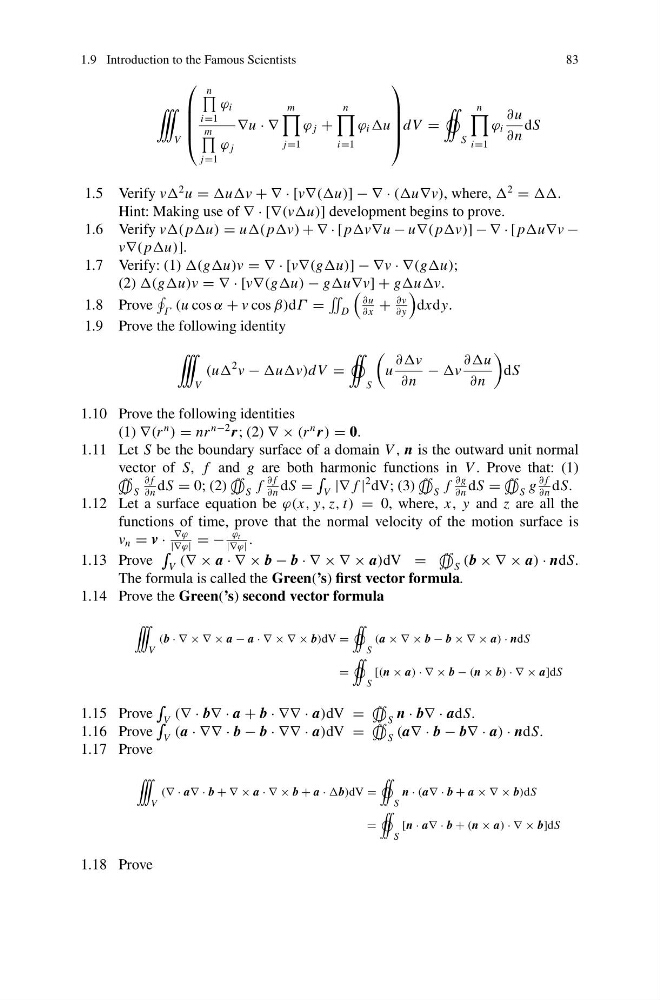
1.5 Verify v
2 u = uv + ∇ · [v∇((u)] − ∇ · ((u∇v), where,
2
= .
Hint: Making use of ∇ · [∇(vu)] development begins to prove.
1.6 Verify v( pu) = u( pv) + ∇ · [pv∇u − u∇( pv)] − ∇ · [pu∇v −
v∇( pu)].
1.7 Verify: (1) (gu)v = ∇ · [v∇(gu)] − ∇v · ∇(gu);
(2) (gu)v = ∇ · [v∇(gu) − gu∇v] + guv.
1.8 Prove
Γ (u cos α + v cos β)dΓ =
˜
D
∂u
∂ x
+
∂v
∂ y
dxdy.
1.9 Prove the following identity
V
(u
2 v − uv)dV =
S
u
∂∂v
∂n
− v
∂∂u
∂n
dS
1.10 Prove the following identities
(1) ∇(r
n
) = nr
n−2 r; (2) ∇ × (r
n r) = 0.
1.11 Let S be the boundary surface of a domain V , n is the outward unit normal
vector of S, f and g are both harmonic functions in V . Prove that: (1)
S
∂ f
∂n
dS = 0; (2)
S f
∂ f
∂n
dS =
V
|∇ f |
2 dV; (3)
S f
∂g
∂n
dS =
S g
∂ f
∂n
dS.
1.12 Let a surface equation be ϕ(x, y, z, t) = 0, where, x, y and z are all the
functions of time, prove that the normal velocity of the motion surface is
v n = v ·
∇ϕ
|∇ϕ| = −
ϕ t
|∇ϕ| .
1.13 Prove
V (∇ × a · ∇ × b − b · ∇ × ∇ × a)dV =
S (b × ∇ × a) · ndS.
The formula is called the Green(’s) first vector formula.
1.14 Prove the Green(’s) second vector formula
V
(b · ∇ × ∇ × a − a · ∇ × ∇ × b)dV =
S
(a × ∇ × b − b × ∇ × a) · ndS
=
S
[(n × a) · ∇ × b − (n × b) · ∇ × a]dS
1.15 Prove
V (∇ · b∇ · a + b · ∇∇ · a)dV =
S n · b∇ · adS.
1.16 Prove
V (a · ∇∇ · b − b · ∇∇ · a)dV =
S (a∇ · b − b∇ · a) · ndS.
1.17 Prove
V
(∇ · a∇ · b + ∇ × a · ∇ × b + a · b)dV =
S
n · (a∇ · b + a × ∇ × b)dS
=
S
[n · a∇ · b + (n × a) · ∇ × b]dS
1.18 Prove
83
V
⎛
⎜
⎜
⎜
⎝
n
i=1
ϕ i
m
j=1
ϕ j
∇u · ∇
m
j=1
ϕ j +
n
i=1
ϕ i u
⎞
⎟
⎟
⎟
⎠
dV =
S
n
i=1
ϕ i
∂u
∂n
dS
1.5 Verify v
2 u = uv + ∇ · [v∇((u)] − ∇ · ((u∇v), where,
2
= .
Hint: Making use of ∇ · [∇(vu)] development begins to prove.
1.6 Verify v( pu) = u( pv) + ∇ · [pv∇u − u∇( pv)] − ∇ · [pu∇v −
v∇( pu)].
1.7 Verify: (1) (gu)v = ∇ · [v∇(gu)] − ∇v · ∇(gu);
(2) (gu)v = ∇ · [v∇(gu) − gu∇v] + guv.
1.8 Prove
Γ (u cos α + v cos β)dΓ =
˜
D
∂u
∂ x
+
∂v
∂ y
dxdy.
1.9 Prove the following identity
V
(u
2 v − uv)dV =
S
u
∂∂v
∂n
− v
∂∂u
∂n
dS
1.10 Prove the following identities
(1) ∇(r
n
) = nr
n−2 r; (2) ∇ × (r
n r) = 0.
1.11 Let S be the boundary surface of a domain V , n is the outward unit normal
vector of S, f and g are both harmonic functions in V . Prove that: (1)
S
∂ f
∂n
dS = 0; (2)
S f
∂ f
∂n
dS =
V
|∇ f |
2 dV; (3)
S f
∂g
∂n
dS =
S g
∂ f
∂n
dS.
1.12 Let a surface equation be ϕ(x, y, z, t) = 0, where, x, y and z are all the
functions of time, prove that the normal velocity of the motion surface is
v n = v ·
∇ϕ
|∇ϕ| = −
ϕ t
|∇ϕ| .
1.13 Prove
V (∇ × a · ∇ × b − b · ∇ × ∇ × a)dV =
S (b × ∇ × a) · ndS.
The formula is called the Green(’s) first vector formula.
1.14 Prove the Green(’s) second vector formula
V
(b · ∇ × ∇ × a − a · ∇ × ∇ × b)dV =
S
(a × ∇ × b − b × ∇ × a) · ndS
=
S
[(n × a) · ∇ × b − (n × b) · ∇ × a]dS
1.15 Prove
V (∇ · b∇ · a + b · ∇∇ · a)dV =
S n · b∇ · adS.
1.16 Prove
V (a · ∇∇ · b − b · ∇∇ · a)dV =
S (a∇ · b − b∇ · a) · ndS.
1.17 Prove
V
(∇ · a∇ · b + ∇ × a · ∇ × b + a · b)dV =
S
n · (a∇ · b + a × ∇ × b)dS
=
S
[n · a∇ · b + (n × a) · ∇ × b]dS
1.18 Prove