

2 Frustrated Lewis Pair Catalyzed Asymmetric Reactions
81
X
H
O
R'
+
N
N
OR
O
RO
O
X ∗
O
R'
HN
N
COOR
COOR
Ph
N
H
CF3
N
Me
Me
Ph O
B(C 6 F 5 ) 3
X
H
O
R'
B(C 6 F 5 ) 3
Ph
HN
F 3 C
N
Me
Me
Ph
O
O
X
R
(C 6 F 5 ) 3 B
Me 2 N
Ph
N
Ph
N
N
O
OR'
R'OOC
CF 3
O
H
H
X
O
R'
B(C 6 F 5 ) 3
Ph
HN
F 3 C
HN
Me
Me
Ph
O
δ+
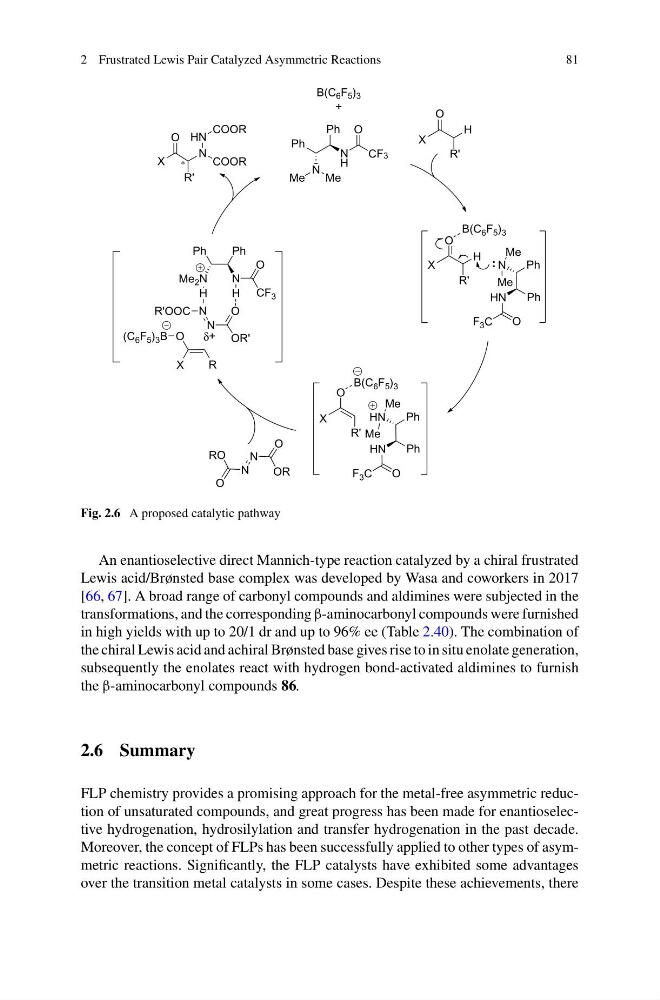
Fig. 2.6 A proposed catalytic pathway
An enantioselective direct Mannich-type reaction catalyzed by a chiral frustrated
Lewis acid/Brønsted base complex was developed by Wasa and coworkers in 2017
[66, 67]. A broad range of carbonyl compounds and aldimines were subjected in the
transformations, and the corresponding β-aminocarbonyl compounds were furnished
in high yields with up to 20/1 dr and up to 96% ee (Table 2.40). The combination of
the chiral Lewis acid and achiral Brønsted base gives rise to in situ enolate generation,
subsequently the enolates react with hydrogen bond-activated aldimines to furnish
the β-aminocarbonyl compounds 86.
2.6 Summary
FLP chemistry provides a promising approach for the metal-free asymmetric reduction of unsaturated compounds, and great progress has been made for enantioselective hydrogenation, hydrosilylation and transfer hydrogenation in the past decade.
Moreover, the concept of FLPs has been successfully applied to other types of asymmetric reactions. Significantly, the FLP catalysts have exhibited some advantages
over the transition metal catalysts in some cases. Despite these achievements, there
81
X
H
O
R'
+
N
N
OR
O
RO
O
X ∗
O
R'
HN
N
COOR
COOR
Ph
N
H
CF3
N
Me
Me
Ph O
B(C 6 F 5 ) 3
X
H
O
R'
B(C 6 F 5 ) 3
Ph
HN
F 3 C
N
Me
Me
Ph
O
O
X
R
(C 6 F 5 ) 3 B
Me 2 N
Ph
N
Ph
N
N
O
OR'
R'OOC
CF 3
O
H
H
X
O
R'
B(C 6 F 5 ) 3
Ph
HN
F 3 C
HN
Me
Me
Ph
O
δ+
Fig. 2.6 A proposed catalytic pathway
An enantioselective direct Mannich-type reaction catalyzed by a chiral frustrated
Lewis acid/Brønsted base complex was developed by Wasa and coworkers in 2017
[66, 67]. A broad range of carbonyl compounds and aldimines were subjected in the
transformations, and the corresponding β-aminocarbonyl compounds were furnished
in high yields with up to 20/1 dr and up to 96% ee (Table 2.40). The combination of
the chiral Lewis acid and achiral Brønsted base gives rise to in situ enolate generation,
subsequently the enolates react with hydrogen bond-activated aldimines to furnish
the β-aminocarbonyl compounds 86.
2.6 Summary
FLP chemistry provides a promising approach for the metal-free asymmetric reduction of unsaturated compounds, and great progress has been made for enantioselective hydrogenation, hydrosilylation and transfer hydrogenation in the past decade.
Moreover, the concept of FLPs has been successfully applied to other types of asymmetric reactions. Significantly, the FLP catalysts have exhibited some advantages
over the transition metal catalysts in some cases. Despite these achievements, there