

2 Frustrated Lewis Pair Catalyzed Asymmetric Reactions
59
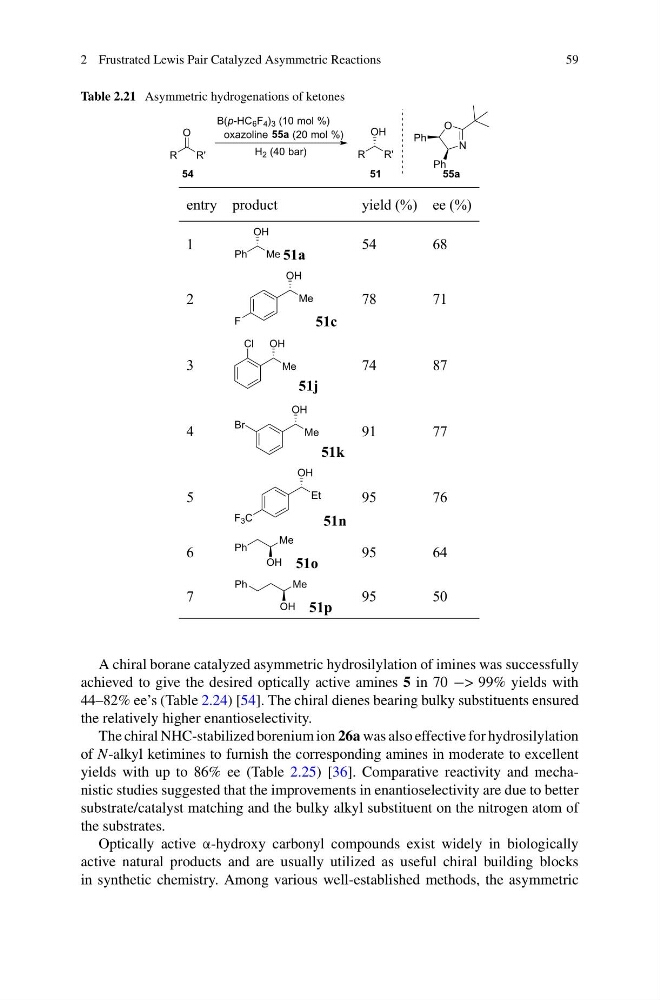
Table 2.21 Asymmetric hydrogenations of ketones
O
R
R'
OH
R
R'
B(p-HC 6 F 4 ) 3 (10 mol %)
oxazoline 55a (20 mol %)
H 2 (40 bar)
N
O
Ph
Ph
54
51
55a
entry product
yield (%) ee (%)
1
51a
Ph
Me
OH
54
68
2
51c
Me
OH
F
78
71
3
51j
Me
OH
Cl
74
87
4
51k
Me
OH
Br
91
77
5
51n
Et
OH
F 3 C
95
76
6
51o
Ph
Me
OH
95
64
7
51p
Me
OH
Ph
95
50
A chiral borane catalyzed asymmetric hydrosilylation of imines was successfully
achieved to give the desired optically active amines 5 in 70 −> 99% yields with
44–82% ee’s (Table 2.24) [54]. The chiral dienes bearing bulky substituents ensured
the relatively higher enantioselectivity.
The chiral NHC-stabilized borenium ion 26a was also effective for hydrosilylation
of N-alkyl ketimines to furnish the corresponding amines in moderate to excellent
yields with up to 86% ee (Table 2.25) [36]. Comparative reactivity and mechanistic studies suggested that the improvements in enantioselectivity are due to better
substrate/catalyst matching and the bulky alkyl substituent on the nitrogen atom of
the substrates.
Optically active α-hydroxy carbonyl compounds exist widely in biologically
active natural products and are usually utilized as useful chiral building blocks
in synthetic chemistry. Among various well-established methods, the asymmetric
59
Table 2.21 Asymmetric hydrogenations of ketones
O
R
R'
OH
R
R'
B(p-HC 6 F 4 ) 3 (10 mol %)
oxazoline 55a (20 mol %)
H 2 (40 bar)
N
O
Ph
Ph
54
51
55a
entry product
yield (%) ee (%)
1
51a
Ph
Me
OH
54
68
2
51c
Me
OH
F
78
71
3
51j
Me
OH
Cl
74
87
4
51k
Me
OH
Br
91
77
5
51n
Et
OH
F 3 C
95
76
6
51o
Ph
Me
OH
95
64
7
51p
Me
OH
Ph
95
50
A chiral borane catalyzed asymmetric hydrosilylation of imines was successfully
achieved to give the desired optically active amines 5 in 70 −> 99% yields with
44–82% ee’s (Table 2.24) [54]. The chiral dienes bearing bulky substituents ensured
the relatively higher enantioselectivity.
The chiral NHC-stabilized borenium ion 26a was also effective for hydrosilylation
of N-alkyl ketimines to furnish the corresponding amines in moderate to excellent
yields with up to 86% ee (Table 2.25) [36]. Comparative reactivity and mechanistic studies suggested that the improvements in enantioselectivity are due to better
substrate/catalyst matching and the bulky alkyl substituent on the nitrogen atom of
the substrates.
Optically active α-hydroxy carbonyl compounds exist widely in biologically
active natural products and are usually utilized as useful chiral building blocks
in synthetic chemistry. Among various well-established methods, the asymmetric