

2 Frustrated Lewis Pair Catalyzed Asymmetric Reactions
43
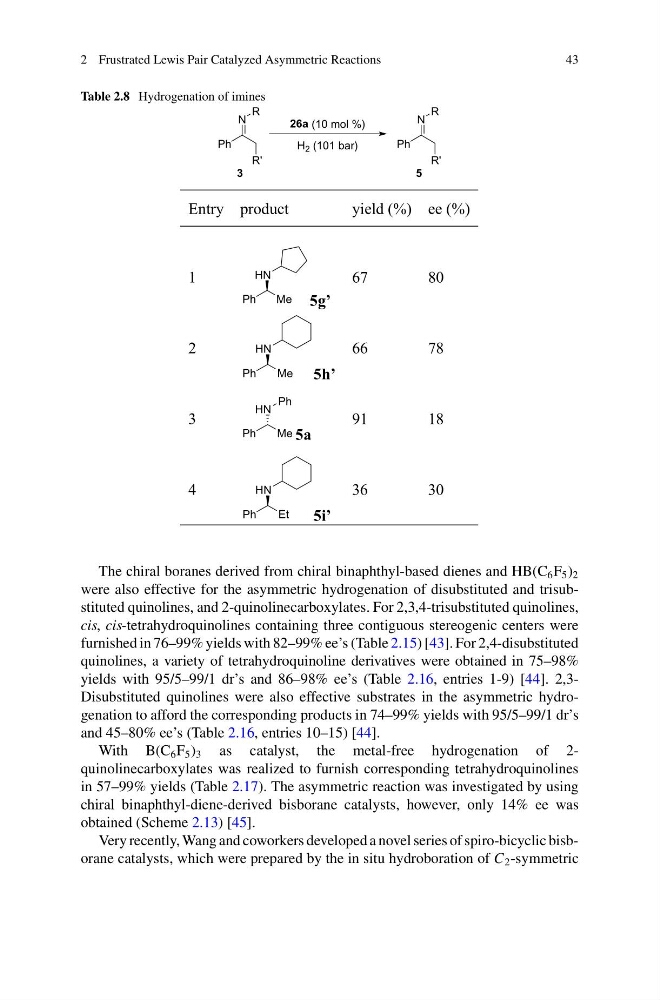
Table 2.8 Hydrogenation of imines
N
Ph
R'
R
N
Ph
R'
R
26a (10 mol %)
H 2 (101 bar)
3
5
Entry product
yield (%) ee (%)
1
5g’
Ph
Me
HN
67
80
2
5h’
Ph
Me
HN
66
78
3
5a
Ph
Me
HN
Ph
91
18
4
5i’
Ph
Et
HN
36
30
The chiral boranes derived from chiral binaphthyl-based dienes and HB(C 6 F 5 ) 2
were also effective for the asymmetric hydrogenation of disubstituted and trisubstituted quinolines, and 2-quinolinecarboxylates. For 2,3,4-trisubstituted quinolines,
cis, cis-tetrahydroquinolines containing three contiguous stereogenic centers were
furnished in 76–99% yields with 82–99% ee’s (Table 2.15) [43]. For 2,4-disubstituted
quinolines, a variety of tetrahydroquinoline derivatives were obtained in 75–98%
yields with 95/5–99/1 dr’s and 86–98% ee’s (Table 2.16, entries 1-9) [44]. 2,3Disubstituted quinolines were also effective substrates in the asymmetric hydrogenation to afford the corresponding products in 74–99% yields with 95/5–99/1 dr’s
and 45–80% ee’s (Table 2.16, entries 10–15) [44].
With B(C 6 F 5 ) 3 as catalyst, the metal-free hydrogenation of 2quinolinecarboxylates was realized to furnish corresponding tetrahydroquinolines
in 57–99% yields (Table 2.17). The asymmetric reaction was investigated by using
chiral binaphthyl-diene-derived bisborane catalysts, however, only 14% ee was
obtained (Scheme 2.13) [45].
Very recently, Wang and coworkers developed a novel series of spiro-bicyclic bisborane catalysts, which were prepared by the in situ hydroboration of C 2 -symmetric
43
Table 2.8 Hydrogenation of imines
N
Ph
R'
R
N
Ph
R'
R
26a (10 mol %)
H 2 (101 bar)
3
5
Entry product
yield (%) ee (%)
1
5g’
Ph
Me
HN
67
80
2
5h’
Ph
Me
HN
66
78
3
5a
Ph
Me
HN
Ph
91
18
4
5i’
Ph
Et
HN
36
30
The chiral boranes derived from chiral binaphthyl-based dienes and HB(C 6 F 5 ) 2
were also effective for the asymmetric hydrogenation of disubstituted and trisubstituted quinolines, and 2-quinolinecarboxylates. For 2,3,4-trisubstituted quinolines,
cis, cis-tetrahydroquinolines containing three contiguous stereogenic centers were
furnished in 76–99% yields with 82–99% ee’s (Table 2.15) [43]. For 2,4-disubstituted
quinolines, a variety of tetrahydroquinoline derivatives were obtained in 75–98%
yields with 95/5–99/1 dr’s and 86–98% ee’s (Table 2.16, entries 1-9) [44]. 2,3Disubstituted quinolines were also effective substrates in the asymmetric hydrogenation to afford the corresponding products in 74–99% yields with 95/5–99/1 dr’s
and 45–80% ee’s (Table 2.16, entries 10–15) [44].
With B(C 6 F 5 ) 3 as catalyst, the metal-free hydrogenation of 2quinolinecarboxylates was realized to furnish corresponding tetrahydroquinolines
in 57–99% yields (Table 2.17). The asymmetric reaction was investigated by using
chiral binaphthyl-diene-derived bisborane catalysts, however, only 14% ee was
obtained (Scheme 2.13) [45].
Very recently, Wang and coworkers developed a novel series of spiro-bicyclic bisborane catalysts, which were prepared by the in situ hydroboration of C 2 -symmetric