

10 Radicals in Frustrated Lewis Pair Chemistry
381
10 mol% B(C 6 F 5 ) 3
405 nm LED
N
R
O
+
N
R
O
EA A = 1.43 eV
N
R
O
+
EA A = 2.73 eV
B(C 6 F 5 ) 3
B(C 6 F 5 ) 3
h
N
R
O
+
B(C 6 F 5 ) 3
-B(C 6 F 5 ) 3
32
33
34
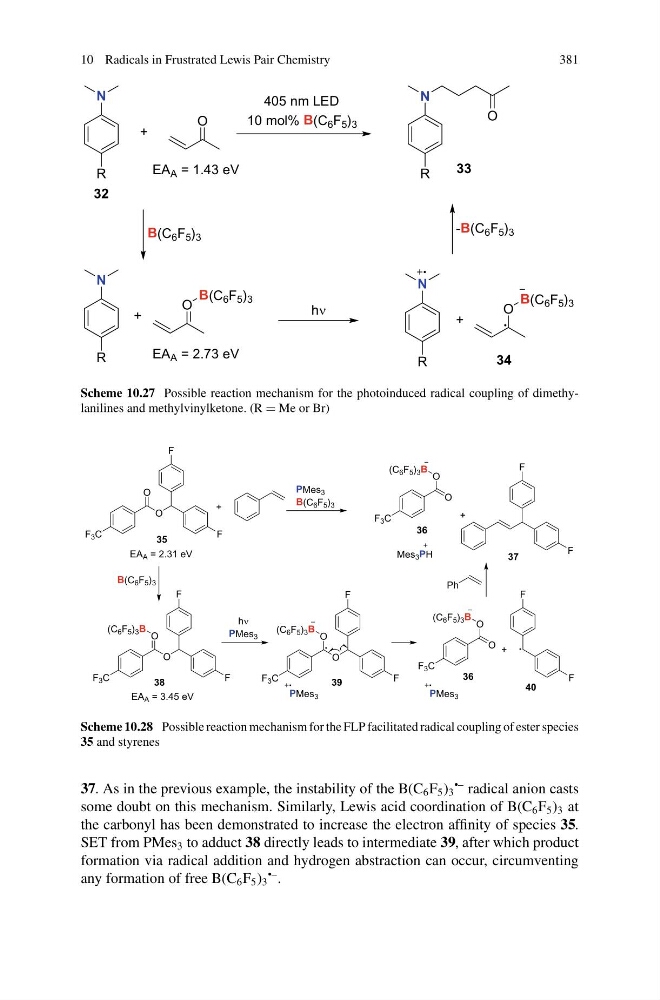
Scheme 10.27 Possible reaction mechanism for the photoinduced radical coupling of dimethylanilines and methylvinylketone. (R = Me or Br)
O
O
F
F
F 3 C
O
O
F
F
F 3 C
(C 6 F 5 ) 3 B
EA A = 3.45 eV
F
F
+
PMes 3
B(C 6 F 5 ) 3
+
35
O
O
F 3 C
(C 6 F 5 ) 3 B
EA A = 2.31 eV
B(C 6 F 5 ) 3
h
PMes 3
O
O
F
F
F 3 C
(C 6 F 5 ) 3 B
Mes 3 PH
PMes 3
F
F
O
O
F 3 C
(C 6 F 5 ) 3 B
PMes 3
+
Ph
38
39
36
40
37
36
Scheme 10.28 Possible reaction mechanism for the FLP facilitated radical coupling of ester species
35 and styrenes
37. As in the previous example, the instability of the B(C 6 F 5 ) 3
•– radical anion casts
some doubt on this mechanism. Similarly, Lewis acid coordination of B(C 6 F 5 ) 3 at
the carbonyl has been demonstrated to increase the electron affinity of species 35.
SET from PMes 3 to adduct 38 directly leads to intermediate 39, after which product
formation via radical addition and hydrogen abstraction can occur, circumventing
any formation of free B(C 6 F 5 ) 3
•– .
381
10 mol% B(C 6 F 5 ) 3
405 nm LED
N
R
O
+
N
R
O
EA A = 1.43 eV
N
R
O
+
EA A = 2.73 eV
B(C 6 F 5 ) 3
B(C 6 F 5 ) 3
h
N
R
O
+
B(C 6 F 5 ) 3
-B(C 6 F 5 ) 3
32
33
34
Scheme 10.27 Possible reaction mechanism for the photoinduced radical coupling of dimethylanilines and methylvinylketone. (R = Me or Br)
O
O
F
F
F 3 C
O
O
F
F
F 3 C
(C 6 F 5 ) 3 B
EA A = 3.45 eV
F
F
+
PMes 3
B(C 6 F 5 ) 3
+
35
O
O
F 3 C
(C 6 F 5 ) 3 B
EA A = 2.31 eV
B(C 6 F 5 ) 3
h
PMes 3
O
O
F
F
F 3 C
(C 6 F 5 ) 3 B
Mes 3 PH
PMes 3
F
F
O
O
F 3 C
(C 6 F 5 ) 3 B
PMes 3
+
Ph
38
39
36
40
37
36
Scheme 10.28 Possible reaction mechanism for the FLP facilitated radical coupling of ester species
35 and styrenes
37. As in the previous example, the instability of the B(C 6 F 5 ) 3
•– radical anion casts
some doubt on this mechanism. Similarly, Lewis acid coordination of B(C 6 F 5 ) 3 at
the carbonyl has been demonstrated to increase the electron affinity of species 35.
SET from PMes 3 to adduct 38 directly leads to intermediate 39, after which product
formation via radical addition and hydrogen abstraction can occur, circumventing
any formation of free B(C 6 F 5 ) 3
•– .