

370
F. Holtrop et al.
The reaction using Cp* 2 Fe/Al(C 6 F 5 ) 3 and S 8 was not described.
Stephan et al. also investigated the reactivity of such systems with other group 16
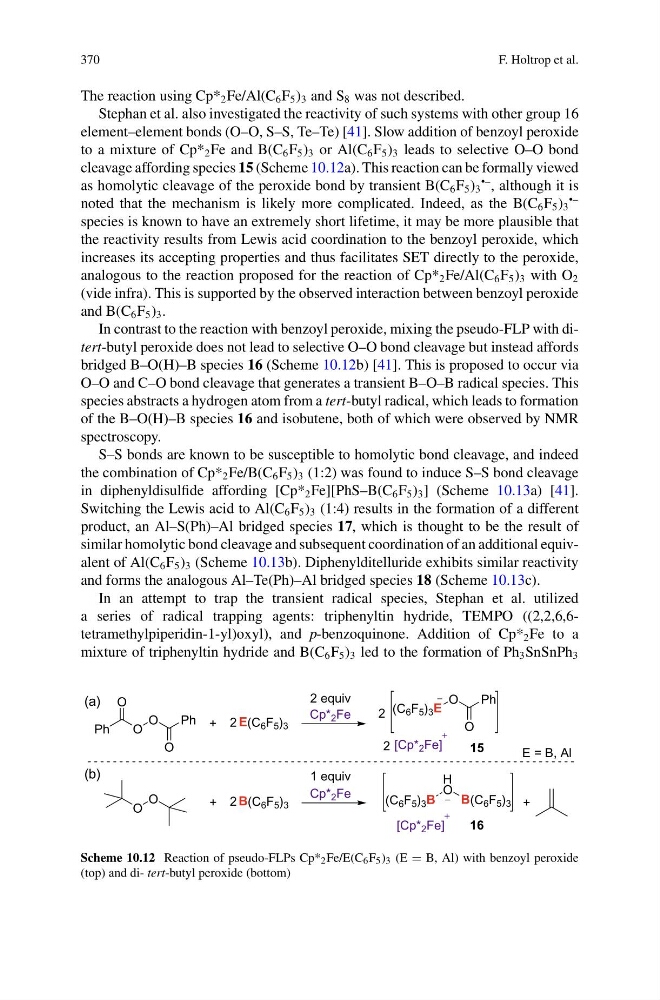
element–element bonds (O–O, S–S, Te–Te) [41]. Slow addition of benzoyl peroxide
to a mixture of Cp* 2 Fe and B(C 6 F 5 ) 3 or Al(C 6 F 5 ) 3 leads to selective O–O bond
cleavage affording species 15 (Scheme 10.12a). This reaction can be formally viewed
as homolytic cleavage of the peroxide bond by transient B(C 6 F 5 ) 3
•– , although it is
noted that the mechanism is likely more complicated. Indeed, as the B(C 6 F 5 ) 3
•–
species is known to have an extremely short lifetime, it may be more plausible that
the reactivity results from Lewis acid coordination to the benzoyl peroxide, which
increases its accepting properties and thus facilitates SET directly to the peroxide,
analogous to the reaction proposed for the reaction of Cp* 2 Fe/Al(C 6 F 5 ) 3 with O 2
(vide infra). This is supported by the observed interaction between benzoyl peroxide
and B(C 6 F 5 ) 3 .
In contrast to the reaction with benzoyl peroxide, mixing the pseudo-FLP with ditert-butyl peroxide does not lead to selective O–O bond cleavage but instead affords
bridged B–O(H)–B species 16 (Scheme 10.12b) [41]. This is proposed to occur via
O–O and C–O bond cleavage that generates a transient B–O–B radical species. This
species abstracts a hydrogen atom from a tert-butyl radical, which leads to formation
of the B–O(H)–B species 16 and isobutene, both of which were observed by NMR
spectroscopy.
S–S bonds are known to be susceptible to homolytic bond cleavage, and indeed
the combination of Cp* 2 Fe/B(C 6 F 5 ) 3 (1:2) was found to induce S–S bond cleavage
in diphenyldisulfide affording [Cp* 2 Fe][PhS–B(C 6 F 5 ) 3 ] (Scheme 10.13a) [41].
Switching the Lewis acid to Al(C 6 F 5 ) 3 (1:4) results in the formation of a different
product, an Al–S(Ph)–Al bridged species 17, which is thought to be the result of
similar homolytic bond cleavage and subsequent coordination of an additional equivalent of Al(C 6 F 5 ) 3 (Scheme 10.13b). Diphenylditelluride exhibits similar reactivity
and forms the analogous Al–Te(Ph)–Al bridged species 18 (Scheme 10.13c).
In an attempt to trap the transient radical species, Stephan et al. utilized
a series of radical trapping agents: triphenyltin hydride, TEMPO ((2,2,6,6tetramethylpiperidin-1-yl)oxyl), and p-benzoquinone. Addition of Cp* 2 Fe to a
mixture of triphenyltin hydride and B(C 6 F 5 ) 3 led to the formation of Ph 3 SnSnPh 3
O
O
O
O
Ph
Ph
E(C 6 F 5 ) 3
Cp* 2 Fe
+
(C 6 F 5 ) 3 E
O
O
Ph
[Cp* 2 Fe]
O
O
B(C 6 F 5 ) 3
Cp* 2 Fe
+
(C 6 F 5 ) 3 B
H
O
B(C 6 F 5 ) 3
[Cp* 2 Fe]
E = B, Al
(a)
(b)
2
2
2
2
2 equiv
1 equiv
16
+
15
Scheme 10.12 Reaction of pseudo-FLPs Cp* 2 Fe/E(C 6 F 5 ) 3 (E = B, Al) with benzoyl peroxide
(top) and di- tert-butyl peroxide (bottom)
F. Holtrop et al.
The reaction using Cp* 2 Fe/Al(C 6 F 5 ) 3 and S 8 was not described.
Stephan et al. also investigated the reactivity of such systems with other group 16
element–element bonds (O–O, S–S, Te–Te) [41]. Slow addition of benzoyl peroxide
to a mixture of Cp* 2 Fe and B(C 6 F 5 ) 3 or Al(C 6 F 5 ) 3 leads to selective O–O bond
cleavage affording species 15 (Scheme 10.12a). This reaction can be formally viewed
as homolytic cleavage of the peroxide bond by transient B(C 6 F 5 ) 3
•– , although it is
noted that the mechanism is likely more complicated. Indeed, as the B(C 6 F 5 ) 3
•–
species is known to have an extremely short lifetime, it may be more plausible that
the reactivity results from Lewis acid coordination to the benzoyl peroxide, which
increases its accepting properties and thus facilitates SET directly to the peroxide,
analogous to the reaction proposed for the reaction of Cp* 2 Fe/Al(C 6 F 5 ) 3 with O 2
(vide infra). This is supported by the observed interaction between benzoyl peroxide
and B(C 6 F 5 ) 3 .
In contrast to the reaction with benzoyl peroxide, mixing the pseudo-FLP with ditert-butyl peroxide does not lead to selective O–O bond cleavage but instead affords
bridged B–O(H)–B species 16 (Scheme 10.12b) [41]. This is proposed to occur via
O–O and C–O bond cleavage that generates a transient B–O–B radical species. This
species abstracts a hydrogen atom from a tert-butyl radical, which leads to formation
of the B–O(H)–B species 16 and isobutene, both of which were observed by NMR
spectroscopy.
S–S bonds are known to be susceptible to homolytic bond cleavage, and indeed
the combination of Cp* 2 Fe/B(C 6 F 5 ) 3 (1:2) was found to induce S–S bond cleavage
in diphenyldisulfide affording [Cp* 2 Fe][PhS–B(C 6 F 5 ) 3 ] (Scheme 10.13a) [41].
Switching the Lewis acid to Al(C 6 F 5 ) 3 (1:4) results in the formation of a different
product, an Al–S(Ph)–Al bridged species 17, which is thought to be the result of
similar homolytic bond cleavage and subsequent coordination of an additional equivalent of Al(C 6 F 5 ) 3 (Scheme 10.13b). Diphenylditelluride exhibits similar reactivity
and forms the analogous Al–Te(Ph)–Al bridged species 18 (Scheme 10.13c).
In an attempt to trap the transient radical species, Stephan et al. utilized
a series of radical trapping agents: triphenyltin hydride, TEMPO ((2,2,6,6tetramethylpiperidin-1-yl)oxyl), and p-benzoquinone. Addition of Cp* 2 Fe to a
mixture of triphenyltin hydride and B(C 6 F 5 ) 3 led to the formation of Ph 3 SnSnPh 3
O
O
O
O
Ph
Ph
E(C 6 F 5 ) 3
Cp* 2 Fe
+
(C 6 F 5 ) 3 E
O
O
Ph
[Cp* 2 Fe]
O
O
B(C 6 F 5 ) 3
Cp* 2 Fe
+
(C 6 F 5 ) 3 B
H
O
B(C 6 F 5 ) 3
[Cp* 2 Fe]
E = B, Al
(a)
(b)
2
2
2
2
2 equiv
1 equiv
16
+
15
Scheme 10.12 Reaction of pseudo-FLPs Cp* 2 Fe/E(C 6 F 5 ) 3 (E = B, Al) with benzoyl peroxide
(top) and di- tert-butyl peroxide (bottom)