

8 Lewis Acid−Base Pairs for Polymerization Catalysis …
291
N
N
R 2
R 1
NHO-5: R 1 = Ph, R 2 = Ph, R 3 = Me
NHO-6: R 1 = Ph, R 2 = Me, R 3 = Me
NHO-7: R 1 = H, R 2 = Me, R 3 = Me
R 3
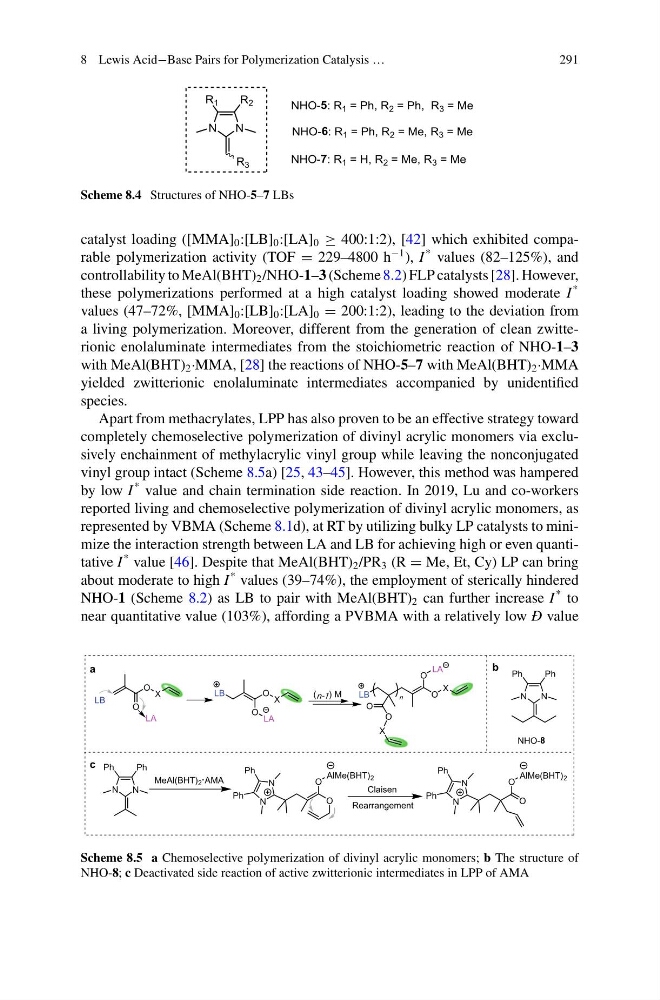
Scheme 8.4 Structures of NHO-5–7 LBs
catalyst loading ([MMA] 0 :[LB] 0 :[LA] 0 ≥ 400:1:2), [42] which exhibited comparable polymerization activity (TOF = 229–4800 h
−1 ), I
* values (82–125%), and
controllability to MeAl(BHT) 2 /NHO-1–3 (Scheme 8.2) FLP catalysts [28]. However,
these polymerizations performed at a high catalyst loading showed moderate I
*
values (47–72%, [MMA] 0 :[LB] 0 :[LA] 0 = 200:1:2), leading to the deviation from
a living polymerization. Moreover, different from the generation of clean zwitterionic enolaluminate intermediates from the stoichiometric reaction of NHO-1–3
with MeAl(BHT) 2 ·MMA, [28] the reactions of NHO-5–7 with MeAl(BHT) 2 ·MMA
yielded zwitterionic enolaluminate intermediates accompanied by unidentified
species.
Apart from methacrylates, LPP has also proven to be an effective strategy toward
completely chemoselective polymerization of divinyl acrylic monomers via exclusively enchainment of methylacrylic vinyl group while leaving the nonconjugated
vinyl group intact (Scheme 8.5a) [25, 43–45]. However, this method was hampered
by low I
* value and chain termination side reaction. In 2019, Lu and co-workers
reported living and chemoselective polymerization of divinyl acrylic monomers, as
represented by VBMA (Scheme 8.1d), at RT by utilizing bulky LP catalysts to minimize the interaction strength between LA and LB for achieving high or even quantitative I
* value [46]. Despite that MeAl(BHT) 2 /PR 3 (R = Me, Et, Cy) LP can bring
about moderate to high I
* values (39–74%), the employment of sterically hindered
NHO-1 (Scheme 8.2) as LB to pair with MeAl(BHT) 2 can further increase I
* to
near quantitative value (103%), affording a PVBMA with a relatively low Ð value
N
N
Ph
Ph
LB
O
O
X
LA
O
O
X
LA
LB
(n-1) M
LB
O
O
O
O
LA
n
X
X
NHO-8
N
N
Ph
Ph
MeAl(BHT) 2 ·AMA
N
N
Ph
Ph
O
O
AlMe(BHT) 2
N
N
Ph
Ph
O
O
AlMe(BHT) 2
Claisen
Rearrangement
a
b
c
Scheme 8.5 a Chemoselective polymerization of divinyl acrylic monomers; b The structure of
NHO-8; c Deactivated side reaction of active zwitterionic intermediates in LPP of AMA
291
N
N
R 2
R 1
NHO-5: R 1 = Ph, R 2 = Ph, R 3 = Me
NHO-6: R 1 = Ph, R 2 = Me, R 3 = Me
NHO-7: R 1 = H, R 2 = Me, R 3 = Me
R 3
Scheme 8.4 Structures of NHO-5–7 LBs
catalyst loading ([MMA] 0 :[LB] 0 :[LA] 0 ≥ 400:1:2), [42] which exhibited comparable polymerization activity (TOF = 229–4800 h
−1 ), I
* values (82–125%), and
controllability to MeAl(BHT) 2 /NHO-1–3 (Scheme 8.2) FLP catalysts [28]. However,
these polymerizations performed at a high catalyst loading showed moderate I
*
values (47–72%, [MMA] 0 :[LB] 0 :[LA] 0 = 200:1:2), leading to the deviation from
a living polymerization. Moreover, different from the generation of clean zwitterionic enolaluminate intermediates from the stoichiometric reaction of NHO-1–3
with MeAl(BHT) 2 ·MMA, [28] the reactions of NHO-5–7 with MeAl(BHT) 2 ·MMA
yielded zwitterionic enolaluminate intermediates accompanied by unidentified
species.
Apart from methacrylates, LPP has also proven to be an effective strategy toward
completely chemoselective polymerization of divinyl acrylic monomers via exclusively enchainment of methylacrylic vinyl group while leaving the nonconjugated
vinyl group intact (Scheme 8.5a) [25, 43–45]. However, this method was hampered
by low I
* value and chain termination side reaction. In 2019, Lu and co-workers
reported living and chemoselective polymerization of divinyl acrylic monomers, as
represented by VBMA (Scheme 8.1d), at RT by utilizing bulky LP catalysts to minimize the interaction strength between LA and LB for achieving high or even quantitative I
* value [46]. Despite that MeAl(BHT) 2 /PR 3 (R = Me, Et, Cy) LP can bring
about moderate to high I
* values (39–74%), the employment of sterically hindered
NHO-1 (Scheme 8.2) as LB to pair with MeAl(BHT) 2 can further increase I
* to
near quantitative value (103%), affording a PVBMA with a relatively low Ð value
N
N
Ph
Ph
LB
O
O
X
LA
O
O
X
LA
LB
(n-1) M
LB
O
O
O
O
LA
n
X
X
NHO-8
N
N
Ph
Ph
MeAl(BHT) 2 ·AMA
N
N
Ph
Ph
O
O
AlMe(BHT) 2
N
N
Ph
Ph
O
O
AlMe(BHT) 2
Claisen
Rearrangement
a
b
c
Scheme 8.5 a Chemoselective polymerization of divinyl acrylic monomers; b The structure of
NHO-8; c Deactivated side reaction of active zwitterionic intermediates in LPP of AMA