

288
M. Hong
is organized into two main sections. The first section focuses on LPP of polar
vinyl monomers, including petroleum-based monomers and novel biomass-derived
monomers developed recently, while the second section covers the progress in LPmediated RO(C)P of cyclic esters, epoxides, and cyclic anhydrides. The attempt
to provide a perspective for the future developments of this exciting area is also
presented.
8.2 Lewis Pair Polymerization of Polar Vinyl Monomers
8.2.1 Petroleum-Based Polar Vinyl Monomers
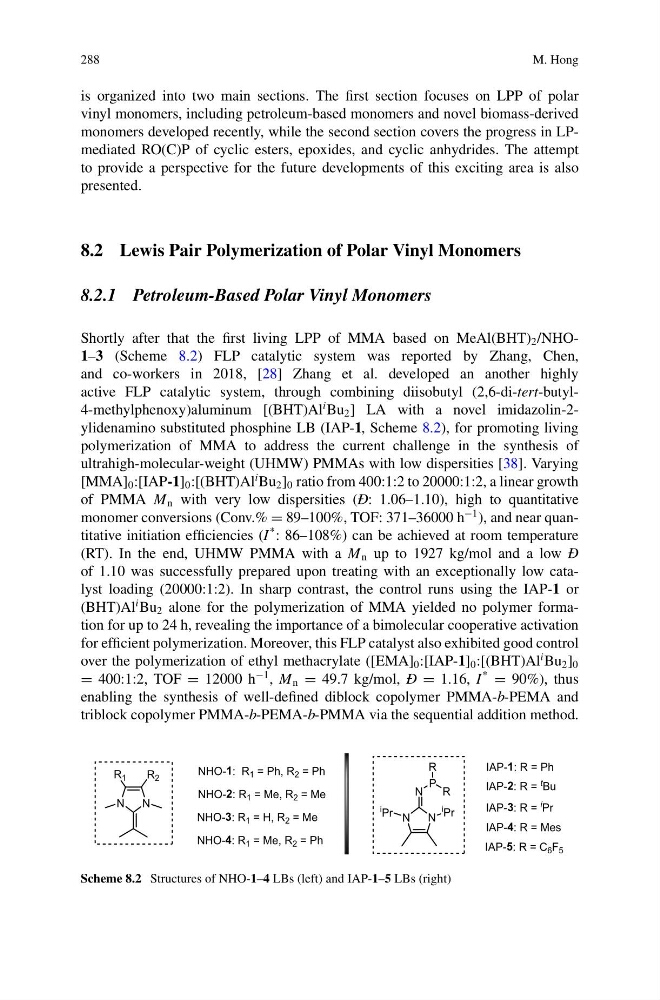
Shortly after that the first living LPP of MMA based on MeAl(BHT) 2 /NHO1–3 (Scheme 8.2) FLP catalytic system was reported by Zhang, Chen,
and co-workers in 2018, [28] Zhang et al. developed an another highly
active FLP catalytic system, through combining diisobutyl (2,6-di-tert-butyl4-methylphenoxy)aluminum [(BHT)Al
i Bu 2 ] LA with a novel imidazolin-2ylidenamino substituted phosphine LB (IAP-1, Scheme 8.2), for promoting living
polymerization of MMA to address the current challenge in the synthesis of
ultrahigh-molecular-weight (UHMW) PMMAs with low dispersities [38]. Varying
[MMA] 0 :[IAP-1] 0 :[(BHT)Al
i Bu 2 ] 0 ratio from 400:1:2 to 20000:1:2, a linear growth
of PMMA M n with very low dispersities (Ð: 1.06–1.10), high to quantitative
monomer conversions (Conv.% = 89–100%, TOF: 371–36000 h
−1 ), and near quantitative initiation efficiencies (I
* : 86–108%) can be achieved at room temperature
(RT). In the end, UHMW PMMA with a M n up to 1927 kg/mol and a low Ð
of 1.10 was successfully prepared upon treating with an exceptionally low catalyst loading (20000:1:2). In sharp contrast, the control runs using the IAP-1 or
(BHT)Al
i Bu 2 alone for the polymerization of MMA yielded no polymer formation for up to 24 h, revealing the importance of a bimolecular cooperative activation
for efficient polymerization. Moreover, this FLP catalyst also exhibited good control
over the polymerization of ethyl methacrylate ([EMA] 0 :[IAP-1] 0 :[(BHT)Al
i Bu 2 ] 0
= 400:1:2, TOF = 12000 h
−1 , M n = 49.7 kg/mol, Ð = 1.16, I
*
= 90%), thus
enabling the synthesis of well-defined diblock copolymer PMMA-b-PEMA and
triblock copolymer PMMA-b-PEMA-b-PMMA via the sequential addition method.
N
N
N
P
R
R
i
Pr
i Pr
IAP-1: R = Ph
IAP-2: R =
t Bu
IAP-3: R =
i
Pr
IAP-4: R = Mes
IAP-5: R = C 6 F 5
N
N
R 2
R 1
NHO-1: R 1 = Ph, R 2 = Ph
NHO-2: R 1 = Me, R 2 = Me
NHO-4: R 1 = Me, R 2 = Ph
NHO-3: R 1 = H, R 2 = Me
Scheme 8.2 Structures of NHO-1–4 LBs (left) and IAP-1–5 LBs (right)
M. Hong
is organized into two main sections. The first section focuses on LPP of polar
vinyl monomers, including petroleum-based monomers and novel biomass-derived
monomers developed recently, while the second section covers the progress in LPmediated RO(C)P of cyclic esters, epoxides, and cyclic anhydrides. The attempt
to provide a perspective for the future developments of this exciting area is also
presented.
8.2 Lewis Pair Polymerization of Polar Vinyl Monomers
8.2.1 Petroleum-Based Polar Vinyl Monomers
Shortly after that the first living LPP of MMA based on MeAl(BHT) 2 /NHO1–3 (Scheme 8.2) FLP catalytic system was reported by Zhang, Chen,
and co-workers in 2018, [28] Zhang et al. developed an another highly
active FLP catalytic system, through combining diisobutyl (2,6-di-tert-butyl4-methylphenoxy)aluminum [(BHT)Al
i Bu 2 ] LA with a novel imidazolin-2ylidenamino substituted phosphine LB (IAP-1, Scheme 8.2), for promoting living
polymerization of MMA to address the current challenge in the synthesis of
ultrahigh-molecular-weight (UHMW) PMMAs with low dispersities [38]. Varying
[MMA] 0 :[IAP-1] 0 :[(BHT)Al
i Bu 2 ] 0 ratio from 400:1:2 to 20000:1:2, a linear growth
of PMMA M n with very low dispersities (Ð: 1.06–1.10), high to quantitative
monomer conversions (Conv.% = 89–100%, TOF: 371–36000 h
−1 ), and near quantitative initiation efficiencies (I
* : 86–108%) can be achieved at room temperature
(RT). In the end, UHMW PMMA with a M n up to 1927 kg/mol and a low Ð
of 1.10 was successfully prepared upon treating with an exceptionally low catalyst loading (20000:1:2). In sharp contrast, the control runs using the IAP-1 or
(BHT)Al
i Bu 2 alone for the polymerization of MMA yielded no polymer formation for up to 24 h, revealing the importance of a bimolecular cooperative activation
for efficient polymerization. Moreover, this FLP catalyst also exhibited good control
over the polymerization of ethyl methacrylate ([EMA] 0 :[IAP-1] 0 :[(BHT)Al
i Bu 2 ] 0
= 400:1:2, TOF = 12000 h
−1 , M n = 49.7 kg/mol, Ð = 1.16, I
*
= 90%), thus
enabling the synthesis of well-defined diblock copolymer PMMA-b-PEMA and
triblock copolymer PMMA-b-PEMA-b-PMMA via the sequential addition method.
N
N
N
P
R
R
i
Pr
i Pr
IAP-1: R = Ph
IAP-2: R =
t Bu
IAP-3: R =
i
Pr
IAP-4: R = Mes
IAP-5: R = C 6 F 5
N
N
R 2
R 1
NHO-1: R 1 = Ph, R 2 = Ph
NHO-2: R 1 = Me, R 2 = Me
NHO-4: R 1 = Me, R 2 = Ph
NHO-3: R 1 = H, R 2 = Me
Scheme 8.2 Structures of NHO-1–4 LBs (left) and IAP-1–5 LBs (right)