

258
A. R. Jupp
a)
b)
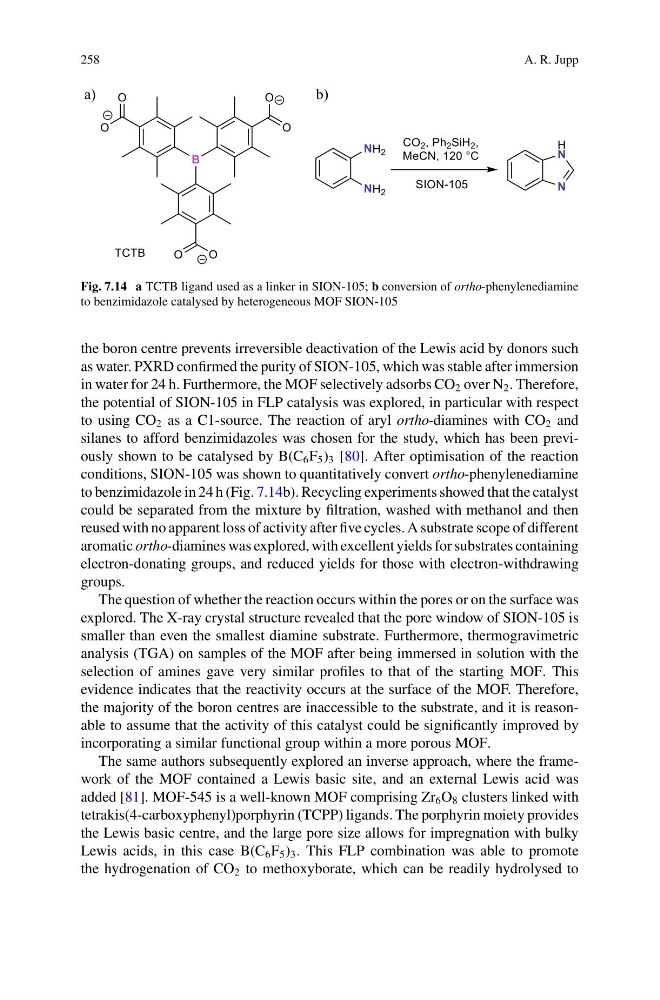
Fig. 7.14 a TCTB ligand used as a linker in SION-105; b conversion of ortho-phenylenediamine
to benzimidazole catalysed by heterogeneous MOF SION-105
the boron centre prevents irreversible deactivation of the Lewis acid by donors such
as water. PXRD confirmed the purity of SION-105, which was stable after immersion
in water for 24 h. Furthermore, the MOF selectively adsorbs CO 2 over N 2 . Therefore,
the potential of SION-105 in FLP catalysis was explored, in particular with respect
to using CO 2 as a C1-source. The reaction of aryl ortho-diamines with CO 2 and
silanes to afford benzimidazoles was chosen for the study, which has been previously shown to be catalysed by B(C 6 F 5 ) 3 [80]. After optimisation of the reaction
conditions, SION-105 was shown to quantitatively convert ortho-phenylenediamine
to benzimidazole in 24 h (Fig. 7.14b). Recycling experiments showed that the catalyst
could be separated from the mixture by filtration, washed with methanol and then
reused with no apparent loss of activity after five cycles. A substrate scope of different
aromatic ortho-diamines was explored, with excellent yields for substrates containing
electron-donating groups, and reduced yields for those with electron-withdrawing
groups.
The question of whether the reaction occurs within the pores or on the surface was
explored. The X-ray crystal structure revealed that the pore window of SION-105 is
smaller than even the smallest diamine substrate. Furthermore, thermogravimetric
analysis (TGA) on samples of the MOF after being immersed in solution with the
selection of amines gave very similar profiles to that of the starting MOF. This
evidence indicates that the reactivity occurs at the surface of the MOF. Therefore,
the majority of the boron centres are inaccessible to the substrate, and it is reasonable to assume that the activity of this catalyst could be significantly improved by
incorporating a similar functional group within a more porous MOF.
The same authors subsequently explored an inverse approach, where the framework of the MOF contained a Lewis basic site, and an external Lewis acid was
added [81]. MOF-545 is a well-known MOF comprising Zr 6 O 8 clusters linked with
tetrakis(4-carboxyphenyl)porphyrin (TCPP) ligands. The porphyrin moiety provides
the Lewis basic centre, and the large pore size allows for impregnation with bulky
Lewis acids, in this case B(C 6 F 5 ) 3 . This FLP combination was able to promote
the hydrogenation of CO 2 to methoxyborate, which can be readily hydrolysed to
A. R. Jupp
a)
b)
Fig. 7.14 a TCTB ligand used as a linker in SION-105; b conversion of ortho-phenylenediamine
to benzimidazole catalysed by heterogeneous MOF SION-105
the boron centre prevents irreversible deactivation of the Lewis acid by donors such
as water. PXRD confirmed the purity of SION-105, which was stable after immersion
in water for 24 h. Furthermore, the MOF selectively adsorbs CO 2 over N 2 . Therefore,
the potential of SION-105 in FLP catalysis was explored, in particular with respect
to using CO 2 as a C1-source. The reaction of aryl ortho-diamines with CO 2 and
silanes to afford benzimidazoles was chosen for the study, which has been previously shown to be catalysed by B(C 6 F 5 ) 3 [80]. After optimisation of the reaction
conditions, SION-105 was shown to quantitatively convert ortho-phenylenediamine
to benzimidazole in 24 h (Fig. 7.14b). Recycling experiments showed that the catalyst
could be separated from the mixture by filtration, washed with methanol and then
reused with no apparent loss of activity after five cycles. A substrate scope of different
aromatic ortho-diamines was explored, with excellent yields for substrates containing
electron-donating groups, and reduced yields for those with electron-withdrawing
groups.
The question of whether the reaction occurs within the pores or on the surface was
explored. The X-ray crystal structure revealed that the pore window of SION-105 is
smaller than even the smallest diamine substrate. Furthermore, thermogravimetric
analysis (TGA) on samples of the MOF after being immersed in solution with the
selection of amines gave very similar profiles to that of the starting MOF. This
evidence indicates that the reactivity occurs at the surface of the MOF. Therefore,
the majority of the boron centres are inaccessible to the substrate, and it is reasonable to assume that the activity of this catalyst could be significantly improved by
incorporating a similar functional group within a more porous MOF.
The same authors subsequently explored an inverse approach, where the framework of the MOF contained a Lewis basic site, and an external Lewis acid was
added [81]. MOF-545 is a well-known MOF comprising Zr 6 O 8 clusters linked with
tetrakis(4-carboxyphenyl)porphyrin (TCPP) ligands. The porphyrin moiety provides
the Lewis basic centre, and the large pore size allows for impregnation with bulky
Lewis acids, in this case B(C 6 F 5 ) 3 . This FLP combination was able to promote
the hydrogenation of CO 2 to methoxyborate, which can be readily hydrolysed to