

256
A. R. Jupp
realised, it would reflect a significantly more sustainable approach than the established industrial process, which relies on the partial oxidation or dehydrogenation
of methanol derived from Fischer-Tropsch processes. The authors propose that the
formaldehyde can be continuously and readily desorbed from the MOF and collected
via condensation, due to the difference in boiling points between the product and
the gaseous reactants. The unreacted starting materials can then be recycled back
over the heterogeneous catalyst, leading to high overall conversions for the reaction.
This study shows the versatility of the functionalised MOFs, as the same system can
theoretically catalyse a number of different reactions.
All of the previously discussed examples of incorporating Lewis acids and bases in
the pores of MOFs were studied in silico. The first group to experimentally realise this
concept in a laboratory setting was that of Ma [75, 76]. They used the common MOF
MIL-101(Cr), which features trimeric Cr
III clusters bridged by BDC linkers, and
was chosen based on its stability, large pore size and abundance of open metal sites.
Whereas Johnson et al. targeted (computationally) the covalent functionalisation of
the bridging ligands, Ma et al. simply used the MOF as a support by impregnating
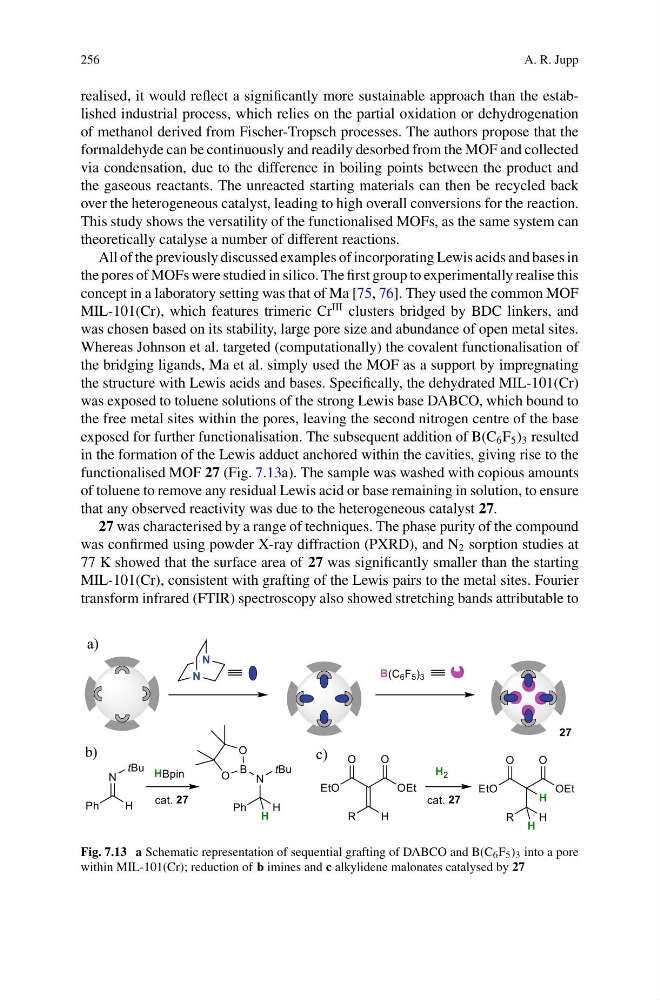
the structure with Lewis acids and bases. Specifically, the dehydrated MIL-101(Cr)
was exposed to toluene solutions of the strong Lewis base DABCO, which bound to
the free metal sites within the pores, leaving the second nitrogen centre of the base
exposed for further functionalisation. The subsequent addition of B(C 6 F 5 ) 3 resulted
in the formation of the Lewis adduct anchored within the cavities, giving rise to the
functionalised MOF 27 (Fig. 7.13a). The sample was washed with copious amounts
of toluene to remove any residual Lewis acid or base remaining in solution, to ensure
that any observed reactivity was due to the heterogeneous catalyst 27.
27 was characterised by a range of techniques. The phase purity of the compound
was confirmed using powder X-ray diffraction (PXRD), and N 2 sorption studies at
77 K showed that the surface area of 27 was significantly smaller than the starting
MIL-101(Cr), consistent with grafting of the Lewis pairs to the metal sites. Fourier
transform infrared (FTIR) spectroscopy also showed stretching bands attributable to
a)
b)
c)
Fig. 7.13 a Schematic representation of sequential grafting of DABCO and B(C 6 F 5 ) 3 into a pore
within MIL-101(Cr); reduction of b imines and c alkylidene malonates catalysed by 27
A. R. Jupp
realised, it would reflect a significantly more sustainable approach than the established industrial process, which relies on the partial oxidation or dehydrogenation
of methanol derived from Fischer-Tropsch processes. The authors propose that the
formaldehyde can be continuously and readily desorbed from the MOF and collected
via condensation, due to the difference in boiling points between the product and
the gaseous reactants. The unreacted starting materials can then be recycled back
over the heterogeneous catalyst, leading to high overall conversions for the reaction.
This study shows the versatility of the functionalised MOFs, as the same system can
theoretically catalyse a number of different reactions.
All of the previously discussed examples of incorporating Lewis acids and bases in
the pores of MOFs were studied in silico. The first group to experimentally realise this
concept in a laboratory setting was that of Ma [75, 76]. They used the common MOF
MIL-101(Cr), which features trimeric Cr
III clusters bridged by BDC linkers, and
was chosen based on its stability, large pore size and abundance of open metal sites.
Whereas Johnson et al. targeted (computationally) the covalent functionalisation of
the bridging ligands, Ma et al. simply used the MOF as a support by impregnating
the structure with Lewis acids and bases. Specifically, the dehydrated MIL-101(Cr)
was exposed to toluene solutions of the strong Lewis base DABCO, which bound to
the free metal sites within the pores, leaving the second nitrogen centre of the base
exposed for further functionalisation. The subsequent addition of B(C 6 F 5 ) 3 resulted
in the formation of the Lewis adduct anchored within the cavities, giving rise to the
functionalised MOF 27 (Fig. 7.13a). The sample was washed with copious amounts
of toluene to remove any residual Lewis acid or base remaining in solution, to ensure
that any observed reactivity was due to the heterogeneous catalyst 27.
27 was characterised by a range of techniques. The phase purity of the compound
was confirmed using powder X-ray diffraction (PXRD), and N 2 sorption studies at
77 K showed that the surface area of 27 was significantly smaller than the starting
MIL-101(Cr), consistent with grafting of the Lewis pairs to the metal sites. Fourier
transform infrared (FTIR) spectroscopy also showed stretching bands attributable to
a)
b)
c)
Fig. 7.13 a Schematic representation of sequential grafting of DABCO and B(C 6 F 5 ) 3 into a pore
within MIL-101(Cr); reduction of b imines and c alkylidene malonates catalysed by 27