

254
A. R. Jupp
a)
b)
c)
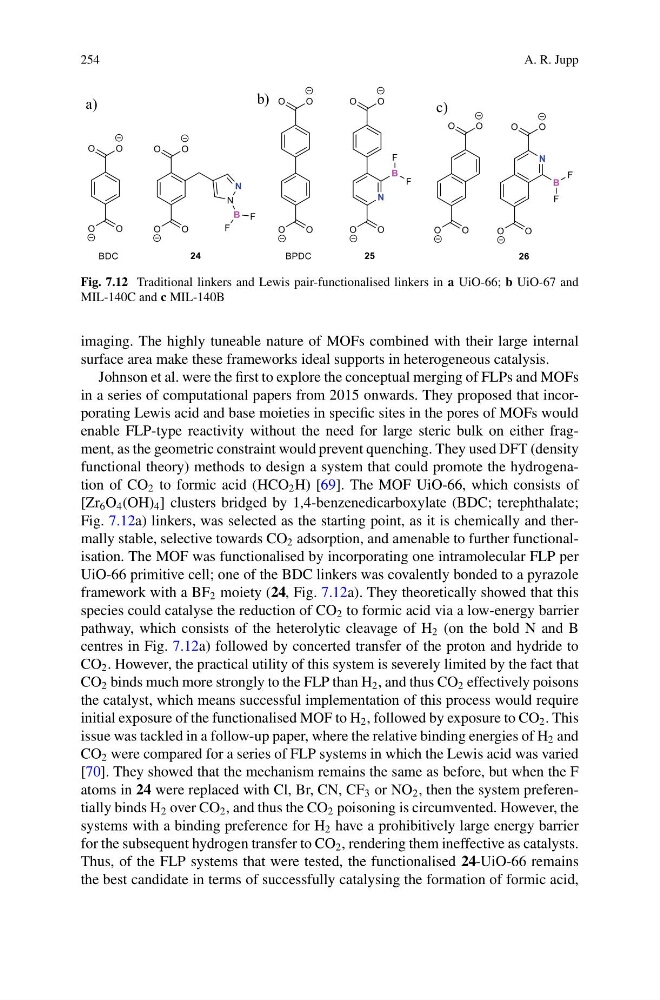
Fig. 7.12 Traditional linkers and Lewis pair-functionalised linkers in a UiO-66; b UiO-67 and
MIL-140C and c MIL-140B
imaging. The highly tuneable nature of MOFs combined with their large internal
surface area make these frameworks ideal supports in heterogeneous catalysis.
Johnson et al. were the first to explore the conceptual merging of FLPs and MOFs
in a series of computational papers from 2015 onwards. They proposed that incorporating Lewis acid and base moieties in specific sites in the pores of MOFs would
enable FLP-type reactivity without the need for large steric bulk on either fragment, as the geometric constraint would prevent quenching. They used DFT (density
functional theory) methods to design a system that could promote the hydrogenation of CO 2 to formic acid (HCO 2 H) [69]. The MOF UiO-66, which consists of
[Zr 6 O 4 (OH) 4 ] clusters bridged by 1,4-benzenedicarboxylate (BDC; terephthalate;
Fig. 7.12a) linkers, was selected as the starting point, as it is chemically and thermally stable, selective towards CO 2 adsorption, and amenable to further functionalisation. The MOF was functionalised by incorporating one intramolecular FLP per
UiO-66 primitive cell; one of the BDC linkers was covalently bonded to a pyrazole
framework with a BF 2 moiety (24, Fig. 7.12a). They theoretically showed that this
species could catalyse the reduction of CO 2 to formic acid via a low-energy barrier
pathway, which consists of the heterolytic cleavage of H 2 (on the bold N and B
centres in Fig. 7.12a) followed by concerted transfer of the proton and hydride to
CO 2 . However, the practical utility of this system is severely limited by the fact that
CO 2 binds much more strongly to the FLP than H 2 , and thus CO 2 effectively poisons
the catalyst, which means successful implementation of this process would require
initial exposure of the functionalised MOF to H 2 , followed by exposure to CO 2 . This
issue was tackled in a follow-up paper, where the relative binding energies of H 2 and
CO 2 were compared for a series of FLP systems in which the Lewis acid was varied
[70]. They showed that the mechanism remains the same as before, but when the F
atoms in 24 were replaced with Cl, Br, CN, CF 3 or NO 2 , then the system preferentially binds H 2 over CO 2 , and thus the CO 2 poisoning is circumvented. However, the
systems with a binding preference for H 2 have a prohibitively large energy barrier
for the subsequent hydrogen transfer to CO 2 , rendering them ineffective as catalysts.
Thus, of the FLP systems that were tested, the functionalised 24-UiO-66 remains
the best candidate in terms of successfully catalysing the formation of formic acid,
A. R. Jupp
a)
b)
c)
Fig. 7.12 Traditional linkers and Lewis pair-functionalised linkers in a UiO-66; b UiO-67 and
MIL-140C and c MIL-140B
imaging. The highly tuneable nature of MOFs combined with their large internal
surface area make these frameworks ideal supports in heterogeneous catalysis.
Johnson et al. were the first to explore the conceptual merging of FLPs and MOFs
in a series of computational papers from 2015 onwards. They proposed that incorporating Lewis acid and base moieties in specific sites in the pores of MOFs would
enable FLP-type reactivity without the need for large steric bulk on either fragment, as the geometric constraint would prevent quenching. They used DFT (density
functional theory) methods to design a system that could promote the hydrogenation of CO 2 to formic acid (HCO 2 H) [69]. The MOF UiO-66, which consists of
[Zr 6 O 4 (OH) 4 ] clusters bridged by 1,4-benzenedicarboxylate (BDC; terephthalate;
Fig. 7.12a) linkers, was selected as the starting point, as it is chemically and thermally stable, selective towards CO 2 adsorption, and amenable to further functionalisation. The MOF was functionalised by incorporating one intramolecular FLP per
UiO-66 primitive cell; one of the BDC linkers was covalently bonded to a pyrazole
framework with a BF 2 moiety (24, Fig. 7.12a). They theoretically showed that this
species could catalyse the reduction of CO 2 to formic acid via a low-energy barrier
pathway, which consists of the heterolytic cleavage of H 2 (on the bold N and B
centres in Fig. 7.12a) followed by concerted transfer of the proton and hydride to
CO 2 . However, the practical utility of this system is severely limited by the fact that
CO 2 binds much more strongly to the FLP than H 2 , and thus CO 2 effectively poisons
the catalyst, which means successful implementation of this process would require
initial exposure of the functionalised MOF to H 2 , followed by exposure to CO 2 . This
issue was tackled in a follow-up paper, where the relative binding energies of H 2 and
CO 2 were compared for a series of FLP systems in which the Lewis acid was varied
[70]. They showed that the mechanism remains the same as before, but when the F
atoms in 24 were replaced with Cl, Br, CN, CF 3 or NO 2 , then the system preferentially binds H 2 over CO 2 , and thus the CO 2 poisoning is circumvented. However, the
systems with a binding preference for H 2 have a prohibitively large energy barrier
for the subsequent hydrogen transfer to CO 2 , rendering them ineffective as catalysts.
Thus, of the FLP systems that were tested, the functionalised 24-UiO-66 remains
the best candidate in terms of successfully catalysing the formation of formic acid,