

7 Heterogeneous Catalysis by Frustrated Lewis Pairs
241
the product, and will need to be refreshed for subsequent recycling experiments. The
examples of semi-immobilised FLP systems described in this section are divided
into those where the Lewis base is the solid component, and those where the Lewis
acid is the solid.
7.2.1 Solid Lewis Base with a Soluble Lewis Acid
The approach of Taoufik et al. was to mimic the well-studied homogeneous FLP
systems, but generate a heterogeneous catalyst by grafting the Lewis basic component to a solid support [29]. They first synthesised a hybrid organic/inorganic
support by grafting tri-isobutyl aluminium on dehydroxylated silica at 700 °C, which
consumed all of the reactive silanol groups [30]. Treatment with a slight excess
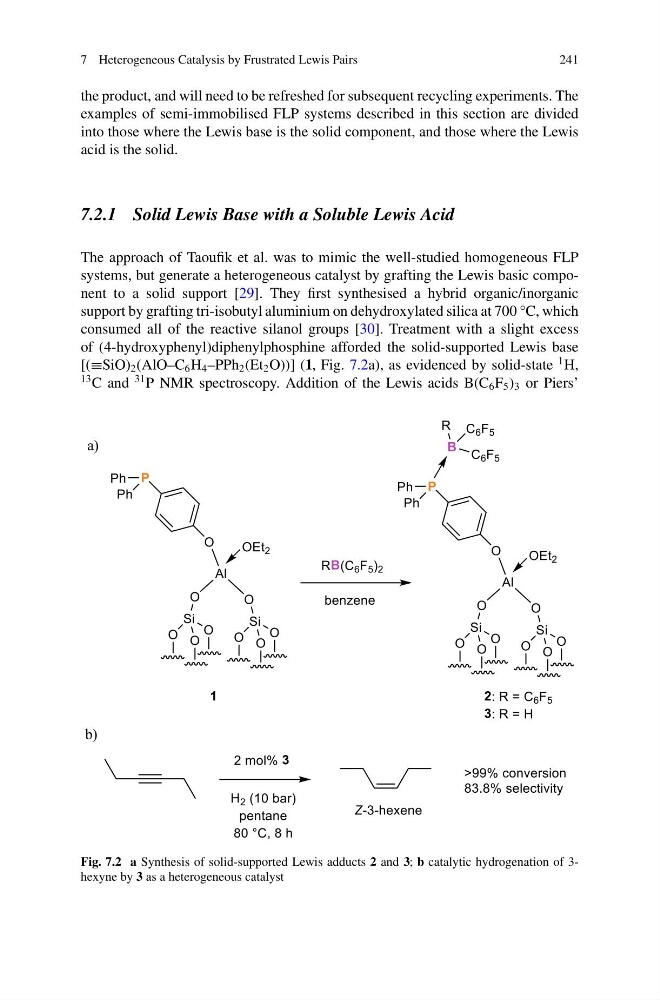
of (4-hydroxyphenyl)diphenylphosphine afforded the solid-supported Lewis base
[(≡SiO) 2 (AlO–C 6 H 4 –PPh 2 (Et 2 O))] (1, Fig. 7.2a), as evidenced by solid-state
1 H,
13 C and
31 P NMR spectroscopy. Addition of the Lewis acids B(C 6 F 5 ) 3 or Piers’
a)
b)
Fig. 7.2 a Synthesis of solid-supported Lewis adducts 2 and 3; b catalytic hydrogenation of 3hexyne by 3 as a heterogeneous catalyst
241
the product, and will need to be refreshed for subsequent recycling experiments. The
examples of semi-immobilised FLP systems described in this section are divided
into those where the Lewis base is the solid component, and those where the Lewis
acid is the solid.
7.2.1 Solid Lewis Base with a Soluble Lewis Acid
The approach of Taoufik et al. was to mimic the well-studied homogeneous FLP
systems, but generate a heterogeneous catalyst by grafting the Lewis basic component to a solid support [29]. They first synthesised a hybrid organic/inorganic
support by grafting tri-isobutyl aluminium on dehydroxylated silica at 700 °C, which
consumed all of the reactive silanol groups [30]. Treatment with a slight excess
of (4-hydroxyphenyl)diphenylphosphine afforded the solid-supported Lewis base
[(≡SiO) 2 (AlO–C 6 H 4 –PPh 2 (Et 2 O))] (1, Fig. 7.2a), as evidenced by solid-state
1 H,
13 C and
31 P NMR spectroscopy. Addition of the Lewis acids B(C 6 F 5 ) 3 or Piers’
a)
b)
Fig. 7.2 a Synthesis of solid-supported Lewis adducts 2 and 3; b catalytic hydrogenation of 3hexyne by 3 as a heterogeneous catalyst