

7 Heterogeneous Catalysis by Frustrated Lewis Pairs
239
7.1 Introduction
Catalysis underpins the vast majority of industrially important reactions. In particular, hydrogenation is employed in upgrading crude oil, as well as in the synthesis of
agrochemicals, pharmaceuticals and materials [1]. Historically, this has been carried
out with transition metal complexes; however, in 2006 Stephan et al. articulated the
concept of frustrated Lewis pairs (FLPs), and showed that unquenched combinations
of bulky Lewis acids and Lewis bases could synergistically and reversibly activate
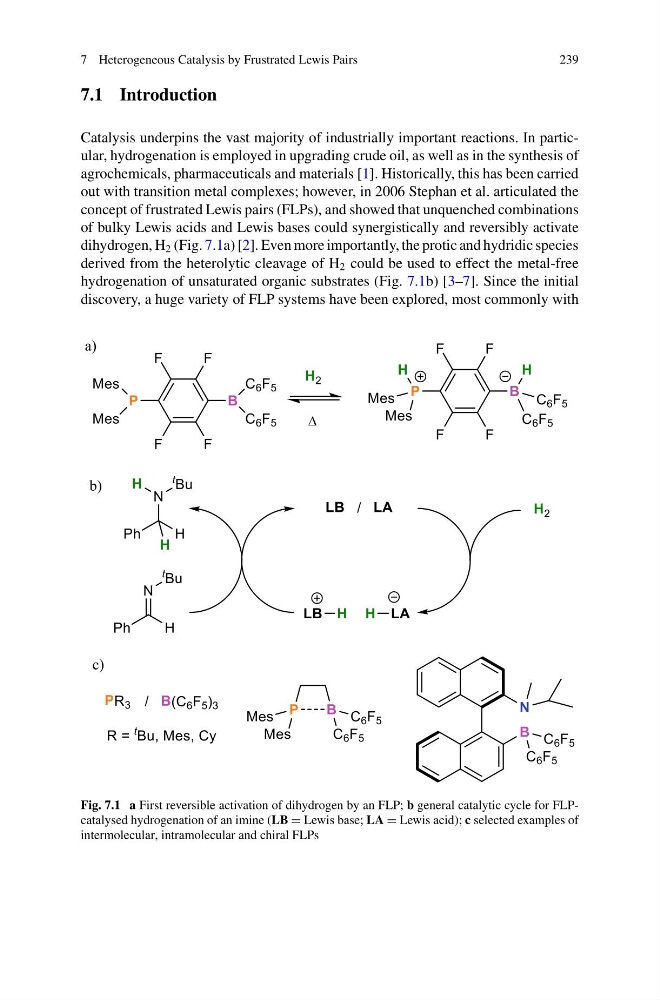
dihydrogen, H 2 (Fig. 7.1a) [2]. Even more importantly, the protic and hydridic species
derived from the heterolytic cleavage of H 2 could be used to effect the metal-free
hydrogenation of unsaturated organic substrates (Fig. 7.1b) [3–7]. Since the initial
discovery, a huge variety of FLP systems have been explored, most commonly with
a)
b)
c)
Fig. 7.1 a First reversible activation of dihydrogen by an FLP; b general catalytic cycle for FLPcatalysed hydrogenation of an imine (LB = Lewis base; LA = Lewis acid); c selected examples of
intermolecular, intramolecular and chiral FLPs
239
7.1 Introduction
Catalysis underpins the vast majority of industrially important reactions. In particular, hydrogenation is employed in upgrading crude oil, as well as in the synthesis of
agrochemicals, pharmaceuticals and materials [1]. Historically, this has been carried
out with transition metal complexes; however, in 2006 Stephan et al. articulated the
concept of frustrated Lewis pairs (FLPs), and showed that unquenched combinations
of bulky Lewis acids and Lewis bases could synergistically and reversibly activate
dihydrogen, H 2 (Fig. 7.1a) [2]. Even more importantly, the protic and hydridic species
derived from the heterolytic cleavage of H 2 could be used to effect the metal-free
hydrogenation of unsaturated organic substrates (Fig. 7.1b) [3–7]. Since the initial
discovery, a huge variety of FLP systems have been explored, most commonly with
a)
b)
c)
Fig. 7.1 a First reversible activation of dihydrogen by an FLP; b general catalytic cycle for FLPcatalysed hydrogenation of an imine (LB = Lewis base; LA = Lewis acid); c selected examples of
intermolecular, intramolecular and chiral FLPs