

190
M. Heshmat et al.
TS
HH with the active water
TS
HT with the active water
a)
b)
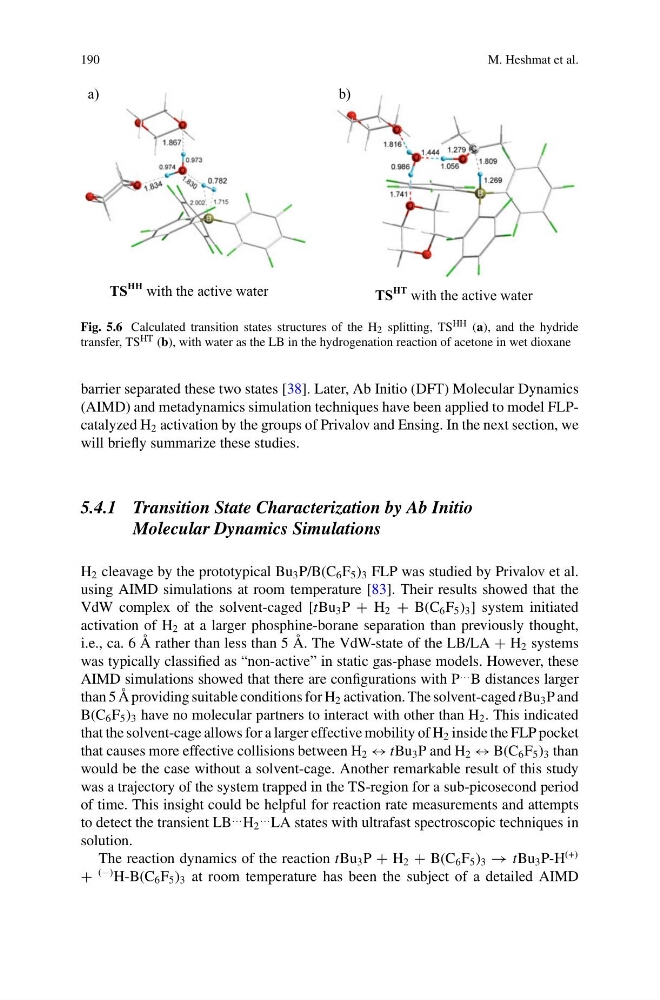
Fig. 5.6 Calculated transition states structures of the H 2 splitting, TS HH (a), and the hydride
transfer, TS HT (b), with water as the LB in the hydrogenation reaction of acetone in wet dioxane
barrier separated these two states [38]. Later, Ab Initio (DFT) Molecular Dynamics
(AIMD) and metadynamics simulation techniques have been applied to model FLPcatalyzed H 2 activation by the groups of Privalov and Ensing. In the next section, we
will briefly summarize these studies.
5.4.1 Transition State Characterization by Ab Initio
Molecular Dynamics Simulations
H 2 cleavage by the prototypical Bu 3 P/B(C 6 F 5 ) 3 FLP was studied by Privalov et al.
using AIMD simulations at room temperature [83]. Their results showed that the
VdW complex of the solvent-caged [tBu 3 P + H 2 + B(C 6 F 5 ) 3 ] system initiated
activation of H 2 at a larger phosphine-borane separation than previously thought,
i.e., ca. 6 Å rather than less than 5 Å. The VdW-state of the LB/LA + H 2 systems
was typically classified as “non-active” in static gas-phase models. However, these
AIMD simulations showed that there are configurations with P
… B distances larger
than 5 Å providing suitable conditions for H 2 activation. The solvent-caged tBu 3 P and
B(C 6 F 5 ) 3 have no molecular partners to interact with other than H 2 . This indicated
that the solvent-cage allows for a larger effective mobility of H 2 inside the FLP pocket
that causes more effective collisions between H 2 ↔ tBu 3 P and H 2 ↔ B(C 6 F 5 ) 3 than
would be the case without a solvent-cage. Another remarkable result of this study
was a trajectory of the system trapped in the TS-region for a sub-picosecond period
of time. This insight could be helpful for reaction rate measurements and attempts
to detect the transient LB
… H 2
… LA states with ultrafast spectroscopic techniques in
solution.
The reaction dynamics of the reaction tBu 3 P + H 2 + B(C 6 F 5 ) 3 → tBu 3 P-H
(+)
+
(−) H-B(C 6 F 5 ) 3 at room temperature has been the subject of a detailed AIMD
M. Heshmat et al.
TS
HH with the active water
TS
HT with the active water
a)
b)
Fig. 5.6 Calculated transition states structures of the H 2 splitting, TS HH (a), and the hydride
transfer, TS HT (b), with water as the LB in the hydrogenation reaction of acetone in wet dioxane
barrier separated these two states [38]. Later, Ab Initio (DFT) Molecular Dynamics
(AIMD) and metadynamics simulation techniques have been applied to model FLPcatalyzed H 2 activation by the groups of Privalov and Ensing. In the next section, we
will briefly summarize these studies.
5.4.1 Transition State Characterization by Ab Initio
Molecular Dynamics Simulations
H 2 cleavage by the prototypical Bu 3 P/B(C 6 F 5 ) 3 FLP was studied by Privalov et al.
using AIMD simulations at room temperature [83]. Their results showed that the
VdW complex of the solvent-caged [tBu 3 P + H 2 + B(C 6 F 5 ) 3 ] system initiated
activation of H 2 at a larger phosphine-borane separation than previously thought,
i.e., ca. 6 Å rather than less than 5 Å. The VdW-state of the LB/LA + H 2 systems
was typically classified as “non-active” in static gas-phase models. However, these
AIMD simulations showed that there are configurations with P
… B distances larger
than 5 Å providing suitable conditions for H 2 activation. The solvent-caged tBu 3 P and
B(C 6 F 5 ) 3 have no molecular partners to interact with other than H 2 . This indicated
that the solvent-cage allows for a larger effective mobility of H 2 inside the FLP pocket
that causes more effective collisions between H 2 ↔ tBu 3 P and H 2 ↔ B(C 6 F 5 ) 3 than
would be the case without a solvent-cage. Another remarkable result of this study
was a trajectory of the system trapped in the TS-region for a sub-picosecond period
of time. This insight could be helpful for reaction rate measurements and attempts
to detect the transient LB
… H 2
… LA states with ultrafast spectroscopic techniques in
solution.
The reaction dynamics of the reaction tBu 3 P + H 2 + B(C 6 F 5 ) 3 → tBu 3 P-H
(+)
+
(−) H-B(C 6 F 5 ) 3 at room temperature has been the subject of a detailed AIMD