

182
M. Heshmat et al.
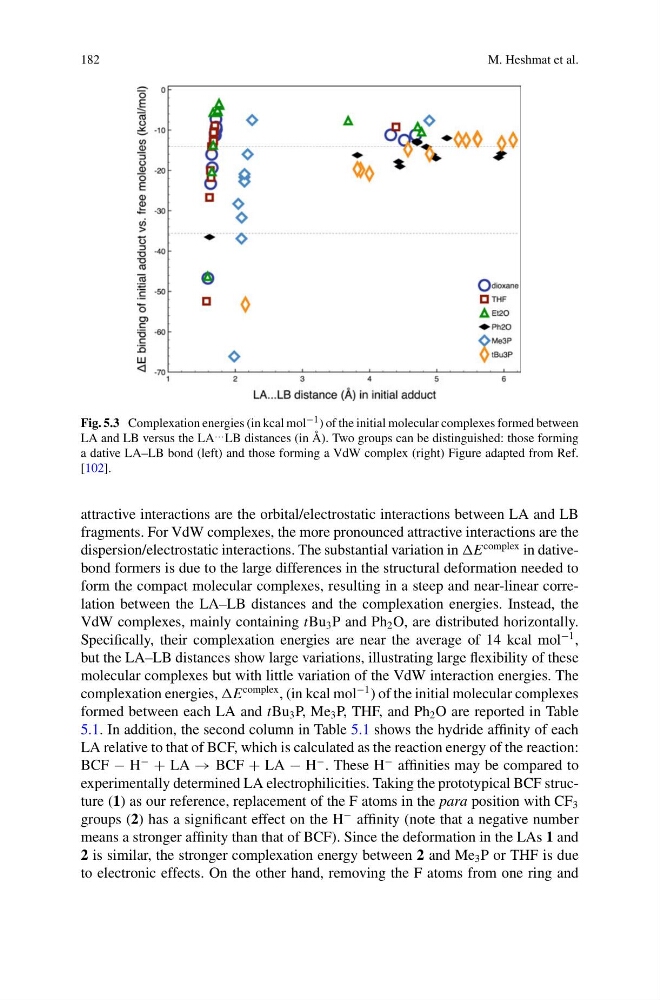
Fig. 5.3 Complexation energies (in kcal mol −1 ) of the initial molecular complexes formed between
LA and LB versus the LA … LB distances (in Å). Two groups can be distinguished: those forming
a dative LA–LB bond (left) and those forming a VdW complex (right) Figure adapted from Ref.
[102].
attractive interactions are the orbital/electrostatic interactions between LA and LB
fragments. For VdW complexes, the more pronounced attractive interactions are the
dispersion/electrostatic interactions. The substantial variation in E
complex in dativebond formers is due to the large differences in the structural deformation needed to
form the compact molecular complexes, resulting in a steep and near-linear correlation between the LA–LB distances and the complexation energies. Instead, the
VdW complexes, mainly containing tBu 3 P and Ph 2 O, are distributed horizontally.
Specifically, their complexation energies are near the average of 14 kcal mol
−1 ,
but the LA–LB distances show large variations, illustrating large flexibility of these
molecular complexes but with little variation of the VdW interaction energies. The
complexation energies, E
complex , (in kcal mol
−1 ) of the initial molecular complexes
formed between each LA and tBu 3 P, Me 3 P, THF, and Ph 2 O are reported in Table
5.1. In addition, the second column in Table 5.1 shows the hydride affinity of each
LA relative to that of BCF, which is calculated as the reaction energy of the reaction:
BCF − H
−
+ LA → BCF + LA − H
− . These H
− affinities may be compared to
experimentally determined LA electrophilicities. Taking the prototypical BCF structure (1) as our reference, replacement of the F atoms in the para position with CF 3
groups (2) has a significant effect on the H
− affinity (note that a negative number
means a stronger affinity than that of BCF). Since the deformation in the LAs 1 and
2 is similar, the stronger complexation energy between 2 and Me 3 P or THF is due
to electronic effects. On the other hand, removing the F atoms from one ring and
M. Heshmat et al.
Fig. 5.3 Complexation energies (in kcal mol −1 ) of the initial molecular complexes formed between
LA and LB versus the LA … LB distances (in Å). Two groups can be distinguished: those forming
a dative LA–LB bond (left) and those forming a VdW complex (right) Figure adapted from Ref.
[102].
attractive interactions are the orbital/electrostatic interactions between LA and LB
fragments. For VdW complexes, the more pronounced attractive interactions are the
dispersion/electrostatic interactions. The substantial variation in E
complex in dativebond formers is due to the large differences in the structural deformation needed to
form the compact molecular complexes, resulting in a steep and near-linear correlation between the LA–LB distances and the complexation energies. Instead, the
VdW complexes, mainly containing tBu 3 P and Ph 2 O, are distributed horizontally.
Specifically, their complexation energies are near the average of 14 kcal mol
−1 ,
but the LA–LB distances show large variations, illustrating large flexibility of these
molecular complexes but with little variation of the VdW interaction energies. The
complexation energies, E
complex , (in kcal mol
−1 ) of the initial molecular complexes
formed between each LA and tBu 3 P, Me 3 P, THF, and Ph 2 O are reported in Table
5.1. In addition, the second column in Table 5.1 shows the hydride affinity of each
LA relative to that of BCF, which is calculated as the reaction energy of the reaction:
BCF − H
−
+ LA → BCF + LA − H
− . These H
− affinities may be compared to
experimentally determined LA electrophilicities. Taking the prototypical BCF structure (1) as our reference, replacement of the F atoms in the para position with CF 3
groups (2) has a significant effect on the H
− affinity (note that a negative number
means a stronger affinity than that of BCF). Since the deformation in the LAs 1 and
2 is similar, the stronger complexation energy between 2 and Me 3 P or THF is due
to electronic effects. On the other hand, removing the F atoms from one ring and