

5 Mechanistic Insight into the Hydrogen Activation by Frustrated Lewis Pairs
179
Hence, the structural characteristics of the LA and LB play important roles in the
cleavage. These mechanistic details of the H–H bond polarization are still a subject
of debate and the number of theoretical studies in the literature focused on this topic
continues to grow.
In a recent study by Privalov’s group, the authors characterized, by means of the
fragment-based Energy Decomposition Analysis (EDA) and the Frontier Molecular
Orbital (FMO) analysis, the interplay of electrostatic and orbital interactions in the
Transition State (TS) structures of a series of FLPs in heterolytic H 2 activation [55],
where B(C 6 F 5 ) 3 was used as the Lewis acid together with a selection of Lewis bases
including tBu 3 P, (o-C 6 H 4 Me) 3 P, 2,6-lutidine, 2,4,6-collidine, MeN=C(Ph)Me imine,
MeN(H)-C(H)PhMe amine, THF, 1,4-dioxane and acetone. The authors showed that
both orbital interactions (electron transfer between HOMO/LUMO) and electrostatic
interactions (classical Coulomb interactions between negative and positive charges)
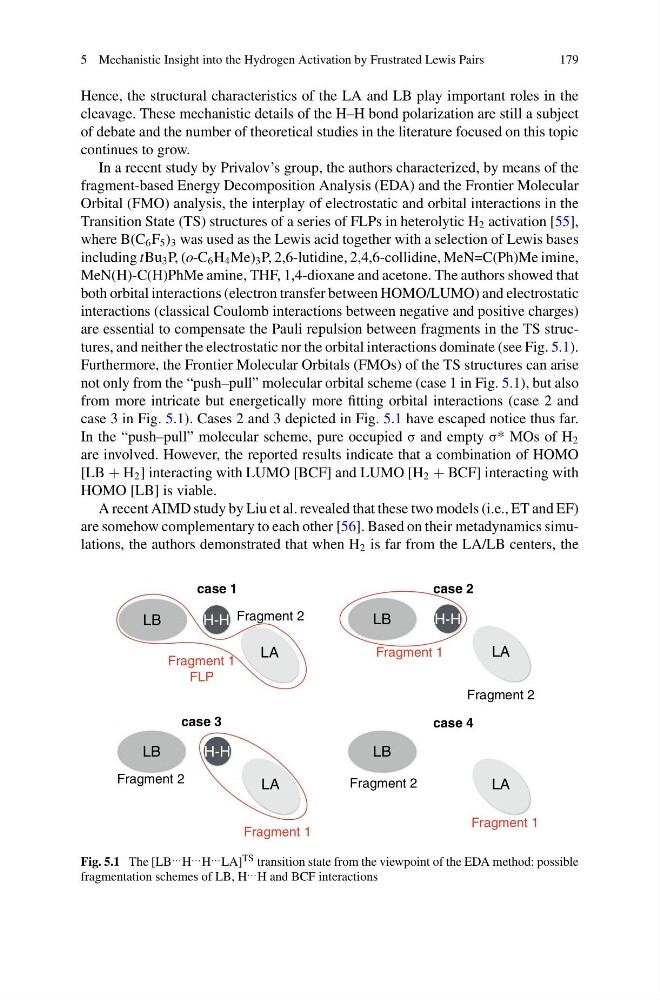
are essential to compensate the Pauli repulsion between fragments in the TS structures, and neither the electrostatic nor the orbital interactions dominate (see Fig. 5.1).
Furthermore, the Frontier Molecular Orbitals (FMOs) of the TS structures can arise
not only from the “push–pull” molecular orbital scheme (case 1 in Fig. 5.1), but also
from more intricate but energetically more fitting orbital interactions (case 2 and
case 3 in Fig. 5.1). Cases 2 and 3 depicted in Fig. 5.1 have escaped notice thus far.
In the “push–pull” molecular scheme, pure occupied σ and empty σ* MOs of H 2
are involved. However, the reported results indicate that a combination of HOMO
[LB + H 2 ] interacting with LUMO [BCF] and LUMO [H 2 + BCF] interacting with
HOMO [LB] is viable.
A recent AIMD study by Liu et al. revealed that these two models (i.e., ET and EF)
are somehow complementary to each other [56]. Based on their metadynamics simulations, the authors demonstrated that when H 2 is far from the LA/LB centers, the
LB
LA
H-H
LB
LA
H-H
LB
LA
LB
LA
H-H
Fragment 2
Fragment 1
FLP
Fragment 1
Fragment 2
Fragment 1
Fragment 2
Fragment 2
Fragment 1
case 1
case 2
case 4
case 3
Fig. 5.1 The [LB … H … H … LA] TS transition state from the viewpoint of the EDA method: possible
fragmentation schemes of LB, H … H and BCF interactions
179
Hence, the structural characteristics of the LA and LB play important roles in the
cleavage. These mechanistic details of the H–H bond polarization are still a subject
of debate and the number of theoretical studies in the literature focused on this topic
continues to grow.
In a recent study by Privalov’s group, the authors characterized, by means of the
fragment-based Energy Decomposition Analysis (EDA) and the Frontier Molecular
Orbital (FMO) analysis, the interplay of electrostatic and orbital interactions in the
Transition State (TS) structures of a series of FLPs in heterolytic H 2 activation [55],
where B(C 6 F 5 ) 3 was used as the Lewis acid together with a selection of Lewis bases
including tBu 3 P, (o-C 6 H 4 Me) 3 P, 2,6-lutidine, 2,4,6-collidine, MeN=C(Ph)Me imine,
MeN(H)-C(H)PhMe amine, THF, 1,4-dioxane and acetone. The authors showed that
both orbital interactions (electron transfer between HOMO/LUMO) and electrostatic
interactions (classical Coulomb interactions between negative and positive charges)
are essential to compensate the Pauli repulsion between fragments in the TS structures, and neither the electrostatic nor the orbital interactions dominate (see Fig. 5.1).
Furthermore, the Frontier Molecular Orbitals (FMOs) of the TS structures can arise
not only from the “push–pull” molecular orbital scheme (case 1 in Fig. 5.1), but also
from more intricate but energetically more fitting orbital interactions (case 2 and
case 3 in Fig. 5.1). Cases 2 and 3 depicted in Fig. 5.1 have escaped notice thus far.
In the “push–pull” molecular scheme, pure occupied σ and empty σ* MOs of H 2
are involved. However, the reported results indicate that a combination of HOMO
[LB + H 2 ] interacting with LUMO [BCF] and LUMO [H 2 + BCF] interacting with
HOMO [LB] is viable.
A recent AIMD study by Liu et al. revealed that these two models (i.e., ET and EF)
are somehow complementary to each other [56]. Based on their metadynamics simulations, the authors demonstrated that when H 2 is far from the LA/LB centers, the
LB
LA
H-H
LB
LA
H-H
LB
LA
LB
LA
H-H
Fragment 2
Fragment 1
FLP
Fragment 1
Fragment 2
Fragment 1
Fragment 2
Fragment 2
Fragment 1
case 1
case 2
case 4
case 3
Fig. 5.1 The [LB … H … H … LA] TS transition state from the viewpoint of the EDA method: possible
fragmentation schemes of LB, H … H and BCF interactions