

1 Frustrated Lewis Pair Catalysis: An Introduction
7
[54] subsequently used HB(C 6 F 5 ) 2 in the presence of C 6 F 5 CH CH 2 to hydrogenate
alkynes to give cis-alkenes.
In 2014, we [20] and the Ashley group [21] concurrently reported that ethereal
solvents and B(C 6 F 5 ) 3 permitted the FLP hydrogenations of ketones and aldehydes
(Scheme 1.3). While we used diethyl or di-isopropyl ether, Ashley employed tetrahydrofuran or 1,4-dioxane. Mechanistic studies and crystallographic data showed
the reaction proceeds via activation of H 2 which generates a hydrogen-bonded
ketone/solvent pair cation with the anion [HB(C 6 F 5 ) 3 ]
− . Subsequent hydride delivery
affords the alcohol [20]. In a later study, Ashley et al. [55] showed that such reductions could be performed without rigorously dry conditions. We [56] subsequently
showed that the use of B(C 6 F 5 ) 3 in toluene in the presence of either α-cyclodextrin
(α-CD) or molecular sieves was also an effective protocol for ketone hydrogenation
allowing facile separation of the product alcohol from the catalyst.
1.2.3 Functional-Group Tolerance
The above catalysts, particularly those based on electrophilic fluorinated boranes,
typically tolerate sterically encumbered functional groups [28]. However, it was
the Soós group [57] that recognized that sterically encumbered Lewis acids could
improve functional group tolerance and provide air stability. In early efforts,
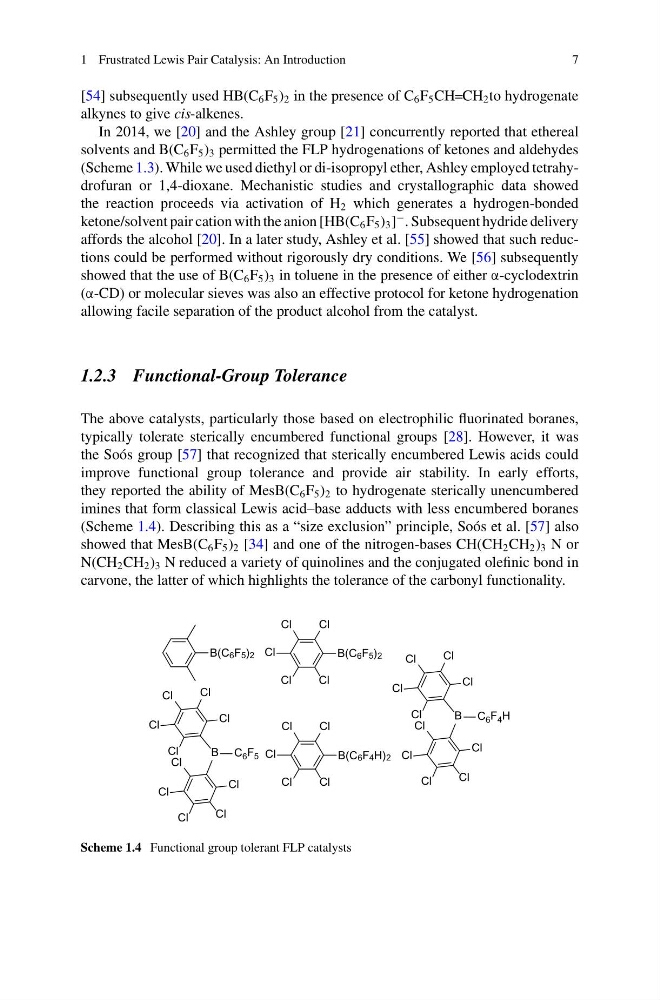
they reported the ability of MesB(C 6 F 5 ) 2 to hydrogenate sterically unencumbered
imines that form classical Lewis acid–base adducts with less encumbered boranes
(Scheme 1.4). Describing this as a “size exclusion” principle, Soós et al. [57] also
showed that MesB(C 6 F 5 ) 2 [34] and one of the nitrogen-bases CH(CH 2 CH 2 ) 3 N or
N(CH 2 CH 2 ) 3 N reduced a variety of quinolines and the conjugated olefinic bond in
carvone, the latter of which highlights the tolerance of the carbonyl functionality.
B(C 6 F 5 ) 2
Cl
Cl
B(C 6 F 5 ) 2
Cl
Cl
Cl
Cl
Cl
B
Cl
Cl
Cl
Cl
Cl
Cl
Cl
Cl
C 6 F 5
Cl
Cl
B
Cl
Cl
Cl
Cl
Cl
Cl
Cl
Cl
C 6 F 4 H
Cl
Cl
B(C6F4H)2
Cl
Cl
Cl
Scheme 1.4 Functional group tolerant FLP catalysts
7
[54] subsequently used HB(C 6 F 5 ) 2 in the presence of C 6 F 5 CH CH 2 to hydrogenate
alkynes to give cis-alkenes.
In 2014, we [20] and the Ashley group [21] concurrently reported that ethereal
solvents and B(C 6 F 5 ) 3 permitted the FLP hydrogenations of ketones and aldehydes
(Scheme 1.3). While we used diethyl or di-isopropyl ether, Ashley employed tetrahydrofuran or 1,4-dioxane. Mechanistic studies and crystallographic data showed
the reaction proceeds via activation of H 2 which generates a hydrogen-bonded
ketone/solvent pair cation with the anion [HB(C 6 F 5 ) 3 ]
− . Subsequent hydride delivery
affords the alcohol [20]. In a later study, Ashley et al. [55] showed that such reductions could be performed without rigorously dry conditions. We [56] subsequently
showed that the use of B(C 6 F 5 ) 3 in toluene in the presence of either α-cyclodextrin
(α-CD) or molecular sieves was also an effective protocol for ketone hydrogenation
allowing facile separation of the product alcohol from the catalyst.
1.2.3 Functional-Group Tolerance
The above catalysts, particularly those based on electrophilic fluorinated boranes,
typically tolerate sterically encumbered functional groups [28]. However, it was
the Soós group [57] that recognized that sterically encumbered Lewis acids could
improve functional group tolerance and provide air stability. In early efforts,
they reported the ability of MesB(C 6 F 5 ) 2 to hydrogenate sterically unencumbered
imines that form classical Lewis acid–base adducts with less encumbered boranes
(Scheme 1.4). Describing this as a “size exclusion” principle, Soós et al. [57] also
showed that MesB(C 6 F 5 ) 2 [34] and one of the nitrogen-bases CH(CH 2 CH 2 ) 3 N or
N(CH 2 CH 2 ) 3 N reduced a variety of quinolines and the conjugated olefinic bond in
carvone, the latter of which highlights the tolerance of the carbonyl functionality.
B(C 6 F 5 ) 2
Cl
Cl
B(C 6 F 5 ) 2
Cl
Cl
Cl
Cl
Cl
B
Cl
Cl
Cl
Cl
Cl
Cl
Cl
Cl
C 6 F 5
Cl
Cl
B
Cl
Cl
Cl
Cl
Cl
Cl
Cl
Cl
C 6 F 4 H
Cl
Cl
B(C6F4H)2
Cl
Cl
Cl
Scheme 1.4 Functional group tolerant FLP catalysts