

142
Y. Soltani and F.-G. Fontaine
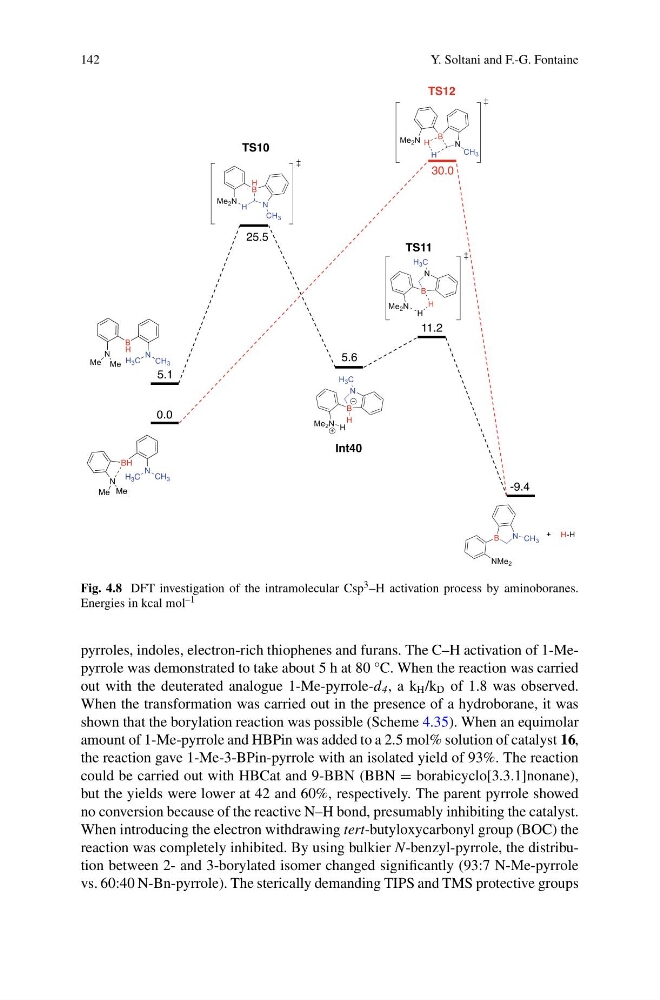
Fig. 4.8 DFT investigation of the intramolecular Csp 3 –H activation process by aminoboranes.
Energies in kcal mol –1
pyrroles, indoles, electron-rich thiophenes and furans. The C–H activation of 1-Mepyrrole was demonstrated to take about 5 h at 80 °C. When the reaction was carried
out with the deuterated analogue 1-Me-pyrrole-d 4 , a k H /k D of 1.8 was observed.
When the transformation was carried out in the presence of a hydroborane, it was
shown that the borylation reaction was possible (Scheme 4.35). When an equimolar
amount of 1-Me-pyrrole and HBPin was added to a 2.5 mol% solution of catalyst 16,
the reaction gave 1-Me-3-BPin-pyrrole with an isolated yield of 93%. The reaction
could be carried out with HBCat and 9-BBN (BBN = borabicyclo[3.3.1]nonane),
but the yields were lower at 42 and 60%, respectively. The parent pyrrole showed
no conversion because of the reactive N–H bond, presumably inhibiting the catalyst.
When introducing the electron withdrawing tert-butyloxycarbonyl group (BOC) the
reaction was completely inhibited. By using bulkier N-benzyl-pyrrole, the distribution between 2- and 3-borylated isomer changed significantly (93:7 N-Me-pyrrole
vs. 60:40 N-Bn-pyrrole). The sterically demanding TIPS and TMS protective groups
Y. Soltani and F.-G. Fontaine
Fig. 4.8 DFT investigation of the intramolecular Csp 3 –H activation process by aminoboranes.
Energies in kcal mol –1
pyrroles, indoles, electron-rich thiophenes and furans. The C–H activation of 1-Mepyrrole was demonstrated to take about 5 h at 80 °C. When the reaction was carried
out with the deuterated analogue 1-Me-pyrrole-d 4 , a k H /k D of 1.8 was observed.
When the transformation was carried out in the presence of a hydroborane, it was
shown that the borylation reaction was possible (Scheme 4.35). When an equimolar
amount of 1-Me-pyrrole and HBPin was added to a 2.5 mol% solution of catalyst 16,
the reaction gave 1-Me-3-BPin-pyrrole with an isolated yield of 93%. The reaction
could be carried out with HBCat and 9-BBN (BBN = borabicyclo[3.3.1]nonane),
but the yields were lower at 42 and 60%, respectively. The parent pyrrole showed
no conversion because of the reactive N–H bond, presumably inhibiting the catalyst.
When introducing the electron withdrawing tert-butyloxycarbonyl group (BOC) the
reaction was completely inhibited. By using bulkier N-benzyl-pyrrole, the distribution between 2- and 3-borylated isomer changed significantly (93:7 N-Me-pyrrole
vs. 60:40 N-Bn-pyrrole). The sterically demanding TIPS and TMS protective groups