

120
Y. Soltani and F.-G. Fontaine
Shubin (2000)
Dewar (1960)
not isolated
SBCl2
AlCl 3
SBCl
[AlCl4]
BCl
S
H Cl
AlCl 3
- HCl, AlCl 3
BCl
S
Int2
Int3
R 1
R 1
N
B
Ph
Me
R 2
2 examples
Murakami (2010)
N
Br 2
B
R 1
R 2
R 3
5 examples
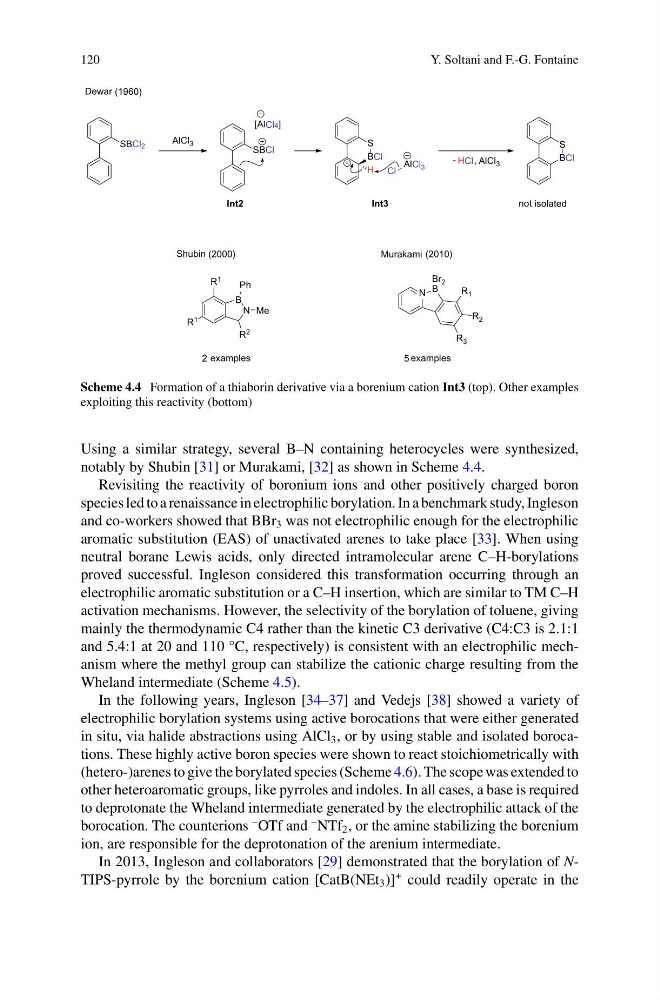
Scheme 4.4 Formation of a thiaborin derivative via a borenium cation Int3 (top). Other examples
exploiting this reactivity (bottom)
Using a similar strategy, several B–N containing heterocycles were synthesized,
notably by Shubin [31] or Murakami, [32] as shown in Scheme 4.4.
Revisiting the reactivity of boronium ions and other positively charged boron
species led to a renaissance in electrophilic borylation. In a benchmark study, Ingleson
and co-workers showed that BBr 3 was not electrophilic enough for the electrophilic
aromatic substitution (EAS) of unactivated arenes to take place [33]. When using
neutral borane Lewis acids, only directed intramolecular arene C–H-borylations
proved successful. Ingleson considered this transformation occurring through an
electrophilic aromatic substitution or a C–H insertion, which are similar to TM C–H
activation mechanisms. However, the selectivity of the borylation of toluene, giving
mainly the thermodynamic C4 rather than the kinetic C3 derivative (C4:C3 is 2.1:1
and 5.4:1 at 20 and 110 °C, respectively) is consistent with an electrophilic mechanism where the methyl group can stabilize the cationic charge resulting from the
Wheland intermediate (Scheme 4.5).
In the following years, Ingleson [34–37] and Vedejs [38] showed a variety of
electrophilic borylation systems using active borocations that were either generated
in situ, via halide abstractions using AlCl 3 , or by using stable and isolated borocations. These highly active boron species were shown to react stoichiometrically with
(hetero-)arenes to give the borylated species (Scheme 4.6). The scope was extended to
other heteroaromatic groups, like pyrroles and indoles. In all cases, a base is required
to deprotonate the Wheland intermediate generated by the electrophilic attack of the
borocation. The counterions
– OTf and
– NTf 2 , or the amine stabilizing the borenium
ion, are responsible for the deprotonation of the arenium intermediate.
In 2013, Ingleson and collaborators [29] demonstrated that the borylation of NTIPS-pyrrole by the borenium cation [CatB(NEt 3 )]
+ could readily operate in the
Y. Soltani and F.-G. Fontaine
Shubin (2000)
Dewar (1960)
not isolated
SBCl2
AlCl 3
SBCl
[AlCl4]
BCl
S
H Cl
AlCl 3
- HCl, AlCl 3
BCl
S
Int2
Int3
R 1
R 1
N
B
Ph
Me
R 2
2 examples
Murakami (2010)
N
Br 2
B
R 1
R 2
R 3
5 examples
Scheme 4.4 Formation of a thiaborin derivative via a borenium cation Int3 (top). Other examples
exploiting this reactivity (bottom)
Using a similar strategy, several B–N containing heterocycles were synthesized,
notably by Shubin [31] or Murakami, [32] as shown in Scheme 4.4.
Revisiting the reactivity of boronium ions and other positively charged boron
species led to a renaissance in electrophilic borylation. In a benchmark study, Ingleson
and co-workers showed that BBr 3 was not electrophilic enough for the electrophilic
aromatic substitution (EAS) of unactivated arenes to take place [33]. When using
neutral borane Lewis acids, only directed intramolecular arene C–H-borylations
proved successful. Ingleson considered this transformation occurring through an
electrophilic aromatic substitution or a C–H insertion, which are similar to TM C–H
activation mechanisms. However, the selectivity of the borylation of toluene, giving
mainly the thermodynamic C4 rather than the kinetic C3 derivative (C4:C3 is 2.1:1
and 5.4:1 at 20 and 110 °C, respectively) is consistent with an electrophilic mechanism where the methyl group can stabilize the cationic charge resulting from the
Wheland intermediate (Scheme 4.5).
In the following years, Ingleson [34–37] and Vedejs [38] showed a variety of
electrophilic borylation systems using active borocations that were either generated
in situ, via halide abstractions using AlCl 3 , or by using stable and isolated borocations. These highly active boron species were shown to react stoichiometrically with
(hetero-)arenes to give the borylated species (Scheme 4.6). The scope was extended to
other heteroaromatic groups, like pyrroles and indoles. In all cases, a base is required
to deprotonate the Wheland intermediate generated by the electrophilic attack of the
borocation. The counterions
– OTf and
– NTf 2 , or the amine stabilizing the borenium
ion, are responsible for the deprotonation of the arenium intermediate.
In 2013, Ingleson and collaborators [29] demonstrated that the borylation of NTIPS-pyrrole by the borenium cation [CatB(NEt 3 )]
+ could readily operate in the