

6.3 The Divergence and Laplacian
89
g i j =
1 0
0 ρ
2
, g
i j
=
1 0
0 1/ρ
2
,
|g| = ρ.
(6.33)
The covariant gradient and the corresponding contravariant vector are
f ,k =
f ,ρ , f ,ϕ
, g
ik f ,k =
f ,ρ , f ,ϕ /ρ
2
.
(6.34)
Substituting these into (6.32), we find for the Laplacian the well-known
expression,
∇
2 f =
1
ρ
ρ f ,ρ
,ρ
+
1
ρ 2 f ,ϕ,ϕ = f ,ρ,ρ +
1
ρ
f ,ρ +
1
ρ 2 f ,ϕ,ϕ .
(6.35)
Appendix 1: Curve Derivatives as Vectors
There is a somewhat more sophisticated notation that the reader may encounter
concerning the abstract approach to vectors in Sect. 6.2. We will only mention here
the basic concept and the nomenclature (Misner 1973; Ohanian 1994).
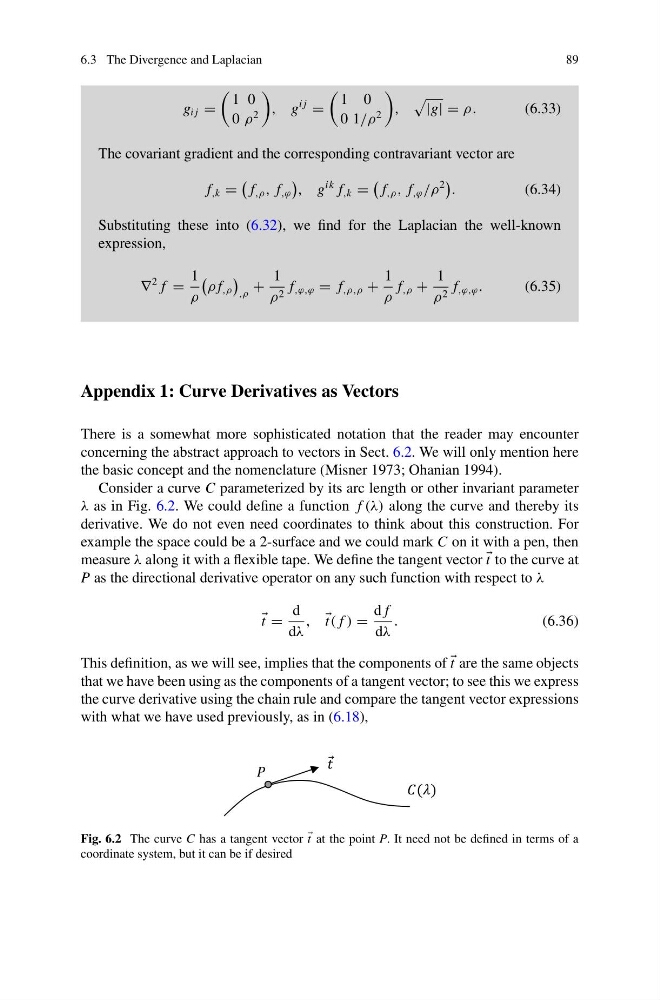
Consider a curve C parameterized by its arc length or other invariant parameter
λ as in Fig. 6.2. We could define a function f (λ) along the curve and thereby its
derivative. We do not even need coordinates to think about this construction. For
example the space could be a 2-surface and we could mark C on it with a pen, then
measure λ along it with a flexible tape. We define the tangent vector
t to the curve at
P as the directional derivative operator on any such function with respect to λ
t =
d
dλ
,
t( f ) =
d f
dλ
.
(6.36)
This definition, as we will see, implies that the components of
t are the same objects
that we have been using as the components of a tangent vector; to see this we express
the curve derivative using the chain rule and compare the tangent vector expressions
with what we have used previously, as in (6.18),
Fig. 6.2 The curve C has a tangent vector
t at the point P. It need not be defined in terms of a
coordinate system, but it can be if desired
89
g i j =
1 0
0 ρ
2
, g
i j
=
1 0
0 1/ρ
2
,
|g| = ρ.
(6.33)
The covariant gradient and the corresponding contravariant vector are
f ,k =
f ,ρ , f ,ϕ
, g
ik f ,k =
f ,ρ , f ,ϕ /ρ
2
.
(6.34)
Substituting these into (6.32), we find for the Laplacian the well-known
expression,
∇
2 f =
1
ρ
ρ f ,ρ
,ρ
+
1
ρ 2 f ,ϕ,ϕ = f ,ρ,ρ +
1
ρ
f ,ρ +
1
ρ 2 f ,ϕ,ϕ .
(6.35)
Appendix 1: Curve Derivatives as Vectors
There is a somewhat more sophisticated notation that the reader may encounter
concerning the abstract approach to vectors in Sect. 6.2. We will only mention here
the basic concept and the nomenclature (Misner 1973; Ohanian 1994).
Consider a curve C parameterized by its arc length or other invariant parameter
λ as in Fig. 6.2. We could define a function f (λ) along the curve and thereby its
derivative. We do not even need coordinates to think about this construction. For
example the space could be a 2-surface and we could mark C on it with a pen, then
measure λ along it with a flexible tape. We define the tangent vector
t to the curve at
P as the directional derivative operator on any such function with respect to λ
t =
d
dλ
,
t( f ) =
d f
dλ
.
(6.36)
This definition, as we will see, implies that the components of
t are the same objects
that we have been using as the components of a tangent vector; to see this we express
the curve derivative using the chain rule and compare the tangent vector expressions
with what we have used previously, as in (6.18),
Fig. 6.2 The curve C has a tangent vector
t at the point P. It need not be defined in terms of a
coordinate system, but it can be if desired