

82
6 Tensor Analysis
d
d
d
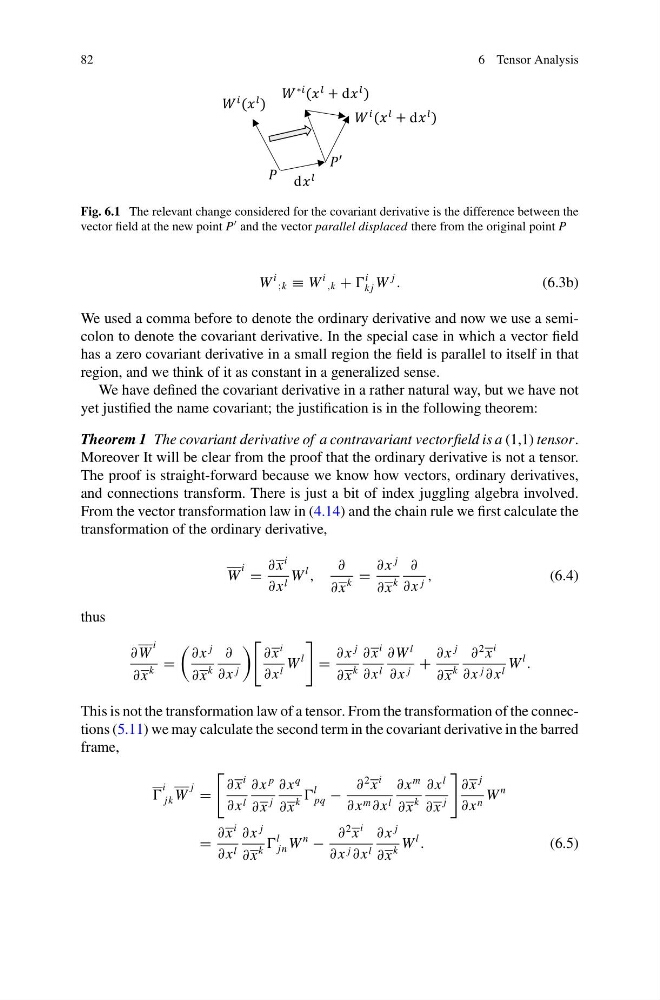
Fig. 6.1 The relevant change considered for the covariant derivative is the difference between the
vector field at the new point P and the vector parallel displaced there from the original point P
W
i ;k ≡ W
i ,k +
i
k j W
j
.
(6.3b)
We used a comma before to denote the ordinary derivative and now we use a semicolon to denote the covariant derivative. In the special case in which a vector field
has a zero covariant derivative in a small region the field is parallel to itself in that
region, and we think of it as constant in a generalized sense.
We have defined the covariant derivative in a rather natural way, but we have not
yet justified the name covariant; the justification is in the following theorem:
Theorem 1 The covariant derivative of a contravariant vectorfield is a (1,1) tensor.
Moreover It will be clear from the proof that the ordinary derivative is not a tensor.
The proof is straight-forward because we know how vectors, ordinary derivatives,
and connections transform. There is just a bit of index juggling algebra involved.
From the vector transformation law in (4.14) and the chain rule we first calculate the
transformation of the ordinary derivative,
W
i =
∂ x
i
∂ x l W
l
,
∂
∂ x
k
=
∂ x
j
∂ x
k
∂
∂ x j ,
(6.4)
thus
∂ W
i
∂ x
k
=
∂ x
j
∂ x
k
∂
∂ x j
∂ x
i
∂ x l W
l
=
∂ x
j
∂ x
k
∂ x
i
∂ x l
∂ W
l
∂ x j +
∂ x
j
∂ x
k
∂
2 x
i
∂ x j ∂ x l W
l
.
This is not the transformation law of a tensor. From the transformation of the connections (5.11) we may calculate the second term in the covariant derivative in the barred
frame,
i
jk W
j =
∂ x
i
∂ x l
∂ x
p
∂ x
j
∂ x
q
∂ x
k
l
pq −
∂
2 x
i
∂ x m ∂ x l
∂ x
m
∂ x
k
∂ x
l
∂ x
j
∂ x
j
∂ x n W
n
=
∂ x
i
∂ x l
∂ x
j
∂ x
k
l
jn W
n
−
∂
2 x
i
∂ x j ∂ x l
∂ x
j
∂ x
k
W
l
.
(6.5)
6 Tensor Analysis
d
d
d
Fig. 6.1 The relevant change considered for the covariant derivative is the difference between the
vector field at the new point P and the vector parallel displaced there from the original point P
W
i ;k ≡ W
i ,k +
i
k j W
j
.
(6.3b)
We used a comma before to denote the ordinary derivative and now we use a semicolon to denote the covariant derivative. In the special case in which a vector field
has a zero covariant derivative in a small region the field is parallel to itself in that
region, and we think of it as constant in a generalized sense.
We have defined the covariant derivative in a rather natural way, but we have not
yet justified the name covariant; the justification is in the following theorem:
Theorem 1 The covariant derivative of a contravariant vectorfield is a (1,1) tensor.
Moreover It will be clear from the proof that the ordinary derivative is not a tensor.
The proof is straight-forward because we know how vectors, ordinary derivatives,
and connections transform. There is just a bit of index juggling algebra involved.
From the vector transformation law in (4.14) and the chain rule we first calculate the
transformation of the ordinary derivative,
W
i =
∂ x
i
∂ x l W
l
,
∂
∂ x
k
=
∂ x
j
∂ x
k
∂
∂ x j ,
(6.4)
thus
∂ W
i
∂ x
k
=
∂ x
j
∂ x
k
∂
∂ x j
∂ x
i
∂ x l W
l
=
∂ x
j
∂ x
k
∂ x
i
∂ x l
∂ W
l
∂ x j +
∂ x
j
∂ x
k
∂
2 x
i
∂ x j ∂ x l W
l
.
This is not the transformation law of a tensor. From the transformation of the connections (5.11) we may calculate the second term in the covariant derivative in the barred
frame,
i
jk W
j =
∂ x
i
∂ x l
∂ x
p
∂ x
j
∂ x
q
∂ x
k
l
pq −
∂
2 x
i
∂ x m ∂ x l
∂ x
m
∂ x
k
∂ x
l
∂ x
j
∂ x
j
∂ x n W
n
=
∂ x
i
∂ x l
∂ x
j
∂ x
k
l
jn W
n
−
∂
2 x
i
∂ x j ∂ x l
∂ x
j
∂ x
k
W
l
.
(6.5)