

78
5 Affine Connections and Geodesics
∂ L
∂ ˙
x i = mg i j ˙
x
j
,
d
dt
∂ L
∂ ˙
x i = m(g i j ¨
x
j
+ g i j,k ˙
x
j
˙
x
k
),
∂ L
∂ x i =
m
2
g i j,k ˙
x
j
˙
x
k
−
∂ V
∂ x i ,
m
g i j ¨
x
j
+ g i j,k ˙
x
j
˙
x
k
−
1
2
g jk,i ˙
x
j
˙
x
k
+
∂ V
∂ x i = 0.
(5.64)
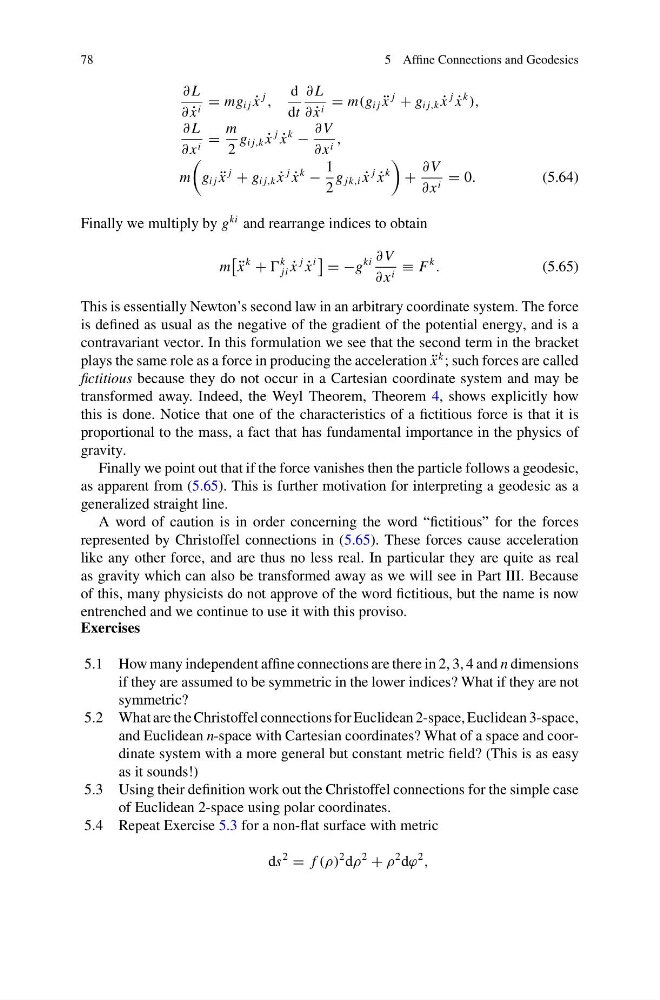
Finally we multiply by g
ki and rearrange indices to obtain
m
¨
x
k
+
k
ji ˙
x
j
˙
x
i
= −g
ki ∂ V
∂ x i ≡ F
k
.
(5.65)
This is essentially Newton’s second law in an arbitrary coordinate system. The force
is defined as usual as the negative of the gradient of the potential energy, and is a
contravariant vector. In this formulation we see that the second term in the bracket
plays the same role as a force in producing the acceleration ¨
x
k ; such forces are called
fictitious because they do not occur in a Cartesian coordinate system and may be
transformed away. Indeed, the Weyl Theorem, Theorem 4, shows explicitly how
this is done. Notice that one of the characteristics of a fictitious force is that it is
proportional to the mass, a fact that has fundamental importance in the physics of
gravity.
Finally we point out that if the force vanishes then the particle follows a geodesic,
as apparent from (5.65). This is further motivation for interpreting a geodesic as a
generalized straight line.
A word of caution is in order concerning the word “fictitious” for the forces
represented by Christoffel connections in (5.65). These forces cause acceleration
like any other force, and are thus no less real. In particular they are quite as real
as gravity which can also be transformed away as we will see in Part III. Because
of this, many physicists do not approve of the word fictitious, but the name is now
entrenched and we continue to use it with this proviso.
Exercises
5.1 How many independent affine connections are there in 2, 3, 4 and n dimensions
if they are assumed to be symmetric in the lower indices? What if they are not
symmetric?
5.2 What are the Christoffel connections for Euclidean 2-space, Euclidean 3-space,
and Euclidean n-space with Cartesian coordinates? What of a space and coordinate system with a more general but constant metric field? (This is as easy
as it sounds!)
5.3 Using their definition work out the Christoffel connections for the simple case
of Euclidean 2-space using polar coordinates.
5.4 Repeat Exercise 5.3 for a non-flat surface with metric
ds
2
= f (ρ)
2 dρ
2
+ ρ
2 dϕ
2
,
5 Affine Connections and Geodesics
∂ L
∂ ˙
x i = mg i j ˙
x
j
,
d
dt
∂ L
∂ ˙
x i = m(g i j ¨
x
j
+ g i j,k ˙
x
j
˙
x
k
),
∂ L
∂ x i =
m
2
g i j,k ˙
x
j
˙
x
k
−
∂ V
∂ x i ,
m
g i j ¨
x
j
+ g i j,k ˙
x
j
˙
x
k
−
1
2
g jk,i ˙
x
j
˙
x
k
+
∂ V
∂ x i = 0.
(5.64)
Finally we multiply by g
ki and rearrange indices to obtain
m
¨
x
k
+
k
ji ˙
x
j
˙
x
i
= −g
ki ∂ V
∂ x i ≡ F
k
.
(5.65)
This is essentially Newton’s second law in an arbitrary coordinate system. The force
is defined as usual as the negative of the gradient of the potential energy, and is a
contravariant vector. In this formulation we see that the second term in the bracket
plays the same role as a force in producing the acceleration ¨
x
k ; such forces are called
fictitious because they do not occur in a Cartesian coordinate system and may be
transformed away. Indeed, the Weyl Theorem, Theorem 4, shows explicitly how
this is done. Notice that one of the characteristics of a fictitious force is that it is
proportional to the mass, a fact that has fundamental importance in the physics of
gravity.
Finally we point out that if the force vanishes then the particle follows a geodesic,
as apparent from (5.65). This is further motivation for interpreting a geodesic as a
generalized straight line.
A word of caution is in order concerning the word “fictitious” for the forces
represented by Christoffel connections in (5.65). These forces cause acceleration
like any other force, and are thus no less real. In particular they are quite as real
as gravity which can also be transformed away as we will see in Part III. Because
of this, many physicists do not approve of the word fictitious, but the name is now
entrenched and we continue to use it with this proviso.
Exercises
5.1 How many independent affine connections are there in 2, 3, 4 and n dimensions
if they are assumed to be symmetric in the lower indices? What if they are not
symmetric?
5.2 What are the Christoffel connections for Euclidean 2-space, Euclidean 3-space,
and Euclidean n-space with Cartesian coordinates? What of a space and coordinate system with a more general but constant metric field? (This is as easy
as it sounds!)
5.3 Using their definition work out the Christoffel connections for the simple case
of Euclidean 2-space using polar coordinates.
5.4 Repeat Exercise 5.3 for a non-flat surface with metric
ds
2
= f (ρ)
2 dρ
2
+ ρ
2 dϕ
2
,