

4.4 Tensors, Component View
45
This is the transformation law of a second rank tensor. It is clear from this how the
general case works. Note that there may be several different contractions of a tensor,
such as T
ωσ σ η and T
σ ω σ η .
Theorem 4 The direct product of tensors is a tensor of higher rank; for example
V
μ W
τ
= T
μτ is a second rank tensor. The proof of this is left as an easy exercise.
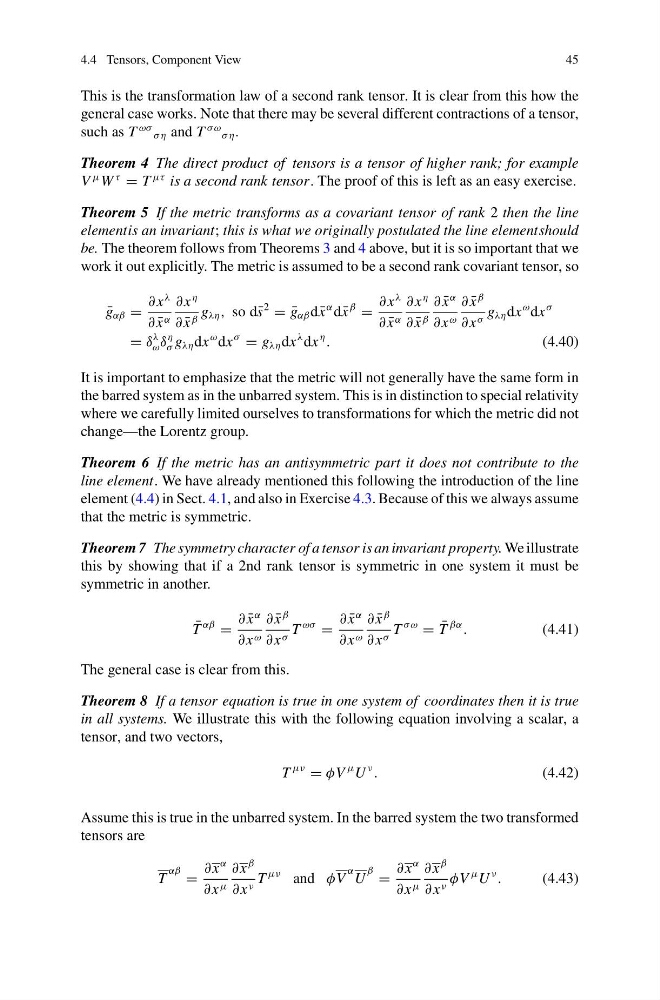
Theorem 5 If the metric transforms as a covariant tensor of rank 2 then the line
elementis an invariant; this is what we originally postulated the line elementshould
be. The theorem follows from Theorems 3 and 4 above, but it is so important that we
work it out explicitly. The metric is assumed to be a second rank covariant tensor, so
¯
g αβ =
∂ x
λ
∂ ¯
x α
∂ x
η
∂ ¯
x β g λη , so d¯ s
2
= ¯
g αβ d ¯
x
α d ¯
x
β
=
∂ x
λ
∂ ¯
x α
∂ x
η
∂ ¯
x β
∂ ¯
x
α
∂ x ω
∂ ¯
x
β
∂ x σ g λη dx
ω dx
σ
= δ
λ
ω δ
η
σ g λη dx
ω dx
σ
= g λη dx
λ dx
η
.
(4.40)
It is important to emphasize that the metric will not generally have the same form in
the barred system as in the unbarred system. This is in distinction to special relativity
where we carefully limited ourselves to transformations for which the metric did not
change—the Lorentz group.
Theorem 6 If the metric has an antisymmetric part it does not contribute to the
line element. We have already mentioned this following the introduction of the line
element (4.4) in Sect. 4.1, and also in Exercise 4.3. Because of this we always assume
that the metric is symmetric.
Theorem 7 The symmetry character of a tensor is an invariant property. We illustrate
this by showing that if a 2nd rank tensor is symmetric in one system it must be
symmetric in another.
¯
T
αβ
=
∂ ¯
x
α
∂ x ω
∂ ¯
x
β
∂ x σ T
ωσ
=
∂ ¯
x
α
∂ x ω
∂ ¯
x
β
∂ x σ T
σ ω
= ¯
T
βα
.
(4.41)
The general case is clear from this.
Theorem 8 If a tensor equation is true in one system of coordinates then it is true
in all systems. We illustrate this with the following equation involving a scalar, a
tensor, and two vectors,
T
μν
= φV
μ U
ν
.
(4.42)
Assume this is true in the unbarred system. In the barred system the two transformed
tensors are
T
αβ =
∂ x
α
∂ x μ
∂ x
β
∂ x ν T
μν and φV
α U
β =
∂ x
α
∂ x μ
∂ x
β
∂ x ν φV
μ U
ν
.
(4.43)
45
This is the transformation law of a second rank tensor. It is clear from this how the
general case works. Note that there may be several different contractions of a tensor,
such as T
ωσ σ η and T
σ ω σ η .
Theorem 4 The direct product of tensors is a tensor of higher rank; for example
V
μ W
τ
= T
μτ is a second rank tensor. The proof of this is left as an easy exercise.
Theorem 5 If the metric transforms as a covariant tensor of rank 2 then the line
elementis an invariant; this is what we originally postulated the line elementshould
be. The theorem follows from Theorems 3 and 4 above, but it is so important that we
work it out explicitly. The metric is assumed to be a second rank covariant tensor, so
¯
g αβ =
∂ x
λ
∂ ¯
x α
∂ x
η
∂ ¯
x β g λη , so d¯ s
2
= ¯
g αβ d ¯
x
α d ¯
x
β
=
∂ x
λ
∂ ¯
x α
∂ x
η
∂ ¯
x β
∂ ¯
x
α
∂ x ω
∂ ¯
x
β
∂ x σ g λη dx
ω dx
σ
= δ
λ
ω δ
η
σ g λη dx
ω dx
σ
= g λη dx
λ dx
η
.
(4.40)
It is important to emphasize that the metric will not generally have the same form in
the barred system as in the unbarred system. This is in distinction to special relativity
where we carefully limited ourselves to transformations for which the metric did not
change—the Lorentz group.
Theorem 6 If the metric has an antisymmetric part it does not contribute to the
line element. We have already mentioned this following the introduction of the line
element (4.4) in Sect. 4.1, and also in Exercise 4.3. Because of this we always assume
that the metric is symmetric.
Theorem 7 The symmetry character of a tensor is an invariant property. We illustrate
this by showing that if a 2nd rank tensor is symmetric in one system it must be
symmetric in another.
¯
T
αβ
=
∂ ¯
x
α
∂ x ω
∂ ¯
x
β
∂ x σ T
ωσ
=
∂ ¯
x
α
∂ x ω
∂ ¯
x
β
∂ x σ T
σ ω
= ¯
T
βα
.
(4.41)
The general case is clear from this.
Theorem 8 If a tensor equation is true in one system of coordinates then it is true
in all systems. We illustrate this with the following equation involving a scalar, a
tensor, and two vectors,
T
μν
= φV
μ U
ν
.
(4.42)
Assume this is true in the unbarred system. In the barred system the two transformed
tensors are
T
αβ =
∂ x
α
∂ x μ
∂ x
β
∂ x ν T
μν and φV
α U
β =
∂ x
α
∂ x μ
∂ x
β
∂ x ν φV
μ U
ν
.
(4.43)