

Appendix 3: Black Hole Remnants as Dark Matter
301
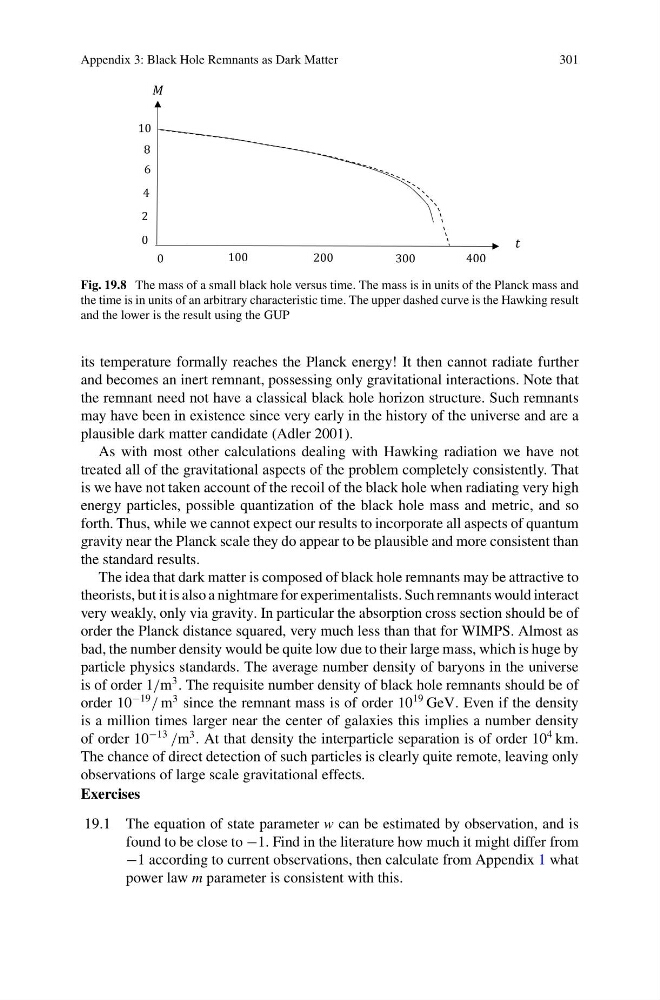
Fig. 19.8 The mass of a small black hole versus time. The mass is in units of the Planck mass and
the time is in units of an arbitrary characteristic time. The upper dashed curve is the Hawking result
and the lower is the result using the GUP
its temperature formally reaches the Planck energy! It then cannot radiate further
and becomes an inert remnant, possessing only gravitational interactions. Note that
the remnant need not have a classical black hole horizon structure. Such remnants
may have been in existence since very early in the history of the universe and are a
plausible dark matter candidate (Adler 2001).
As with most other calculations dealing with Hawking radiation we have not
treated all of the gravitational aspects of the problem completely consistently. That
is we have not taken account of the recoil of the black hole when radiating very high
energy particles, possible quantization of the black hole mass and metric, and so
forth. Thus, while we cannot expect our results to incorporate all aspects of quantum
gravity near the Planck scale they do appear to be plausible and more consistent than
the standard results.
The idea that dark matter is composed of black hole remnants may be attractive to
theorists, but it is also a nightmare for experimentalists. Such remnants would interact
very weakly, only via gravity. In particular the absorption cross section should be of
order the Planck distance squared, very much less than that for WIMPS. Almost as
bad, the number density would be quite low due to their large mass, which is huge by
particle physics standards. The average number density of baryons in the universe
is of order 1/m
3
. The requisite number density of black hole remnants should be of
order 10
−19
/ m
3 since the remnant mass is of order 10
19 GeV. Even if the density
is a million times larger near the center of galaxies this implies a number density
of order 10
−13
/m
3
. At that density the interparticle separation is of order 10
4 km.
The chance of direct detection of such particles is clearly quite remote, leaving only
observations of large scale gravitational effects.
Exercises
19.1 The equation of state parameter w can be estimated by observation, and is
found to be close to −1. Find in the literature how much it might differ from
−1 according to current observations, then calculate from Appendix 1 what
power law m parameter is consistent with this.
301
Fig. 19.8 The mass of a small black hole versus time. The mass is in units of the Planck mass and
the time is in units of an arbitrary characteristic time. The upper dashed curve is the Hawking result
and the lower is the result using the GUP
its temperature formally reaches the Planck energy! It then cannot radiate further
and becomes an inert remnant, possessing only gravitational interactions. Note that
the remnant need not have a classical black hole horizon structure. Such remnants
may have been in existence since very early in the history of the universe and are a
plausible dark matter candidate (Adler 2001).
As with most other calculations dealing with Hawking radiation we have not
treated all of the gravitational aspects of the problem completely consistently. That
is we have not taken account of the recoil of the black hole when radiating very high
energy particles, possible quantization of the black hole mass and metric, and so
forth. Thus, while we cannot expect our results to incorporate all aspects of quantum
gravity near the Planck scale they do appear to be plausible and more consistent than
the standard results.
The idea that dark matter is composed of black hole remnants may be attractive to
theorists, but it is also a nightmare for experimentalists. Such remnants would interact
very weakly, only via gravity. In particular the absorption cross section should be of
order the Planck distance squared, very much less than that for WIMPS. Almost as
bad, the number density would be quite low due to their large mass, which is huge by
particle physics standards. The average number density of baryons in the universe
is of order 1/m
3
. The requisite number density of black hole remnants should be of
order 10
−19
/ m
3 since the remnant mass is of order 10
19 GeV. Even if the density
is a million times larger near the center of galaxies this implies a number density
of order 10
−13
/m
3
. At that density the interparticle separation is of order 10
4 km.
The chance of direct detection of such particles is clearly quite remote, leaving only
observations of large scale gravitational effects.
Exercises
19.1 The equation of state parameter w can be estimated by observation, and is
found to be close to −1. Find in the literature how much it might differ from
−1 according to current observations, then calculate from Appendix 1 what
power law m parameter is consistent with this.