

18
2 Lorentz Transformations
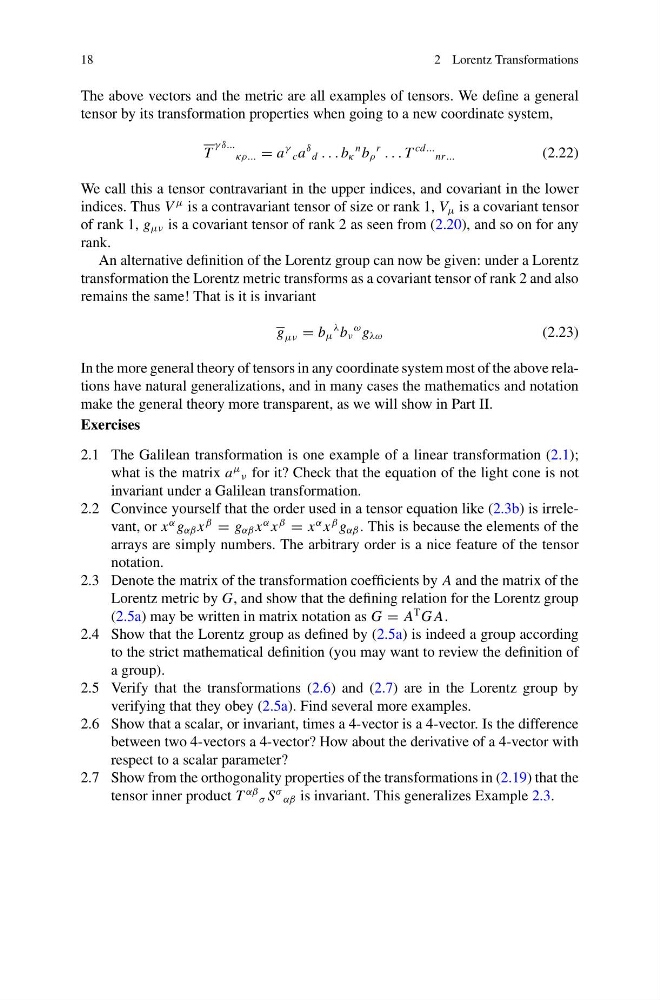
The above vectors and the metric are all examples of tensors. We define a general
tensor by its transformation properties when going to a new coordinate system,
T
γ δ...
κρ... = a
γ
c a
δ
d . . . b κ
n b ρ
r
. . . T
cd...
nr...
(2.22)
We call this a tensor contravariant in the upper indices, and covariant in the lower
indices. Thus V
μ is a contravariant tensor of size or rank 1, V μ is a covariant tensor
of rank 1, g μν is a covariant tensor of rank 2 as seen from (2.20), and so on for any
rank.
An alternative definition of the Lorentz group can now be given: under a Lorentz
transformation the Lorentz metric transforms as a covariant tensor of rank 2 and also
remains the same! That is it is invariant
g μν = b μ
λ b ν
ω g λω
(2.23)
In the more general theory of tensors in any coordinate system most of the above relations have natural generalizations, and in many cases the mathematics and notation
make the general theory more transparent, as we will show in Part II.
Exercises
2.1 The Galilean transformation is one example of a linear transformation (2.1);
what is the matrix a
μ ν for it? Check that the equation of the light cone is not
invariant under a Galilean transformation.
2.2 Convince yourself that the order used in a tensor equation like (2.3b) is irrelevant, or x
α g αβ x
β
= g αβ x
α x
β
= x
α x
β g αβ . This is because the elements of the
arrays are simply numbers. The arbitrary order is a nice feature of the tensor
notation.
2.3 Denote the matrix of the transformation coefficients by A and the matrix of the
Lorentz metric by G, and show that the defining relation for the Lorentz group
(2.5a) may be written in matrix notation as G = A
T G A.
2.4 Show that the Lorentz group as defined by (2.5a) is indeed a group according
to the strict mathematical definition (you may want to review the definition of
a group).
2.5 Verify that the transformations (2.6) and (2.7) are in the Lorentz group by
verifying that they obey (2.5a). Find several more examples.
2.6 Show that a scalar, or invariant, times a 4-vector is a 4-vector. Is the difference
between two 4-vectors a 4-vector? How about the derivative of a 4-vector with
respect to a scalar parameter?
2.7 Show from the orthogonality properties of the transformations in (2.19) that the
tensor inner product T
αβ σ S
σ αβ is invariant. This generalizes Example 2.3.
2 Lorentz Transformations
The above vectors and the metric are all examples of tensors. We define a general
tensor by its transformation properties when going to a new coordinate system,
T
γ δ...
κρ... = a
γ
c a
δ
d . . . b κ
n b ρ
r
. . . T
cd...
nr...
(2.22)
We call this a tensor contravariant in the upper indices, and covariant in the lower
indices. Thus V
μ is a contravariant tensor of size or rank 1, V μ is a covariant tensor
of rank 1, g μν is a covariant tensor of rank 2 as seen from (2.20), and so on for any
rank.
An alternative definition of the Lorentz group can now be given: under a Lorentz
transformation the Lorentz metric transforms as a covariant tensor of rank 2 and also
remains the same! That is it is invariant
g μν = b μ
λ b ν
ω g λω
(2.23)
In the more general theory of tensors in any coordinate system most of the above relations have natural generalizations, and in many cases the mathematics and notation
make the general theory more transparent, as we will show in Part II.
Exercises
2.1 The Galilean transformation is one example of a linear transformation (2.1);
what is the matrix a
μ ν for it? Check that the equation of the light cone is not
invariant under a Galilean transformation.
2.2 Convince yourself that the order used in a tensor equation like (2.3b) is irrelevant, or x
α g αβ x
β
= g αβ x
α x
β
= x
α x
β g αβ . This is because the elements of the
arrays are simply numbers. The arbitrary order is a nice feature of the tensor
notation.
2.3 Denote the matrix of the transformation coefficients by A and the matrix of the
Lorentz metric by G, and show that the defining relation for the Lorentz group
(2.5a) may be written in matrix notation as G = A
T G A.
2.4 Show that the Lorentz group as defined by (2.5a) is indeed a group according
to the strict mathematical definition (you may want to review the definition of
a group).
2.5 Verify that the transformations (2.6) and (2.7) are in the Lorentz group by
verifying that they obey (2.5a). Find several more examples.
2.6 Show that a scalar, or invariant, times a 4-vector is a 4-vector. Is the difference
between two 4-vectors a 4-vector? How about the derivative of a 4-vector with
respect to a scalar parameter?
2.7 Show from the orthogonality properties of the transformations in (2.19) that the
tensor inner product T
αβ σ S
σ αβ is invariant. This generalizes Example 2.3.