

292
19 Inflation and Some Questions
be argued that the end result could be a black hole remnant of about the Planck
mass, that is of order 10
19 GeV (Adler 2001). Such a particle would have only a
gravitational interaction and also a very low number density. As a result it would be
extraordinarily difficult to detect in the lab or by any means other than large scale
gravitational effects; it would be an experimentalist’s nightmare. Moreover Hawking
radiation has been searched for and not yet seen, so black hole remnants are quite
speculative. We will discuss them further in the next section on quantum effects and
in Appendix 3.
An entirely different possibility is that dark matter simply does not exist, that
general relativity is not the correct or complete theory of gravity and the many observations that purport to measure dark matter on a galactic scale and larger are not being
interpreted correctly. One such type of theory is called MOND for “modified Newtonian dynamics” (Milgrom 2014). Another is called conformal gravity (Mannheim
2011). Such theories are not now in the mainstream so we refer the reader to the
above references.
19.6 The Planck Era and Quantum Physics
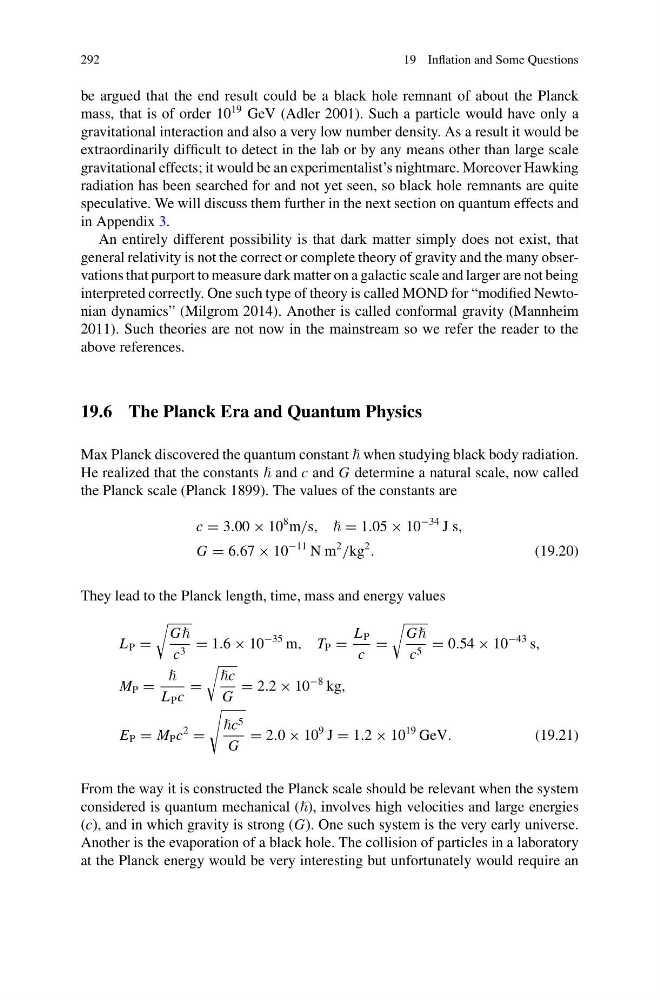
Max Planck discovered the quantum constant when studying black body radiation.
He realized that the constants and c and G determine a natural scale, now called
the Planck scale (Planck 1899). The values of the constants are
c = 3.00 × 10
8 m/s, = 1.05 × 10
−34 J s,
G = 6.67 × 10
−11 N m
2
/kg
2
.
(19.20)
They lead to the Planck length, time, mass and energy values
L P =
G
c 3 = 1.6 × 10
−35 m, T P =
L P
c
=
G
c 5 = 0.54 × 10
−43 s,
M P =
L P c
=
c
G
= 2.2 × 10
−8 kg,
E P = M P c
2
=
c 5
G
= 2.0 × 10
9 J = 1.2 × 10
19 GeV.
(19.21)
From the way it is constructed the Planck scale should be relevant when the system
considered is quantum mechanical (), involves high velocities and large energies
(c), and in which gravity is strong (G). One such system is the very early universe.
Another is the evaporation of a black hole. The collision of particles in a laboratory
at the Planck energy would be very interesting but unfortunately would require an
19 Inflation and Some Questions
be argued that the end result could be a black hole remnant of about the Planck
mass, that is of order 10
19 GeV (Adler 2001). Such a particle would have only a
gravitational interaction and also a very low number density. As a result it would be
extraordinarily difficult to detect in the lab or by any means other than large scale
gravitational effects; it would be an experimentalist’s nightmare. Moreover Hawking
radiation has been searched for and not yet seen, so black hole remnants are quite
speculative. We will discuss them further in the next section on quantum effects and
in Appendix 3.
An entirely different possibility is that dark matter simply does not exist, that
general relativity is not the correct or complete theory of gravity and the many observations that purport to measure dark matter on a galactic scale and larger are not being
interpreted correctly. One such type of theory is called MOND for “modified Newtonian dynamics” (Milgrom 2014). Another is called conformal gravity (Mannheim
2011). Such theories are not now in the mainstream so we refer the reader to the
above references.
19.6 The Planck Era and Quantum Physics
Max Planck discovered the quantum constant when studying black body radiation.
He realized that the constants and c and G determine a natural scale, now called
the Planck scale (Planck 1899). The values of the constants are
c = 3.00 × 10
8 m/s, = 1.05 × 10
−34 J s,
G = 6.67 × 10
−11 N m
2
/kg
2
.
(19.20)
They lead to the Planck length, time, mass and energy values
L P =
G
c 3 = 1.6 × 10
−35 m, T P =
L P
c
=
G
c 5 = 0.54 × 10
−43 s,
M P =
L P c
=
c
G
= 2.2 × 10
−8 kg,
E P = M P c
2
=
c 5
G
= 2.0 × 10
9 J = 1.2 × 10
19 GeV.
(19.21)
From the way it is constructed the Planck scale should be relevant when the system
considered is quantum mechanical (), involves high velocities and large energies
(c), and in which gravity is strong (G). One such system is the very early universe.
Another is the evaporation of a black hole. The collision of particles in a laboratory
at the Planck energy would be very interesting but unfortunately would require an