

288
19 Inflation and Some Questions
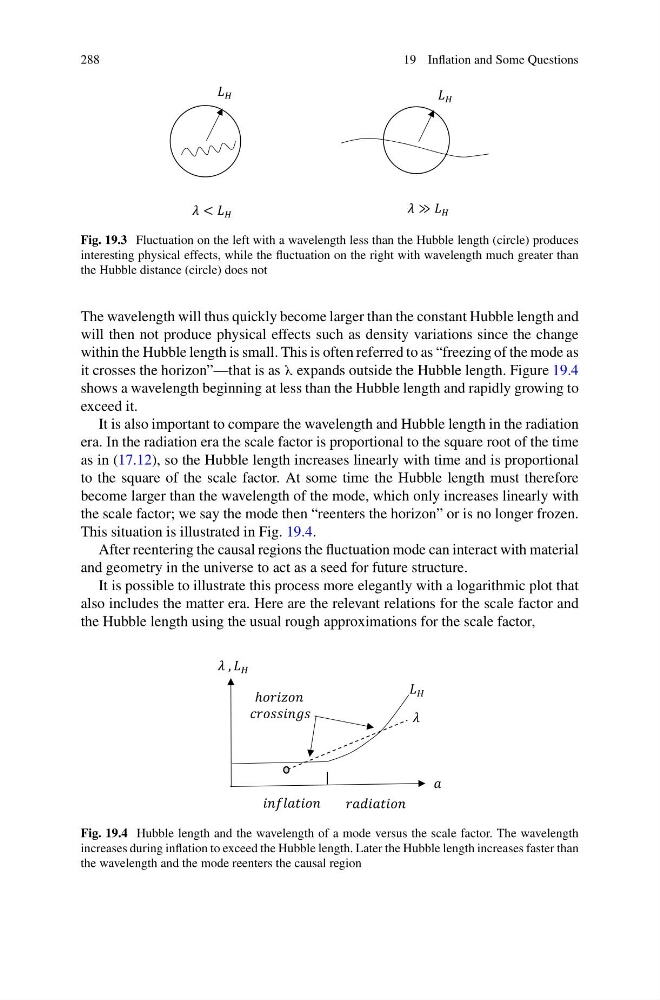
Fig. 19.3 Fluctuation on the left with a wavelength less than the Hubble length (circle) produces
interesting physical effects, while the fluctuation on the right with wavelength much greater than
the Hubble distance (circle) does not
The wavelength will thus quickly become larger than the constant Hubble length and
will then not produce physical effects such as density variations since the change
within the Hubble length is small. This is often referred to as “freezing of the mode as
it crosses the horizon”—that is as λ expands outside the Hubble length. Figure 19.4
shows a wavelength beginning at less than the Hubble length and rapidly growing to
exceed it.
It is also important to compare the wavelength and Hubble length in the radiation
era. In the radiation era the scale factor is proportional to the square root of the time
as in (17.12), so the Hubble length increases linearly with time and is proportional
to the square of the scale factor. At some time the Hubble length must therefore
become larger than the wavelength of the mode, which only increases linearly with
the scale factor; we say the mode then “reenters the horizon” or is no longer frozen.
This situation is illustrated in Fig. 19.4.
After reentering the causal regions the fluctuation mode can interact with material
and geometry in the universe to act as a seed for future structure.
It is possible to illustrate this process more elegantly with a logarithmic plot that
also includes the matter era. Here are the relevant relations for the scale factor and
the Hubble length using the usual rough approximations for the scale factor,
Fig. 19.4 Hubble length and the wavelength of a mode versus the scale factor. The wavelength
increases during inflation to exceed the Hubble length. Later the Hubble length increases faster than
the wavelength and the mode reenters the causal region
19 Inflation and Some Questions
Fig. 19.3 Fluctuation on the left with a wavelength less than the Hubble length (circle) produces
interesting physical effects, while the fluctuation on the right with wavelength much greater than
the Hubble distance (circle) does not
The wavelength will thus quickly become larger than the constant Hubble length and
will then not produce physical effects such as density variations since the change
within the Hubble length is small. This is often referred to as “freezing of the mode as
it crosses the horizon”—that is as λ expands outside the Hubble length. Figure 19.4
shows a wavelength beginning at less than the Hubble length and rapidly growing to
exceed it.
It is also important to compare the wavelength and Hubble length in the radiation
era. In the radiation era the scale factor is proportional to the square root of the time
as in (17.12), so the Hubble length increases linearly with time and is proportional
to the square of the scale factor. At some time the Hubble length must therefore
become larger than the wavelength of the mode, which only increases linearly with
the scale factor; we say the mode then “reenters the horizon” or is no longer frozen.
This situation is illustrated in Fig. 19.4.
After reentering the causal regions the fluctuation mode can interact with material
and geometry in the universe to act as a seed for future structure.
It is possible to illustrate this process more elegantly with a logarithmic plot that
also includes the matter era. Here are the relevant relations for the scale factor and
the Hubble length using the usual rough approximations for the scale factor,
Fig. 19.4 Hubble length and the wavelength of a mode versus the scale factor. The wavelength
increases during inflation to exceed the Hubble length. Later the Hubble length increases faster than
the wavelength and the mode reenters the causal region