

19.2 Inflation Via Scalar Fields
285
(Appendix 2) and the Lagrangian in (19.9) to be
1
√
−|g|
−|g|ϕ, μ g
μν
,ν
+
∂ V
∂ϕ
= 0.
(19.10)
The first term we recognize as the covariant Laplacian, discussed in Chap. 6.
We assume the inflaton field is at least approximately uniform, as appropriate to
an isotropic and homogeneous universe, and use the FLRW metric to obtain the
dynamical equation
¨
ϕ + 3H ˙
ϕ +
∂ V
∂ϕ
= 0, H ≡
˙
a
a
.
(19.11)
Here H is the usual Hubble function and the dot denotes a time derivative. This
equation is the same as that of a particle acted on by a driving force proportional
to the derivative of the potential function and a damping term proportional to the
Hubble function. See Exercises 19.4 and 19.5.
The energy-momentum tensor for the scalar field is fundamentally important since
it is the source of the gravitational field. It may be defined as the variational derivative
of the Lagrangian with respect to the metric and found by standard methods to give
the energy density and pressure of a uniform scalar field (Appendix 2). The result is
ρ ϕ =
1
2
˙
ϕ
2
+ V, p ϕ =
1
2
˙
ϕ
2
− V,
p ϕ
ρ ϕ
= −
V − ˙
ϕ
2
/2
V + ˙
ϕ 2 /2
.
(19.12)
These relations make it clear that a scalar field can act like a constant vacuum density
fluid if the field is spatially uniform and has negligible time variation compared to the
potential V ; that is its effective equation of state is p = −ρ and the energy density
is dominantly due to the self-interaction, ρ ∼ = V .
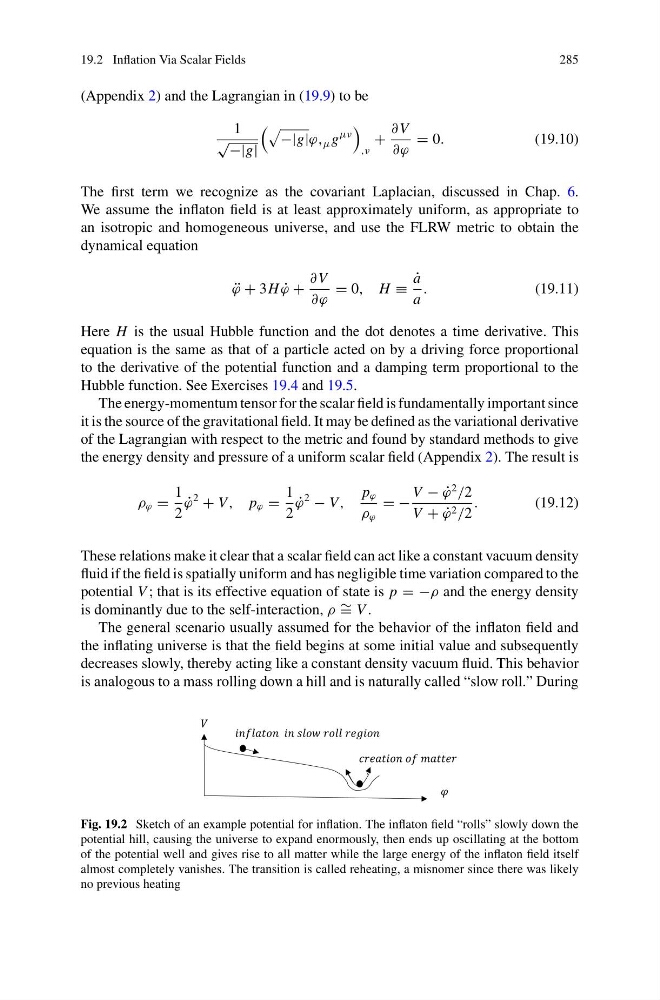
The general scenario usually assumed for the behavior of the inflaton field and
the inflating universe is that the field begins at some initial value and subsequently
decreases slowly, thereby acting like a constant density vacuum fluid. This behavior
is analogous to a mass rolling down a hill and is naturally called “slow roll.” During
Fig. 19.2 Sketch of an example potential for inflation. The inflaton field “rolls” slowly down the
potential hill, causing the universe to expand enormously, then ends up oscillating at the bottom
of the potential well and gives rise to all matter while the large energy of the inflaton field itself
almost completely vanishes. The transition is called reheating, a misnomer since there was likely
no previous heating
285
(Appendix 2) and the Lagrangian in (19.9) to be
1
√
−|g|
−|g|ϕ, μ g
μν
,ν
+
∂ V
∂ϕ
= 0.
(19.10)
The first term we recognize as the covariant Laplacian, discussed in Chap. 6.
We assume the inflaton field is at least approximately uniform, as appropriate to
an isotropic and homogeneous universe, and use the FLRW metric to obtain the
dynamical equation
¨
ϕ + 3H ˙
ϕ +
∂ V
∂ϕ
= 0, H ≡
˙
a
a
.
(19.11)
Here H is the usual Hubble function and the dot denotes a time derivative. This
equation is the same as that of a particle acted on by a driving force proportional
to the derivative of the potential function and a damping term proportional to the
Hubble function. See Exercises 19.4 and 19.5.
The energy-momentum tensor for the scalar field is fundamentally important since
it is the source of the gravitational field. It may be defined as the variational derivative
of the Lagrangian with respect to the metric and found by standard methods to give
the energy density and pressure of a uniform scalar field (Appendix 2). The result is
ρ ϕ =
1
2
˙
ϕ
2
+ V, p ϕ =
1
2
˙
ϕ
2
− V,
p ϕ
ρ ϕ
= −
V − ˙
ϕ
2
/2
V + ˙
ϕ 2 /2
.
(19.12)
These relations make it clear that a scalar field can act like a constant vacuum density
fluid if the field is spatially uniform and has negligible time variation compared to the
potential V ; that is its effective equation of state is p = −ρ and the energy density
is dominantly due to the self-interaction, ρ ∼ = V .
The general scenario usually assumed for the behavior of the inflaton field and
the inflating universe is that the field begins at some initial value and subsequently
decreases slowly, thereby acting like a constant density vacuum fluid. This behavior
is analogous to a mass rolling down a hill and is naturally called “slow roll.” During
Fig. 19.2 Sketch of an example potential for inflation. The inflaton field “rolls” slowly down the
potential hill, causing the universe to expand enormously, then ends up oscillating at the bottom
of the potential well and gives rise to all matter while the large energy of the inflaton field itself
almost completely vanishes. The transition is called reheating, a misnomer since there was likely
no previous heating