

19.1 Basic Ideas of Inflation
283
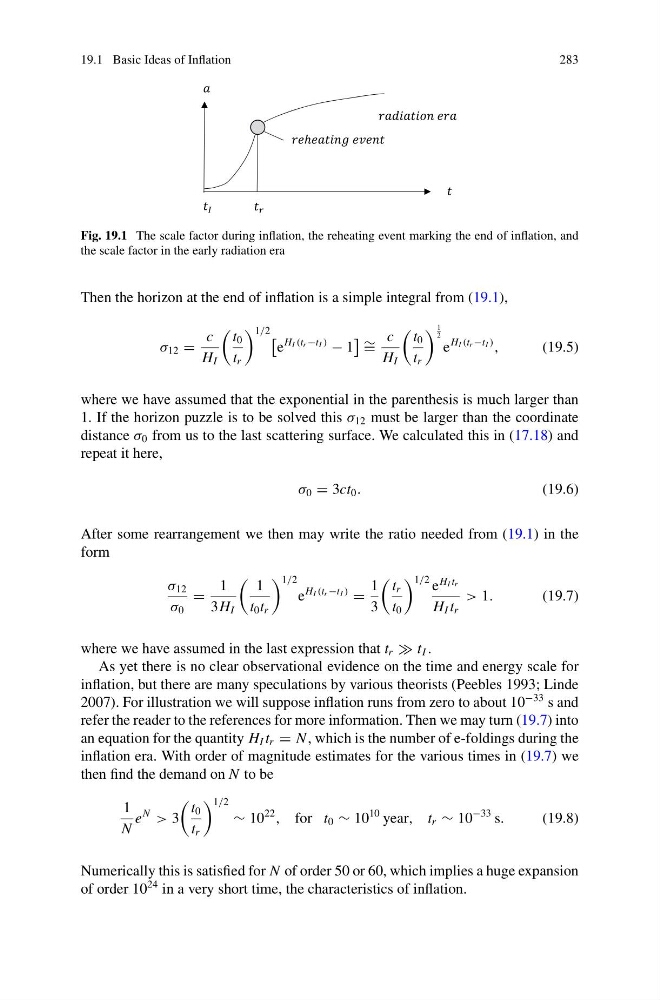
Fig. 19.1 The scale factor during inflation, the reheating event marking the end of inflation, and
the scale factor in the early radiation era
Then the horizon at the end of inflation is a simple integral from (19.1),
σ 12 =
c
H I
t 0
t r
1/2
e
H I (t r −t I )
− 1
∼ =
c
H I
t 0
t r
1
2
e
H I (tr −t I )
,
(19.5)
where we have assumed that the exponential in the parenthesis is much larger than
1. If the horizon puzzle is to be solved this σ 12 must be larger than the coordinate
distance σ 0 from us to the last scattering surface. We calculated this in (17.18) and
repeat it here,
σ 0 = 3ct 0 .
(19.6)
After some rearrangement we then may write the ratio needed from (19.1) in the
form
σ 12
σ 0
=
1
3H I
1
t 0 t r
1/2
e
H I (tr −t I )
=
1
3
t r
t 0
1/2 e
H I t r
H I t r
> 1.
(19.7)
where we have assumed in the last expression that t r t I .
As yet there is no clear observational evidence on the time and energy scale for
inflation, but there are many speculations by various theorists (Peebles 1993; Linde
2007). For illustration we will suppose inflation runs from zero to about 10
−33 s and
refer the reader to the references for more information. Then we may turn (19.7) into
an equation for the quantity H I t r = N , which is the number of e-foldings during the
inflation era. With order of magnitude estimates for the various times in (19.7) we
then find the demand on N to be
1
N
e
N
> 3
t 0
t r
1/2
∼ 10
22
, for t 0 ∼ 10
10 year, t r ∼ 10
−33 s.
(19.8)
Numerically this is satisfied for N of order 50 or 60, which implies a huge expansion
of order 10
24 in a very short time, the characteristics of inflation.
283
Fig. 19.1 The scale factor during inflation, the reheating event marking the end of inflation, and
the scale factor in the early radiation era
Then the horizon at the end of inflation is a simple integral from (19.1),
σ 12 =
c
H I
t 0
t r
1/2
e
H I (t r −t I )
− 1
∼ =
c
H I
t 0
t r
1
2
e
H I (tr −t I )
,
(19.5)
where we have assumed that the exponential in the parenthesis is much larger than
1. If the horizon puzzle is to be solved this σ 12 must be larger than the coordinate
distance σ 0 from us to the last scattering surface. We calculated this in (17.18) and
repeat it here,
σ 0 = 3ct 0 .
(19.6)
After some rearrangement we then may write the ratio needed from (19.1) in the
form
σ 12
σ 0
=
1
3H I
1
t 0 t r
1/2
e
H I (tr −t I )
=
1
3
t r
t 0
1/2 e
H I t r
H I t r
> 1.
(19.7)
where we have assumed in the last expression that t r t I .
As yet there is no clear observational evidence on the time and energy scale for
inflation, but there are many speculations by various theorists (Peebles 1993; Linde
2007). For illustration we will suppose inflation runs from zero to about 10
−33 s and
refer the reader to the references for more information. Then we may turn (19.7) into
an equation for the quantity H I t r = N , which is the number of e-foldings during the
inflation era. With order of magnitude estimates for the various times in (19.7) we
then find the demand on N to be
1
N
e
N
> 3
t 0
t r
1/2
∼ 10
22
, for t 0 ∼ 10
10 year, t r ∼ 10
−33 s.
(19.8)
Numerically this is satisfied for N of order 50 or 60, which implies a huge expansion
of order 10
24 in a very short time, the characteristics of inflation.