

276
18 A Brief Historical Overview of the Universe
The present universe contains mainly hydrogen atoms, about 90% by number,
and Helium atoms, about 10% by number, with everything else being much less.
Only hydrogen and helium, and a small amount of deuterium and helium 3 and
lithium, have existed during most of the life of the universe, and we call these the
primordial elements. The heavier elements that are familiar and abundant on earth
were all formed millions and billions of years later by fusion in stellar interiors,
and subsequently ejected into space by supernova explosions; many of the heaviest
elements are now believed to be formed in kilonovas, the collisions of neutron stars
with other neutron stars or with black holes, indicated by gravitational waves (Peebles
1993; Kasen 2017; Holz 2018). Thus the material that we and our planet are mainly
composed of had quite a spectacular origin in diverse stellar explosions. However we
may ignore elements other than hydrogen and helium in much of our cosmological
discussion.
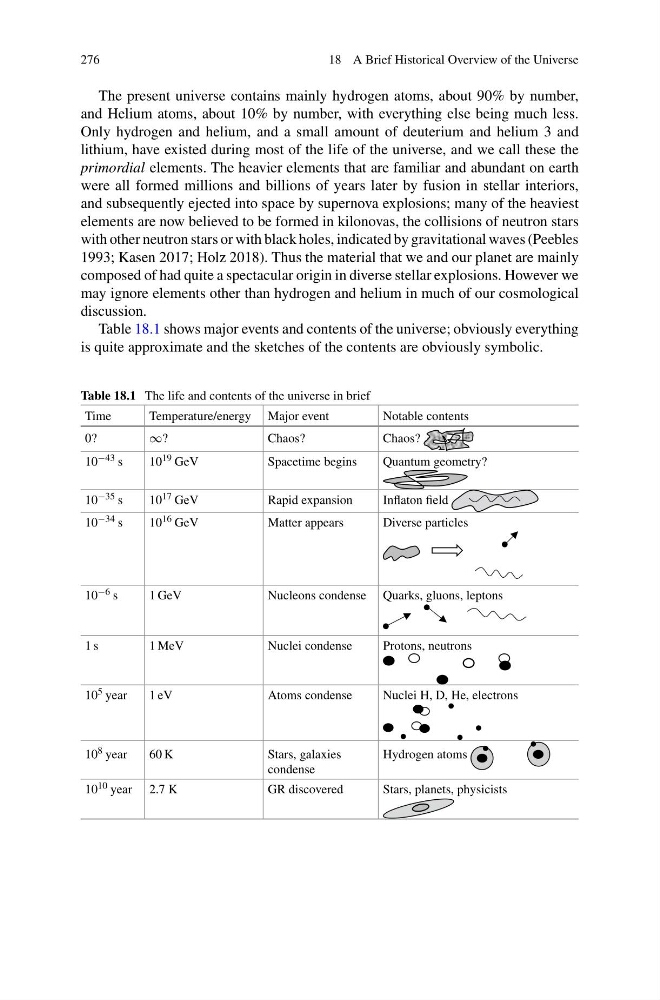
Table 18.1 shows major events and contents of the universe; obviously everything
is quite approximate and the sketches of the contents are obviously symbolic.
Table 18.1 The life and contents of the universe in brief
Time
Temperature/energy Major event
Notable contents
0?
∞?
Chaos?
Chaos?
10 −43 s
10 19 GeV
Spacetime begins
Quantum geometry?
10 −35 s
10 17 GeV
Rapid expansion
Inflaton field
10 −34 s
10 16 GeV
Matter appears
Diverse particles
10 −6 s
1 GeV
Nucleons condense Quarks, gluons, leptons
1 s
1 MeV
Nuclei condense
Protons, neutrons
10 5 year
1 eV
Atoms condense
Nuclei H, D, He, electrons
10 8 year
60 K
Stars, galaxies
condense
Hydrogen atoms
10 10 year 2.7 K
GR discovered
Stars, planets, physicists
18 A Brief Historical Overview of the Universe
The present universe contains mainly hydrogen atoms, about 90% by number,
and Helium atoms, about 10% by number, with everything else being much less.
Only hydrogen and helium, and a small amount of deuterium and helium 3 and
lithium, have existed during most of the life of the universe, and we call these the
primordial elements. The heavier elements that are familiar and abundant on earth
were all formed millions and billions of years later by fusion in stellar interiors,
and subsequently ejected into space by supernova explosions; many of the heaviest
elements are now believed to be formed in kilonovas, the collisions of neutron stars
with other neutron stars or with black holes, indicated by gravitational waves (Peebles
1993; Kasen 2017; Holz 2018). Thus the material that we and our planet are mainly
composed of had quite a spectacular origin in diverse stellar explosions. However we
may ignore elements other than hydrogen and helium in much of our cosmological
discussion.
Table 18.1 shows major events and contents of the universe; obviously everything
is quite approximate and the sketches of the contents are obviously symbolic.
Table 18.1 The life and contents of the universe in brief
Time
Temperature/energy Major event
Notable contents
0?
∞?
Chaos?
Chaos?
10 −43 s
10 19 GeV
Spacetime begins
Quantum geometry?
10 −35 s
10 17 GeV
Rapid expansion
Inflaton field
10 −34 s
10 16 GeV
Matter appears
Diverse particles
10 −6 s
1 GeV
Nucleons condense Quarks, gluons, leptons
1 s
1 MeV
Nuclei condense
Protons, neutrons
10 5 year
1 eV
Atoms condense
Nuclei H, D, He, electrons
10 8 year
60 K
Stars, galaxies
condense
Hydrogen atoms
10 10 year 2.7 K
GR discovered
Stars, planets, physicists