

2.1 The Lorentz Group
15
This relation (2.5a) defines the Lorentz group of transformations. The quantity s
2
plays the role of a four-dimensional distance or arc length. We thus say that the 4distance is invariant under transformations in the Lorentz group. In matrix form the
defining relation (2.5a) may be expressed as
G = A
T G A,
(2.5b)
where the T denotes the transpose matrix; you are asked to verify this in Exercise
2.3.
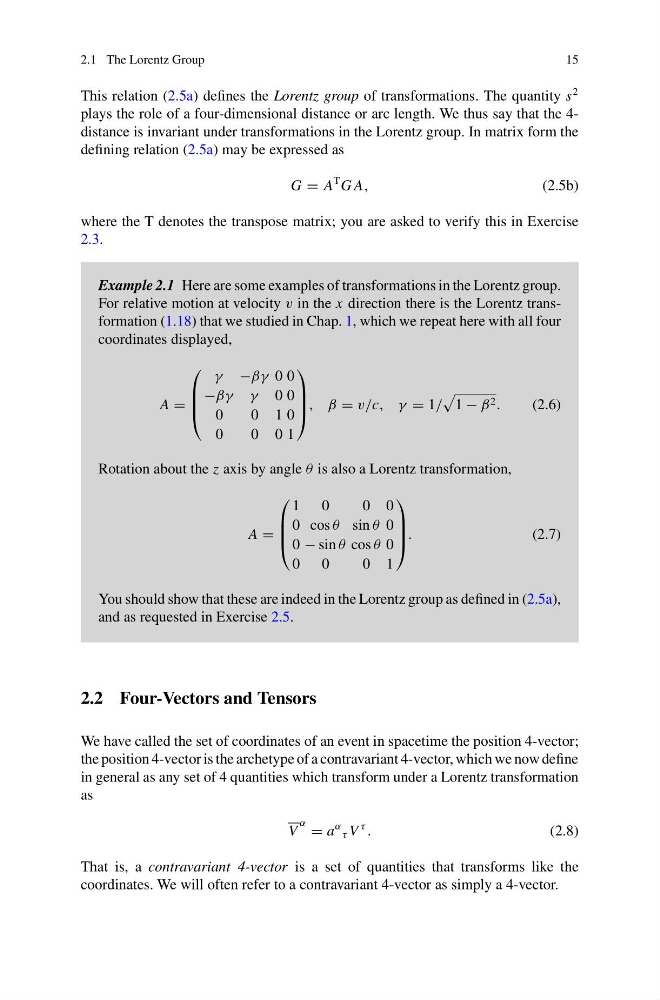
Example 2.1 Here are some examples of transformations in the Lorentz group.
For relative motion at velocity v in the x direction there is the Lorentz transformation (1.18) that we studied in Chap. 1, which we repeat here with all four
coordinates displayed,
A =
⎛
⎜
⎜
⎝
γ −βγ 0 0
−βγ γ 0 0
0
0 1 0
0
0 0 1
⎞
⎟
⎟
⎠ , β = v/c, γ = 1/
1 − β 2 .
(2.6)
Rotation about the z axis by angle θ is also a Lorentz transformation,
A =
⎛
⎜
⎜
⎝
1 0
0 0
0 cos θ sin θ 0
0 − sin θ cos θ 0
0 0
0 1
⎞
⎟
⎟
⎠ .
(2.7)
You should show that these are indeed in the Lorentz group as defined in (2.5a),
and as requested in Exercise 2.5.
2.2 Four-Vectors and Tensors
We have called the set of coordinates of an event in spacetime the position 4-vector;
the position 4-vector is the archetype of a contravariant 4-vector, which we now define
in general as any set of 4 quantities which transform under a Lorentz transformation
as
V
α = a
α τ V
τ
.
(2.8)
That is, a contravariant 4-vector is a set of quantities that transforms like the
coordinates. We will often refer to a contravariant 4-vector as simply a 4-vector.
15
This relation (2.5a) defines the Lorentz group of transformations. The quantity s
2
plays the role of a four-dimensional distance or arc length. We thus say that the 4distance is invariant under transformations in the Lorentz group. In matrix form the
defining relation (2.5a) may be expressed as
G = A
T G A,
(2.5b)
where the T denotes the transpose matrix; you are asked to verify this in Exercise
2.3.
Example 2.1 Here are some examples of transformations in the Lorentz group.
For relative motion at velocity v in the x direction there is the Lorentz transformation (1.18) that we studied in Chap. 1, which we repeat here with all four
coordinates displayed,
A =
⎛
⎜
⎜
⎝
γ −βγ 0 0
−βγ γ 0 0
0
0 1 0
0
0 0 1
⎞
⎟
⎟
⎠ , β = v/c, γ = 1/
1 − β 2 .
(2.6)
Rotation about the z axis by angle θ is also a Lorentz transformation,
A =
⎛
⎜
⎜
⎝
1 0
0 0
0 cos θ sin θ 0
0 − sin θ cos θ 0
0 0
0 1
⎞
⎟
⎟
⎠ .
(2.7)
You should show that these are indeed in the Lorentz group as defined in (2.5a),
and as requested in Exercise 2.5.
2.2 Four-Vectors and Tensors
We have called the set of coordinates of an event in spacetime the position 4-vector;
the position 4-vector is the archetype of a contravariant 4-vector, which we now define
in general as any set of 4 quantities which transform under a Lorentz transformation
as
V
α = a
α τ V
τ
.
(2.8)
That is, a contravariant 4-vector is a set of quantities that transforms like the
coordinates. We will often refer to a contravariant 4-vector as simply a 4-vector.