

Appendix 3: Some Discarded Cosmological Models
245
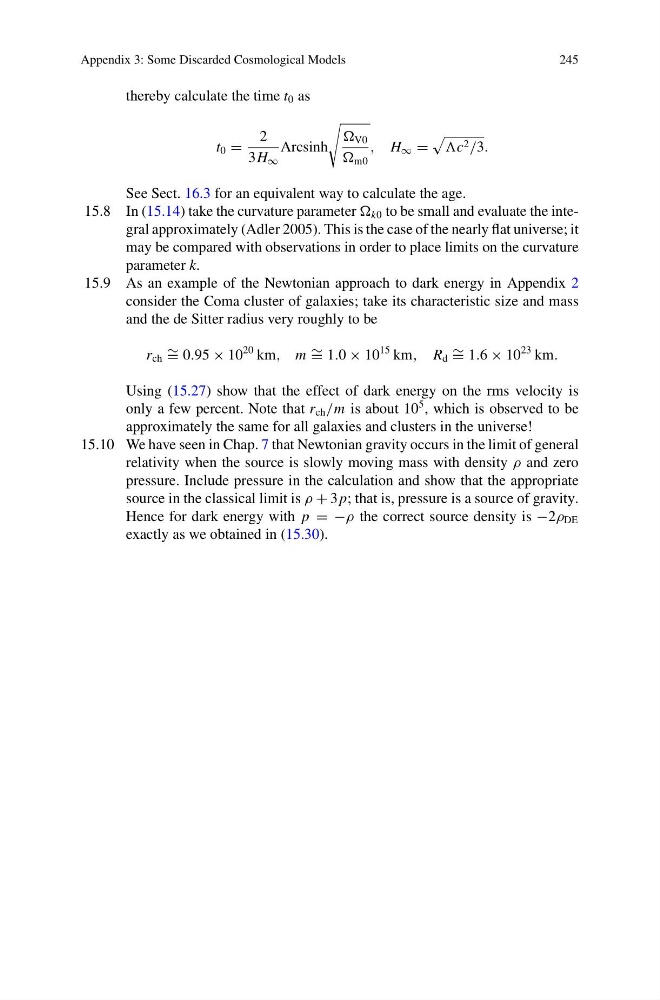
thereby calculate the time t 0 as
t 0 =
2
3H ∞
Arcsinh
V0
m0
, H ∞ =
c 2 /3.
See Sect. 16.3 for an equivalent way to calculate the age.
15.8 In (15.14) take the curvature parameter k0 to be small and evaluate the integral approximately (Adler 2005). This is the case of the nearly flat universe; it
may be compared with observations in order to place limits on the curvature
parameter k.
15.9 As an example of the Newtonian approach to dark energy in Appendix 2
consider the Coma cluster of galaxies; take its characteristic size and mass
and the de Sitter radius very roughly to be
r ch ∼ = 0.95 × 10
20 km, m ∼ = 1.0 × 10
15 km, R d ∼ = 1.6 × 10
23 km.
Using (15.27) show that the effect of dark energy on the rms velocity is
only a few percent. Note that r ch /m is about 10
5 , which is observed to be
approximately the same for all galaxies and clusters in the universe!
15.10 We have seen in Chap. 7 that Newtonian gravity occurs in the limit of general
relativity when the source is slowly moving mass with density ρ and zero
pressure. Include pressure in the calculation and show that the appropriate
source in the classical limit is ρ + 3 p; that is, pressure is a source of gravity.
Hence for dark energy with p = −ρ the correct source density is −2ρ DE
exactly as we obtained in (15.30).
245
thereby calculate the time t 0 as
t 0 =
2
3H ∞
Arcsinh
V0
m0
, H ∞ =
c 2 /3.
See Sect. 16.3 for an equivalent way to calculate the age.
15.8 In (15.14) take the curvature parameter k0 to be small and evaluate the integral approximately (Adler 2005). This is the case of the nearly flat universe; it
may be compared with observations in order to place limits on the curvature
parameter k.
15.9 As an example of the Newtonian approach to dark energy in Appendix 2
consider the Coma cluster of galaxies; take its characteristic size and mass
and the de Sitter radius very roughly to be
r ch ∼ = 0.95 × 10
20 km, m ∼ = 1.0 × 10
15 km, R d ∼ = 1.6 × 10
23 km.
Using (15.27) show that the effect of dark energy on the rms velocity is
only a few percent. Note that r ch /m is about 10
5 , which is observed to be
approximately the same for all galaxies and clusters in the universe!
15.10 We have seen in Chap. 7 that Newtonian gravity occurs in the limit of general
relativity when the source is slowly moving mass with density ρ and zero
pressure. Include pressure in the calculation and show that the appropriate
source in the classical limit is ρ + 3 p; that is, pressure is a source of gravity.
Hence for dark energy with p = −ρ the correct source density is −2ρ DE
exactly as we obtained in (15.30).