

238
15 Solutions for the Present Universe
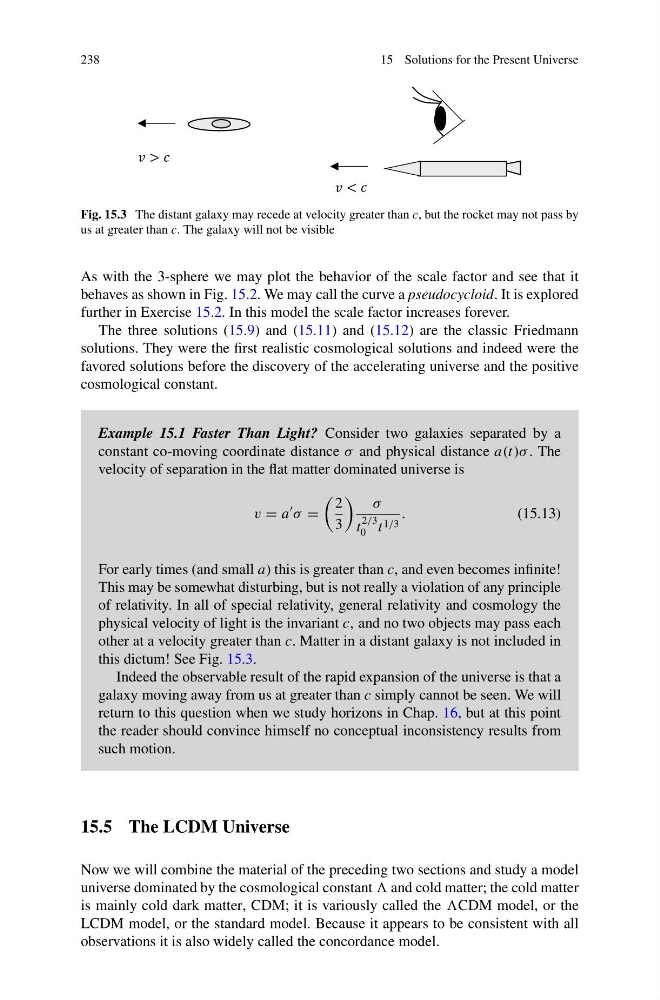
Fig. 15.3 The distant galaxy may recede at velocity greater than c, but the rocket may not pass by
us at greater than c. The galaxy will not be visible
As with the 3-sphere we may plot the behavior of the scale factor and see that it
behaves as shown in Fig. 15.2. We may call the curve a pseudocycloid. It is explored
further in Exercise 15.2. In this model the scale factor increases forever.
The three solutions (15.9) and (15.11) and (15.12) are the classic Friedmann
solutions. They were the first realistic cosmological solutions and indeed were the
favored solutions before the discovery of the accelerating universe and the positive
cosmological constant.
Example 15.1 Faster Than Light? Consider two galaxies separated by a
constant co-moving coordinate distance σ and physical distance a(t)σ . The
velocity of separation in the flat matter dominated universe is
v = a
σ =
2
3
σ
t
2/3
0 t 1/3
.
(15.13)
For early times (and small a) this is greater than c, and even becomes infinite!
This may be somewhat disturbing, but is not really a violation of any principle
of relativity. In all of special relativity, general relativity and cosmology the
physical velocity of light is the invariant c, and no two objects may pass each
other at a velocity greater than c. Matter in a distant galaxy is not included in
this dictum! See Fig. 15.3.
Indeed the observable result of the rapid expansion of the universe is that a
galaxy moving away from us at greater than c simply cannot be seen. We will
return to this question when we study horizons in Chap. 16, but at this point
the reader should convince himself no conceptual inconsistency results from
such motion.
15.5 The LCDM Universe
Now we will combine the material of the preceding two sections and study a model
universe dominated by the cosmological constant and cold matter; the cold matter
is mainly cold dark matter, CDM; it is variously called the CDM model, or the
LCDM model, or the standard model. Because it appears to be consistent with all
observations it is also widely called the concordance model.
15 Solutions for the Present Universe
Fig. 15.3 The distant galaxy may recede at velocity greater than c, but the rocket may not pass by
us at greater than c. The galaxy will not be visible
As with the 3-sphere we may plot the behavior of the scale factor and see that it
behaves as shown in Fig. 15.2. We may call the curve a pseudocycloid. It is explored
further in Exercise 15.2. In this model the scale factor increases forever.
The three solutions (15.9) and (15.11) and (15.12) are the classic Friedmann
solutions. They were the first realistic cosmological solutions and indeed were the
favored solutions before the discovery of the accelerating universe and the positive
cosmological constant.
Example 15.1 Faster Than Light? Consider two galaxies separated by a
constant co-moving coordinate distance σ and physical distance a(t)σ . The
velocity of separation in the flat matter dominated universe is
v = a
σ =
2
3
σ
t
2/3
0 t 1/3
.
(15.13)
For early times (and small a) this is greater than c, and even becomes infinite!
This may be somewhat disturbing, but is not really a violation of any principle
of relativity. In all of special relativity, general relativity and cosmology the
physical velocity of light is the invariant c, and no two objects may pass each
other at a velocity greater than c. Matter in a distant galaxy is not included in
this dictum! See Fig. 15.3.
Indeed the observable result of the rapid expansion of the universe is that a
galaxy moving away from us at greater than c simply cannot be seen. We will
return to this question when we study horizons in Chap. 16, but at this point
the reader should convince himself no conceptual inconsistency results from
such motion.
15.5 The LCDM Universe
Now we will combine the material of the preceding two sections and study a model
universe dominated by the cosmological constant and cold matter; the cold matter
is mainly cold dark matter, CDM; it is variously called the CDM model, or the
LCDM model, or the standard model. Because it appears to be consistent with all
observations it is also widely called the concordance model.