

14.5 The Friedmann Master Equation
231
cold matter, then curvature, then finally dark energy or the cosmological constant.
This does not include the hypothetical epoch of inflation that we will discuss in a
later chapter.
Appendix 1: The Einstein Tensor for the FLRW Metric
The Riemann and Ricci tensors were defined and discussed in Chaps. 8 and 10, and
in particular the Ricci tensor is given in (8.27). The Einstein tensor which occurs on
the geometric left side of the field equations was defined in terms of the Ricci tensor
in (8.31). For the diagonal FLRW metric it is straight-forward to calculate the Ricci
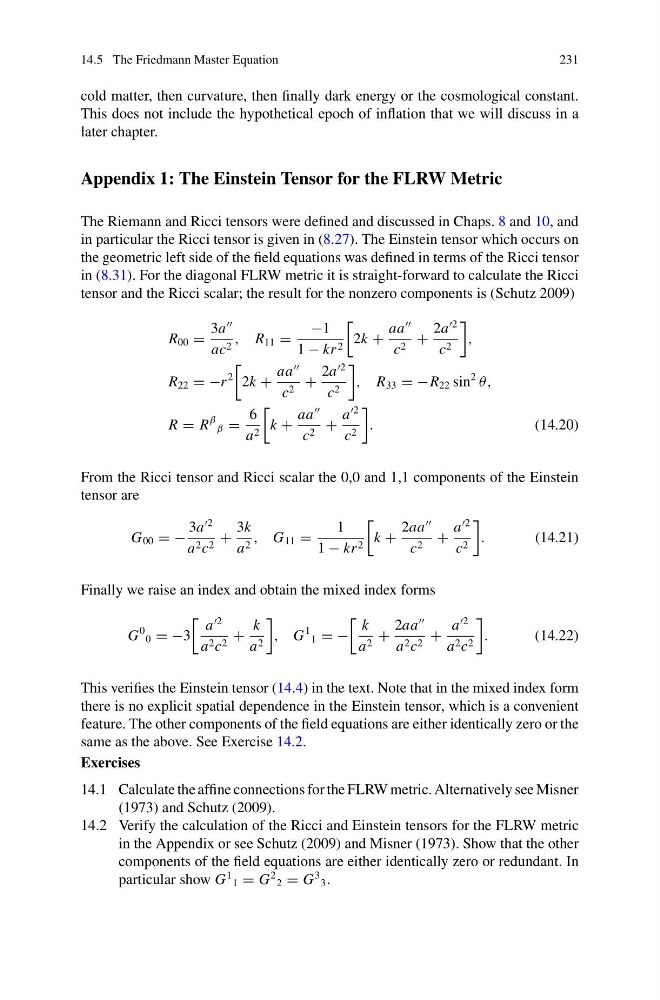
tensor and the Ricci scalar; the result for the nonzero components is (Schutz 2009)
R 00 =
3a
ac 2 , R 11 =
−1
1 − kr 2
2k +
aa
c 2 +
2a
2
c 2
,
R 22 = −r
2
2k +
aa
c 2 +
2a
2
c 2
, R 33 = −R 22 sin
2
θ,
R = R
β β =
6
a 2
k +
aa
c 2 +
a
2
c 2
.
(14.20)
From the Ricci tensor and Ricci scalar the 0,0 and 1,1 components of the Einstein
tensor are
G 00 = −
3a
2
a 2 c 2 +
3k
a 2 , G 11 =
1
1 − kr 2
k +
2aa
c 2 +
a
2
c 2
.
(14.21)
Finally we raise an index and obtain the mixed index forms
G
0
0 = −3
a
2
a 2 c 2 +
k
a 2
, G
1
1 = −
k
a 2 +
2aa
a 2 c 2 +
a
2
a 2 c 2
.
(14.22)
This verifies the Einstein tensor (14.4) in the text. Note that in the mixed index form
there is no explicit spatial dependence in the Einstein tensor, which is a convenient
feature. The other components of the field equations are either identically zero or the
same as the above. See Exercise 14.2.
Exercises
14.1 Calculate the affine connections for the FLRW metric. Alternatively see Misner
(1973) and Schutz (2009).
14.2 Verify the calculation of the Ricci and Einstein tensors for the FLRW metric
in the Appendix or see Schutz (2009) and Misner (1973). Show that the other
components of the field equations are either identically zero or redundant. In
particular show G
1
1 = G
2
2 = G
3
3 .
231
cold matter, then curvature, then finally dark energy or the cosmological constant.
This does not include the hypothetical epoch of inflation that we will discuss in a
later chapter.
Appendix 1: The Einstein Tensor for the FLRW Metric
The Riemann and Ricci tensors were defined and discussed in Chaps. 8 and 10, and
in particular the Ricci tensor is given in (8.27). The Einstein tensor which occurs on
the geometric left side of the field equations was defined in terms of the Ricci tensor
in (8.31). For the diagonal FLRW metric it is straight-forward to calculate the Ricci
tensor and the Ricci scalar; the result for the nonzero components is (Schutz 2009)
R 00 =
3a
ac 2 , R 11 =
−1
1 − kr 2
2k +
aa
c 2 +
2a
2
c 2
,
R 22 = −r
2
2k +
aa
c 2 +
2a
2
c 2
, R 33 = −R 22 sin
2
θ,
R = R
β β =
6
a 2
k +
aa
c 2 +
a
2
c 2
.
(14.20)
From the Ricci tensor and Ricci scalar the 0,0 and 1,1 components of the Einstein
tensor are
G 00 = −
3a
2
a 2 c 2 +
3k
a 2 , G 11 =
1
1 − kr 2
k +
2aa
c 2 +
a
2
c 2
.
(14.21)
Finally we raise an index and obtain the mixed index forms
G
0
0 = −3
a
2
a 2 c 2 +
k
a 2
, G
1
1 = −
k
a 2 +
2aa
a 2 c 2 +
a
2
a 2 c 2
.
(14.22)
This verifies the Einstein tensor (14.4) in the text. Note that in the mixed index form
there is no explicit spatial dependence in the Einstein tensor, which is a convenient
feature. The other components of the field equations are either identically zero or the
same as the above. See Exercise 14.2.
Exercises
14.1 Calculate the affine connections for the FLRW metric. Alternatively see Misner
(1973) and Schutz (2009).
14.2 Verify the calculation of the Ricci and Einstein tensors for the FLRW metric
in the Appendix or see Schutz (2009) and Misner (1973). Show that the other
components of the field equations are either identically zero or redundant. In
particular show G
1
1 = G
2
2 = G
3
3 .