

Appendix 1: Measured Values for the Hubble Constant
221
13.14 Why is it that we can study the mathematics of a pseudosphere but cannot
actually construct one in Euclidian 3-space? Is there any logical inconsistency
here? What of the 3-space for k = −1?
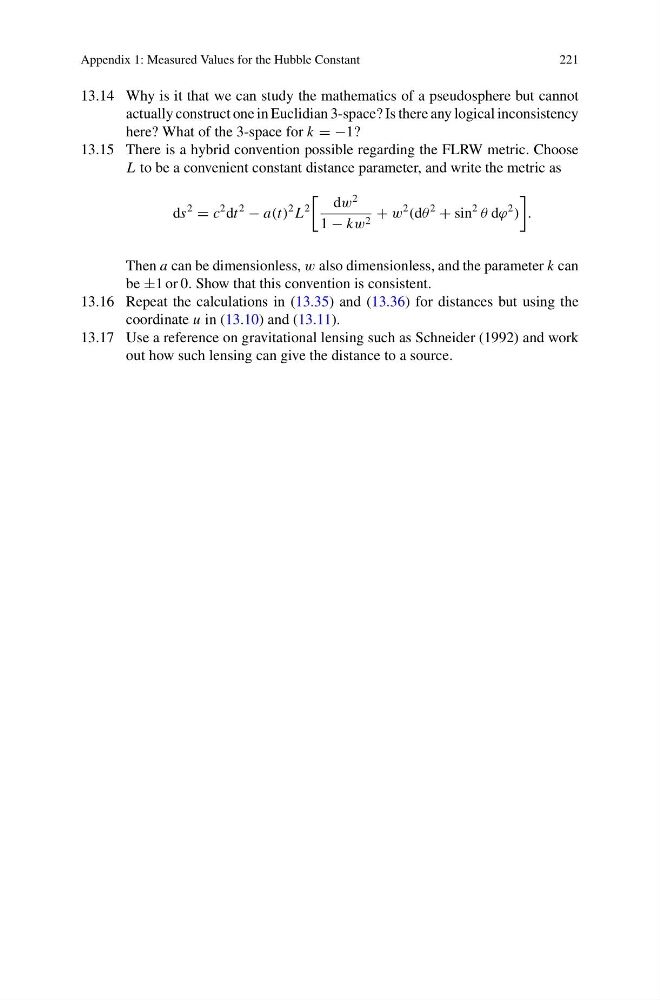
13.15 There is a hybrid convention possible regarding the FLRW metric. Choose
L to be a convenient constant distance parameter, and write the metric as
ds
2
= c
2 dt
2
− a(t)
2 L
2
dw
2
1 − kw 2 + w
2
(dθ
2
+ sin
2
θ dϕ
2
)
.
Then a can be dimensionless, w also dimensionless, and the parameter k can
be ±1 or 0. Show that this convention is consistent.
13.16 Repeat the calculations in (13.35) and (13.36) for distances but using the
coordinate u in (13.10) and (13.11).
13.17 Use a reference on gravitational lensing such as Schneider (1992) and work
out how such lensing can give the distance to a source.
221
13.14 Why is it that we can study the mathematics of a pseudosphere but cannot
actually construct one in Euclidian 3-space? Is there any logical inconsistency
here? What of the 3-space for k = −1?
13.15 There is a hybrid convention possible regarding the FLRW metric. Choose
L to be a convenient constant distance parameter, and write the metric as
ds
2
= c
2 dt
2
− a(t)
2 L
2
dw
2
1 − kw 2 + w
2
(dθ
2
+ sin
2
θ dϕ
2
)
.
Then a can be dimensionless, w also dimensionless, and the parameter k can
be ±1 or 0. Show that this convention is consistent.
13.16 Repeat the calculations in (13.35) and (13.36) for distances but using the
coordinate u in (13.10) and (13.11).
13.17 Use a reference on gravitational lensing such as Schneider (1992) and work
out how such lensing can give the distance to a source.