

200
12 The Einstein Field Equations for Cosmology
With the interpretation of the cosmological term as dark energy one might reasonably argue that it should be zero: why should the vacuum, empty space, have an energy
density? This viewpoint resonates with the esthetic criterion, that the field equations
be as simple as possible. However in quantum field theory the vacuum does not have
zero energy, and the energy density of “empty space” is not zero; instead it is “formally infinite,” and even if allowance is made for a reasonable granularity of space
on a very small scale it is absurdly large. It is so large that the vacuum energy in a
volume the size of a nucleus is about equal to the total energy content of the observed
universe. Stated in another way the estimated “theoretical estimate” of the cosmological constant, with spacetime granularity, is about 10
120 times the value allowed by
present astronomical observations. This absurd result is called by some theorists the
problem of the cosmological constant, and by others the vacuum catastrophe (Adler
1995). For those interested in reconciling quantum theory and general relativity it is a
crucial problem. For those mainly interested in observationally verifiable cosmology
the problem is of less importance.
Many theorists have suggested that a cosmic field of some sort could behave
like the cosmological constant but have a dynamical origin; some such fields have
been termed quintessence and are being actively studied, especially regarding their
observable properties (Amendola 2010).
In the following chapters we will be somewhat unconventional and variously use
the names cosmological constant or vacuum energy or dark energy to refer to the
same generic thing.
12.4 Summary
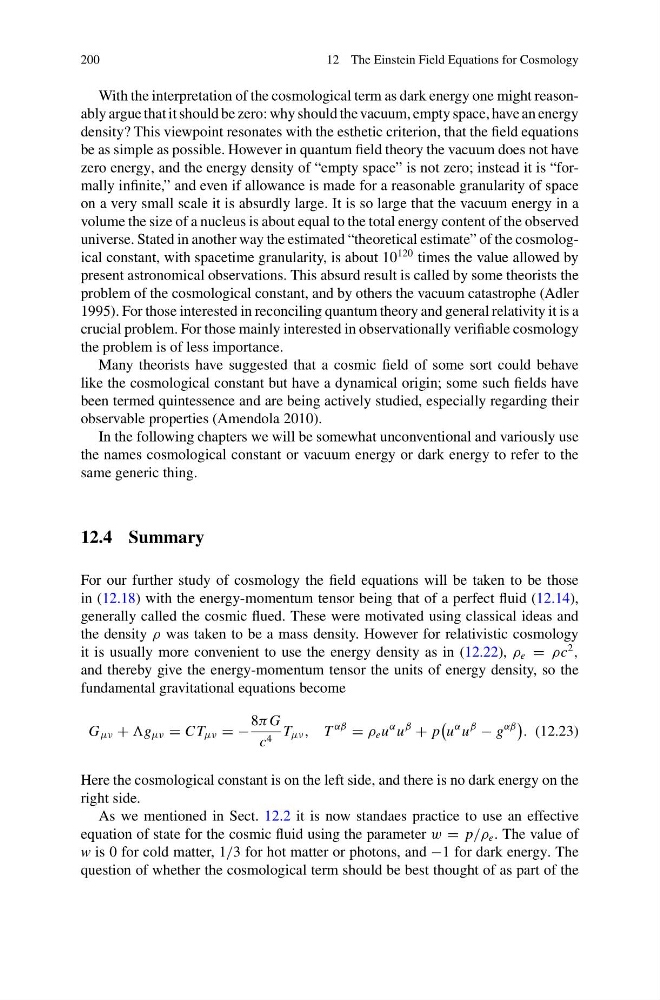
For our further study of cosmology the field equations will be taken to be those
in (12.18) with the energy-momentum tensor being that of a perfect fluid (12.14),
generally called the cosmic flued. These were motivated using classical ideas and
the density ρ was taken to be a mass density. However for relativistic cosmology
it is usually more convenient to use the energy density as in (12.22), ρ e = ρc
2
,
and thereby give the energy-momentum tensor the units of energy density, so the
fundamental gravitational equations become
G μν + g μν = CT μν = −
8π G
c 4 T μν , T
αβ
= ρ e u
α u
β
+ p
u
α u
β
− g
αβ
. (12.23)
Here the cosmological constant is on the left side, and there is no dark energy on the
right side.
As we mentioned in Sect. 12.2 it is now standaes practice to use an effective
equation of state for the cosmic fluid using the parameter w = p/ρ e . The value of
w is 0 for cold matter, 1/3 for hot matter or photons, and −1 for dark energy. The
question of whether the cosmological term should be best thought of as part of the
12 The Einstein Field Equations for Cosmology
With the interpretation of the cosmological term as dark energy one might reasonably argue that it should be zero: why should the vacuum, empty space, have an energy
density? This viewpoint resonates with the esthetic criterion, that the field equations
be as simple as possible. However in quantum field theory the vacuum does not have
zero energy, and the energy density of “empty space” is not zero; instead it is “formally infinite,” and even if allowance is made for a reasonable granularity of space
on a very small scale it is absurdly large. It is so large that the vacuum energy in a
volume the size of a nucleus is about equal to the total energy content of the observed
universe. Stated in another way the estimated “theoretical estimate” of the cosmological constant, with spacetime granularity, is about 10
120 times the value allowed by
present astronomical observations. This absurd result is called by some theorists the
problem of the cosmological constant, and by others the vacuum catastrophe (Adler
1995). For those interested in reconciling quantum theory and general relativity it is a
crucial problem. For those mainly interested in observationally verifiable cosmology
the problem is of less importance.
Many theorists have suggested that a cosmic field of some sort could behave
like the cosmological constant but have a dynamical origin; some such fields have
been termed quintessence and are being actively studied, especially regarding their
observable properties (Amendola 2010).
In the following chapters we will be somewhat unconventional and variously use
the names cosmological constant or vacuum energy or dark energy to refer to the
same generic thing.
12.4 Summary
For our further study of cosmology the field equations will be taken to be those
in (12.18) with the energy-momentum tensor being that of a perfect fluid (12.14),
generally called the cosmic flued. These were motivated using classical ideas and
the density ρ was taken to be a mass density. However for relativistic cosmology
it is usually more convenient to use the energy density as in (12.22), ρ e = ρc
2
,
and thereby give the energy-momentum tensor the units of energy density, so the
fundamental gravitational equations become
G μν + g μν = CT μν = −
8π G
c 4 T μν , T
αβ
= ρ e u
α u
β
+ p
u
α u
β
− g
αβ
. (12.23)
Here the cosmological constant is on the left side, and there is no dark energy on the
right side.
As we mentioned in Sect. 12.2 it is now standaes practice to use an effective
equation of state for the cosmic fluid using the parameter w = p/ρ e . The value of
w is 0 for cold matter, 1/3 for hot matter or photons, and −1 for dark energy. The
question of whether the cosmological term should be best thought of as part of the