

194
12 The Einstein Field Equations for Cosmology
G
μν ;ν = 0, T
μν ;ν = 0.
(12.1b)
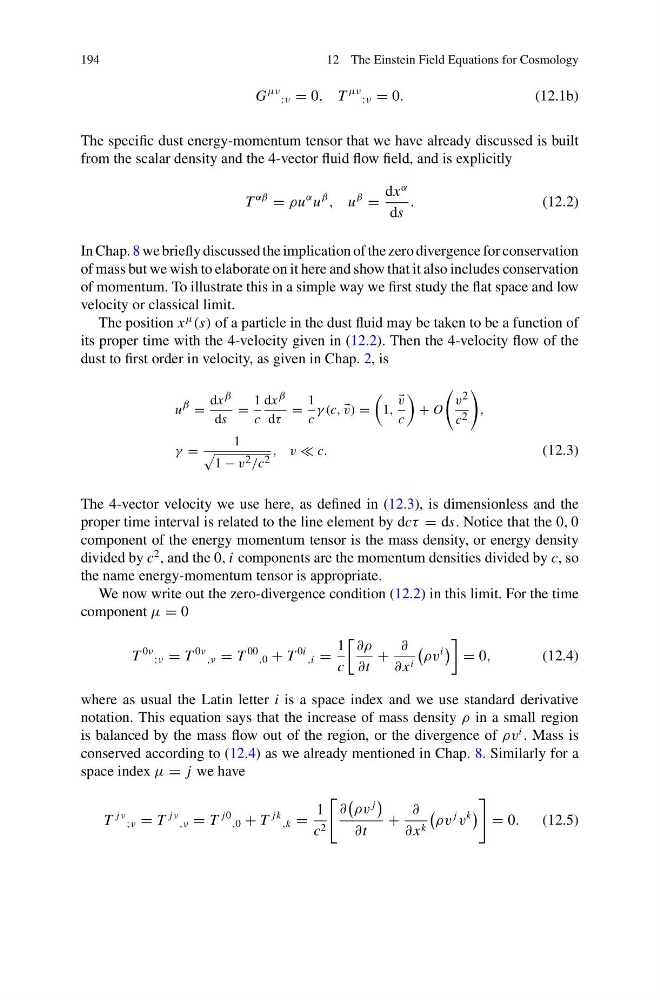
The specific dust energy-momentum tensor that we have already discussed is built
from the scalar density and the 4-vector fluid flow field, and is explicitly
T
αβ
= ρu
α u
β
, u
β
=
dx
α
ds
.
(12.2)
In Chap. 8 we briefly discussed the implication of the zero divergence for conservation
of mass but we wish to elaborate on it here and show that it also includes conservation
of momentum. To illustrate this in a simple way we first study the flat space and low
velocity or classical limit.
The position x
μ
(s) of a particle in the dust fluid may be taken to be a function of
its proper time with the 4-velocity given in (12.2). Then the 4-velocity flow of the
dust to first order in velocity, as given in Chap. 2, is
u β =
dx β
ds
=
1
c
dx β
dτ
=
1
c
γ (c,
v) =
1,
v
c
+ O
v 2
c 2
,
γ =
1
1 − v 2 /c 2
, v c.
(12.3)
The 4-vector velocity we use here, as defined in (12.3), is dimensionless and the
proper time interval is related to the line element by dcτ = ds. Notice that the 0, 0
component of the energy momentum tensor is the mass density, or energy density
divided by c
2 , and the 0, i components are the momentum densities divided by c, so
the name energy-momentum tensor is appropriate.
We now write out the zero-divergence condition (12.2) in this limit. For the time
component μ = 0
T
0ν ;ν = T
0ν ,ν = T
00 ,0 + T
0i ,i =
1
c
∂ρ
∂t
+
∂
∂ x i
ρv
i
= 0,
(12.4)
where as usual the Latin letter i is a space index and we use standard derivative
notation. This equation says that the increase of mass density ρ in a small region
is balanced by the mass flow out of the region, or the divergence of ρv
i . Mass is
conserved according to (12.4) as we already mentioned in Chap. 8. Similarly for a
space index μ = j we have
T
jν ;ν = T
jν ,ν = T
j0 ,0 + T
jk ,k =
1
c 2
∂
ρv
j
∂t
+
∂
∂ x k
ρv
j
v
k
= 0.
(12.5)
12 The Einstein Field Equations for Cosmology
G
μν ;ν = 0, T
μν ;ν = 0.
(12.1b)
The specific dust energy-momentum tensor that we have already discussed is built
from the scalar density and the 4-vector fluid flow field, and is explicitly
T
αβ
= ρu
α u
β
, u
β
=
dx
α
ds
.
(12.2)
In Chap. 8 we briefly discussed the implication of the zero divergence for conservation
of mass but we wish to elaborate on it here and show that it also includes conservation
of momentum. To illustrate this in a simple way we first study the flat space and low
velocity or classical limit.
The position x
μ
(s) of a particle in the dust fluid may be taken to be a function of
its proper time with the 4-velocity given in (12.2). Then the 4-velocity flow of the
dust to first order in velocity, as given in Chap. 2, is
u β =
dx β
ds
=
1
c
dx β
dτ
=
1
c
γ (c,
v) =
1,
v
c
+ O
v 2
c 2
,
γ =
1
1 − v 2 /c 2
, v c.
(12.3)
The 4-vector velocity we use here, as defined in (12.3), is dimensionless and the
proper time interval is related to the line element by dcτ = ds. Notice that the 0, 0
component of the energy momentum tensor is the mass density, or energy density
divided by c
2 , and the 0, i components are the momentum densities divided by c, so
the name energy-momentum tensor is appropriate.
We now write out the zero-divergence condition (12.2) in this limit. For the time
component μ = 0
T
0ν ;ν = T
0ν ,ν = T
00 ,0 + T
0i ,i =
1
c
∂ρ
∂t
+
∂
∂ x i
ρv
i
= 0,
(12.4)
where as usual the Latin letter i is a space index and we use standard derivative
notation. This equation says that the increase of mass density ρ in a small region
is balanced by the mass flow out of the region, or the divergence of ρv
i . Mass is
conserved according to (12.4) as we already mentioned in Chap. 8. Similarly for a
space index μ = j we have
T
jν ;ν = T
jν ,ν = T
j0 ,0 + T
jk ,k =
1
c 2
∂
ρv
j
∂t
+
∂
∂ x k
ρv
j
v
k
= 0.
(12.5)