

11.5 Gravitational Wave Sources
173
¯
h i j = −
4G
c 2
1
r
T i j d
3 x
.
(11.56)
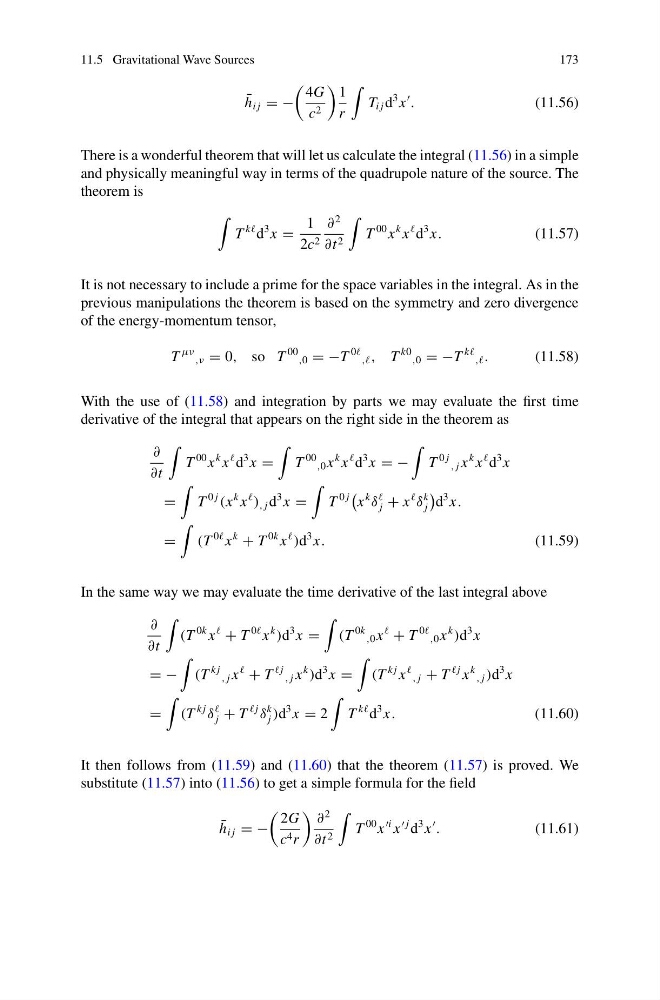
There is a wonderful theorem that will let us calculate the integral (11.56) in a simple
and physically meaningful way in terms of the quadrupole nature of the source. The
theorem is
T
k d
3 x =
1
2c 2
∂
2
∂t 2
T
00 x
k x
d
3 x.
(11.57)
It is not necessary to include a prime for the space variables in the integral. As in the
previous manipulations the theorem is based on the symmetry and zero divergence
of the energy-momentum tensor,
T
μν ,ν = 0, so T
00 ,0 = −T
0 ,, , T
k0 ,0 = −T
k ,, .
(11.58)
With the use of (11.58) and integration by parts we may evaluate the first time
derivative of the integral that appears on the right side in the theorem as
∂
∂t
T
00 x
k x
d
3 x =
T
00 ,0 x
k x
d
3 x = −
T
0 j , j x
k x
d
3 x
=
T
0 j
(x
k x
) , j d
3 x =
T
0 j
x
k
δ
j + x
δ
k
j
d
3 x.
=
(T
0 x
k
+ T
0k x
)d
3 x.
(11.59)
In the same way we may evaluate the time derivative of the last integral above
∂
∂t
(T
0k x
+ T
0 x
k
)d
3 x =
(T
0k ,0 x
+ T
0 ,0 x
k
)d
3 x
= −
(T
k j , j x
+ T
j , j x
k
)d
3 x =
(T
k j x
, j + T
j x
k , j )d
3 x
=
(T
k j
δ
j + T
j
δ
k
j )d
3 x = 2
T
k d
3 x.
(11.60)
It then follows from (11.59) and (11.60) that the theorem (11.57) is proved. We
substitute (11.57) into (11.56) to get a simple formula for the field
¯
h i j = −
2G
c 4 r
∂
2
∂t 2
T
00 x
i x
j d
3 x
.
(11.61)
173
¯
h i j = −
4G
c 2
1
r
T i j d
3 x
.
(11.56)
There is a wonderful theorem that will let us calculate the integral (11.56) in a simple
and physically meaningful way in terms of the quadrupole nature of the source. The
theorem is
T
k d
3 x =
1
2c 2
∂
2
∂t 2
T
00 x
k x
d
3 x.
(11.57)
It is not necessary to include a prime for the space variables in the integral. As in the
previous manipulations the theorem is based on the symmetry and zero divergence
of the energy-momentum tensor,
T
μν ,ν = 0, so T
00 ,0 = −T
0 ,, , T
k0 ,0 = −T
k ,, .
(11.58)
With the use of (11.58) and integration by parts we may evaluate the first time
derivative of the integral that appears on the right side in the theorem as
∂
∂t
T
00 x
k x
d
3 x =
T
00 ,0 x
k x
d
3 x = −
T
0 j , j x
k x
d
3 x
=
T
0 j
(x
k x
) , j d
3 x =
T
0 j
x
k
δ
j + x
δ
k
j
d
3 x.
=
(T
0 x
k
+ T
0k x
)d
3 x.
(11.59)
In the same way we may evaluate the time derivative of the last integral above
∂
∂t
(T
0k x
+ T
0 x
k
)d
3 x =
(T
0k ,0 x
+ T
0 ,0 x
k
)d
3 x
= −
(T
k j , j x
+ T
j , j x
k
)d
3 x =
(T
k j x
, j + T
j x
k , j )d
3 x
=
(T
k j
δ
j + T
j
δ
k
j )d
3 x = 2
T
k d
3 x.
(11.60)
It then follows from (11.59) and (11.60) that the theorem (11.57) is proved. We
substitute (11.57) into (11.56) to get a simple formula for the field
¯
h i j = −
2G
c 4 r
∂
2
∂t 2
T
00 x
i x
j d
3 x
.
(11.61)