

168
11 Linearized General Relativity and Gravitational Waves
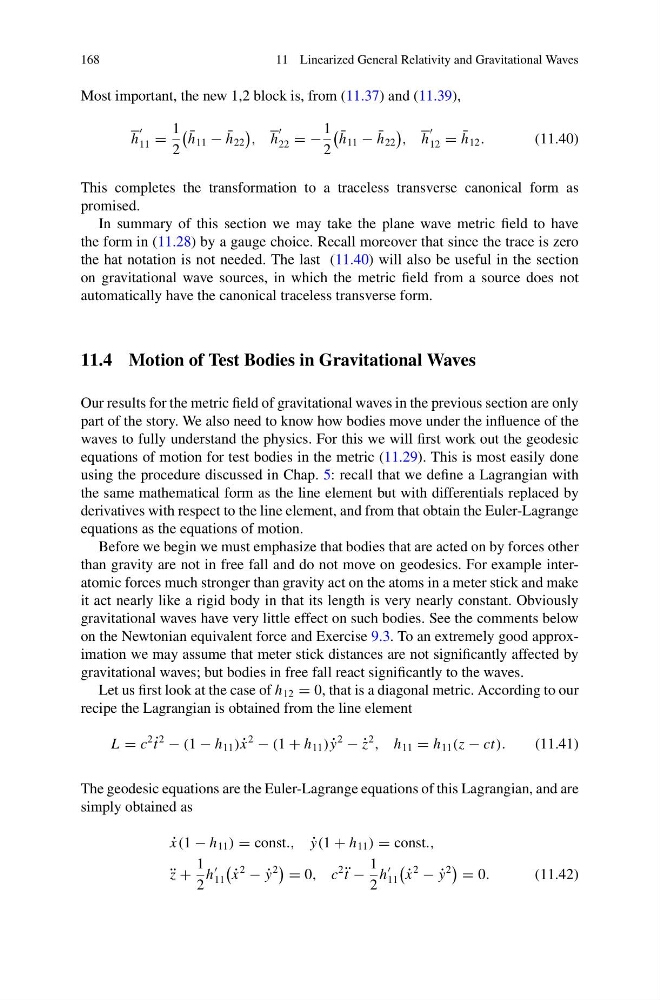
Most important, the new 1,2 block is, from (11.37) and (11.39),
h
11 =
1
2
¯
h 11 − ¯
h 22
, h
22 = −
1
2
¯
h 11 − ¯
h 22
, h
12 = ¯
h 12 .
(11.40)
This completes the transformation to a traceless transverse canonical form as
promised.
In summary of this section we may take the plane wave metric field to have
the form in (11.28) by a gauge choice. Recall moreover that since the trace is zero
the hat notation is not needed. The last (11.40) will also be useful in the section
on gravitational wave sources, in which the metric field from a source does not
automatically have the canonical traceless transverse form.
11.4 Motion of Test Bodies in Gravitational Waves
Our results for the metric field of gravitational waves in the previous section are only
part of the story. We also need to know how bodies move under the influence of the
waves to fully understand the physics. For this we will first work out the geodesic
equations of motion for test bodies in the metric (11.29). This is most easily done
using the procedure discussed in Chap. 5: recall that we define a Lagrangian with
the same mathematical form as the line element but with differentials replaced by
derivatives with respect to the line element, and from that obtain the Euler-Lagrange
equations as the equations of motion.
Before we begin we must emphasize that bodies that are acted on by forces other
than gravity are not in free fall and do not move on geodesics. For example interatomic forces much stronger than gravity act on the atoms in a meter stick and make
it act nearly like a rigid body in that its length is very nearly constant. Obviously
gravitational waves have very little effect on such bodies. See the comments below
on the Newtonian equivalent force and Exercise 9.3. To an extremely good approximation we may assume that meter stick distances are not significantly affected by
gravitational waves; but bodies in free fall react significantly to the waves.
Let us first look at the case of h 12 = 0, that is a diagonal metric. According to our
recipe the Lagrangian is obtained from the line element
L = c
2 ˙
t
2
− (1 − h 11 ) ˙
x
2
− (1 + h 11 ) ˙
y
2
− ˙
z
2
, h 11 = h 11 (z − ct).
(11.41)
The geodesic equations are the Euler-Lagrange equations of this Lagrangian, and are
simply obtained as
˙
x(1 − h 11 ) = const., ˙
y(1 + h 11 ) = const.,
¨
z +
1
2
h
11
˙
x
2
− ˙
y
2
= 0, c
2 ¨
t −
1
2
h
11
˙
x
2
− ˙
y
2
= 0.
(11.42)
11 Linearized General Relativity and Gravitational Waves
Most important, the new 1,2 block is, from (11.37) and (11.39),
h
11 =
1
2
¯
h 11 − ¯
h 22
, h
22 = −
1
2
¯
h 11 − ¯
h 22
, h
12 = ¯
h 12 .
(11.40)
This completes the transformation to a traceless transverse canonical form as
promised.
In summary of this section we may take the plane wave metric field to have
the form in (11.28) by a gauge choice. Recall moreover that since the trace is zero
the hat notation is not needed. The last (11.40) will also be useful in the section
on gravitational wave sources, in which the metric field from a source does not
automatically have the canonical traceless transverse form.
11.4 Motion of Test Bodies in Gravitational Waves
Our results for the metric field of gravitational waves in the previous section are only
part of the story. We also need to know how bodies move under the influence of the
waves to fully understand the physics. For this we will first work out the geodesic
equations of motion for test bodies in the metric (11.29). This is most easily done
using the procedure discussed in Chap. 5: recall that we define a Lagrangian with
the same mathematical form as the line element but with differentials replaced by
derivatives with respect to the line element, and from that obtain the Euler-Lagrange
equations as the equations of motion.
Before we begin we must emphasize that bodies that are acted on by forces other
than gravity are not in free fall and do not move on geodesics. For example interatomic forces much stronger than gravity act on the atoms in a meter stick and make
it act nearly like a rigid body in that its length is very nearly constant. Obviously
gravitational waves have very little effect on such bodies. See the comments below
on the Newtonian equivalent force and Exercise 9.3. To an extremely good approximation we may assume that meter stick distances are not significantly affected by
gravitational waves; but bodies in free fall react significantly to the waves.
Let us first look at the case of h 12 = 0, that is a diagonal metric. According to our
recipe the Lagrangian is obtained from the line element
L = c
2 ˙
t
2
− (1 − h 11 ) ˙
x
2
− (1 + h 11 ) ˙
y
2
− ˙
z
2
, h 11 = h 11 (z − ct).
(11.41)
The geodesic equations are the Euler-Lagrange equations of this Lagrangian, and are
simply obtained as
˙
x(1 − h 11 ) = const., ˙
y(1 + h 11 ) = const.,
¨
z +
1
2
h
11
˙
x
2
− ˙
y
2
= 0, c
2 ¨
t −
1
2
h
11
˙
x
2
− ˙
y
2
= 0.
(11.42)